Real-Time Earthquake Notifications
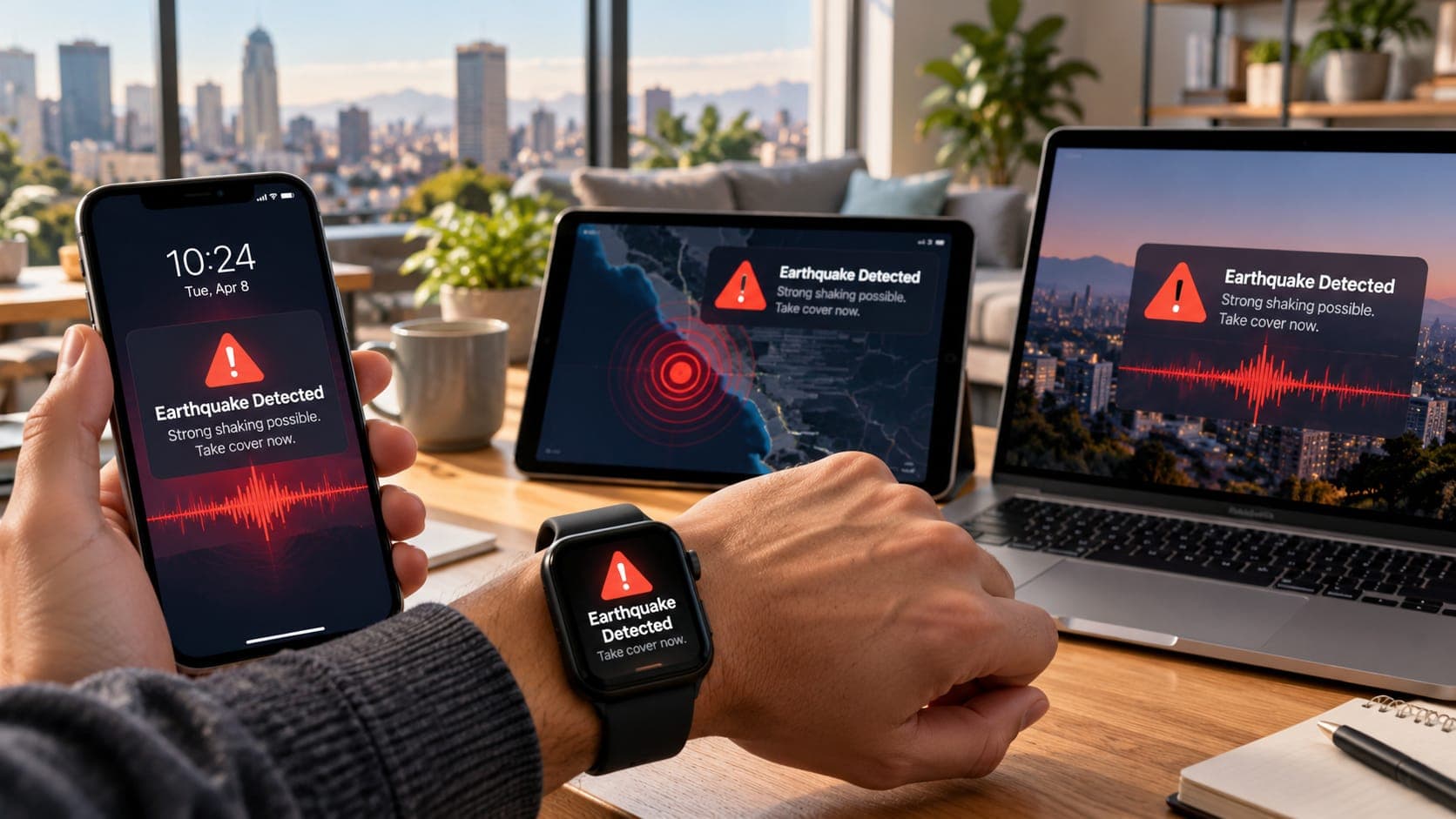
Many apps and websites promise real-time earthquake notifications. That phrase sounds like instant, but in practice it means something more specific: information that is published automatically, usually within minutes, and then refined over the following hours.
Knowing what real-time really means helps you read notifications correctly, avoid being misled by early numbers and set up your alerts so they stay useful instead of becoming noise.
Quick answer
Real-time earthquake notifications tell you about earthquakes that have already been detected and located, typically within a few minutes for events near dense seismic networks and longer for remote ones. The first magnitude and location are automatic and often revised after review. These notifications are not early warnings. Choose a sensible area and magnitude threshold so you get alerts that matter without being overwhelmed.
What real-time actually means
In seismology, real-time usually describes data that flows continuously from stations to processing centers and results that are published automatically, without waiting for a person. It does not mean you learn about the earthquake as it happens.
There are three different speeds of earthquake information. Early warning systems work in seconds, before shaking reaches you, but only in covered areas. Real-time notifications work in minutes, after an earthquake is located. Reviewed catalogs are finalized over hours to days. This article is about the middle category. For the early warning side, see the earthquake early warning system.
A typical timeline
Timing varies a lot by region and event size, but the general sequence looks like this.
| Stage | Rough timing | What you see |
|---|---|---|
| Detection | Seconds | Used by early warning systems; not usually published |
| Automatic solution | Minutes for well-monitored areas; longer for remote or offshore events | First location, depth and magnitude |
| Updated automatic solutions | Minutes to an hour | Refined numbers as more stations report |
| Reviewed solution | Hours to days | Checked by a seismologist; review status changes |
| Added products | Hours to days | ShakeMap, felt reports, fault details for larger events |
Why the numbers change
The first automatic report uses whatever stations have recorded the earthquake so far. As more data arrives, the location tightens, the Depth estimate improves and the Magnitude may switch to a more reliable method. Seismologists then review the event, which can change values again. Occasionally an automatic event is deleted because it was noise or a duplicate.
Each event keeps a stable identifier through these changes. A good notification service uses that ID to update the existing event rather than treating a revised report as a new earthquake. EQRadar's event updates page shows how often and how much reported events shift. More on the science is in how does earthquake detection work?.
How feeds and notification services work
Most notification tools are built on public data feeds. The USGS publishes free feeds of recent earthquakes in formats such as GeoJSON, updated every minute, with filters for time window and magnitude. Apps, websites and alert services check these feeds, look for new or updated events and decide whether to notify you.
That means delay comes from several places added together: the network's processing time, how often the service checks the feed, how it delivers messages and how your phone or email handles them. A service checking every minute and sending push notifications will usually be faster than one sending a daily email summary, but neither will beat the shaking.
Setting sensible thresholds
The most common mistake is setting thresholds too low. Small earthquakes are frequent in active regions, and after a large quake there may be many aftershocks a day for a while. If your phone buzzes for every magnitude 2, you will soon stop paying attention, which is known as alert fatigue.
- Near home, choose a magnitude you would likely feel or want to know about, and a radius that covers your daily area.
- For a wider region or a whole state, use a higher magnitude.
- For worldwide events, a high threshold limits you to significant earthquakes.
- Use quiet hours or digest options for minor events if your service offers them.
- Raise thresholds temporarily during an active aftershock sequence, then lower them again.
Where to get real-time notifications
The free USGS Earthquake Notification Service sends email for regions and magnitudes you choose, worldwide. Many apps send push notifications based on the same feeds. EMSC and many national agencies offer their own apps and services.
EQRadar's alerts page shows in-app notifications of reported earthquakes near places you save, using USGS data. It only works while the EQRadar page is open and does not send SMS, email or push notifications. For a quick look at what has just happened, the live map and timeline show recent events.
How to read a notification calmly
When a notification arrives, check the time, the distance from you and whether the event is automatic or reviewed. Treat the first magnitude as approximate. If the earthquake was large and near a coast, follow official tsunami guidance, available on EQRadar's tsunami page, not the earthquake notification itself. If you felt it, consider reporting it to the USGS Did You Feel It? program.
Frequently asked questions
Are real-time earthquake notifications the same as early warnings?
No. Real-time notifications come after an earthquake has been located, usually within minutes. Early warnings come seconds before shaking reaches you and exist only where a warning system operates.
Why did I get two notifications for the same earthquake?
Some services send a new message when the magnitude or location is revised, or combine data from more than one agency. Better services track events by ID and avoid repeat messages for small changes.
Why is my notification slower for earthquakes in remote places?
Remote and offshore areas have fewer nearby stations, so it takes longer for waves to reach enough of them to compute a reliable location and magnitude.
What magnitude threshold should I choose?
There is no single right answer. Pick a level you would actually care about for each area, typically lower near home and higher farther away, and adjust if you find yourself ignoring alerts.
Key takeaway
Real-time earthquake notifications report earthquakes minutes after they happen, using automatic solutions that are later reviewed and often revised. Use them to stay informed, read early numbers as approximate, and set thresholds high enough that each alert still means something.
Sources
- Real-time Notifications, Feeds, and Web Services — U.S. Geological Survey
- Earthquake Notification Service — U.S. Geological Survey
- Latest Earthquakes — U.S. Geological Survey
- Did You Feel It? — U.S. Geological Survey