Earthquake SMS Alerts
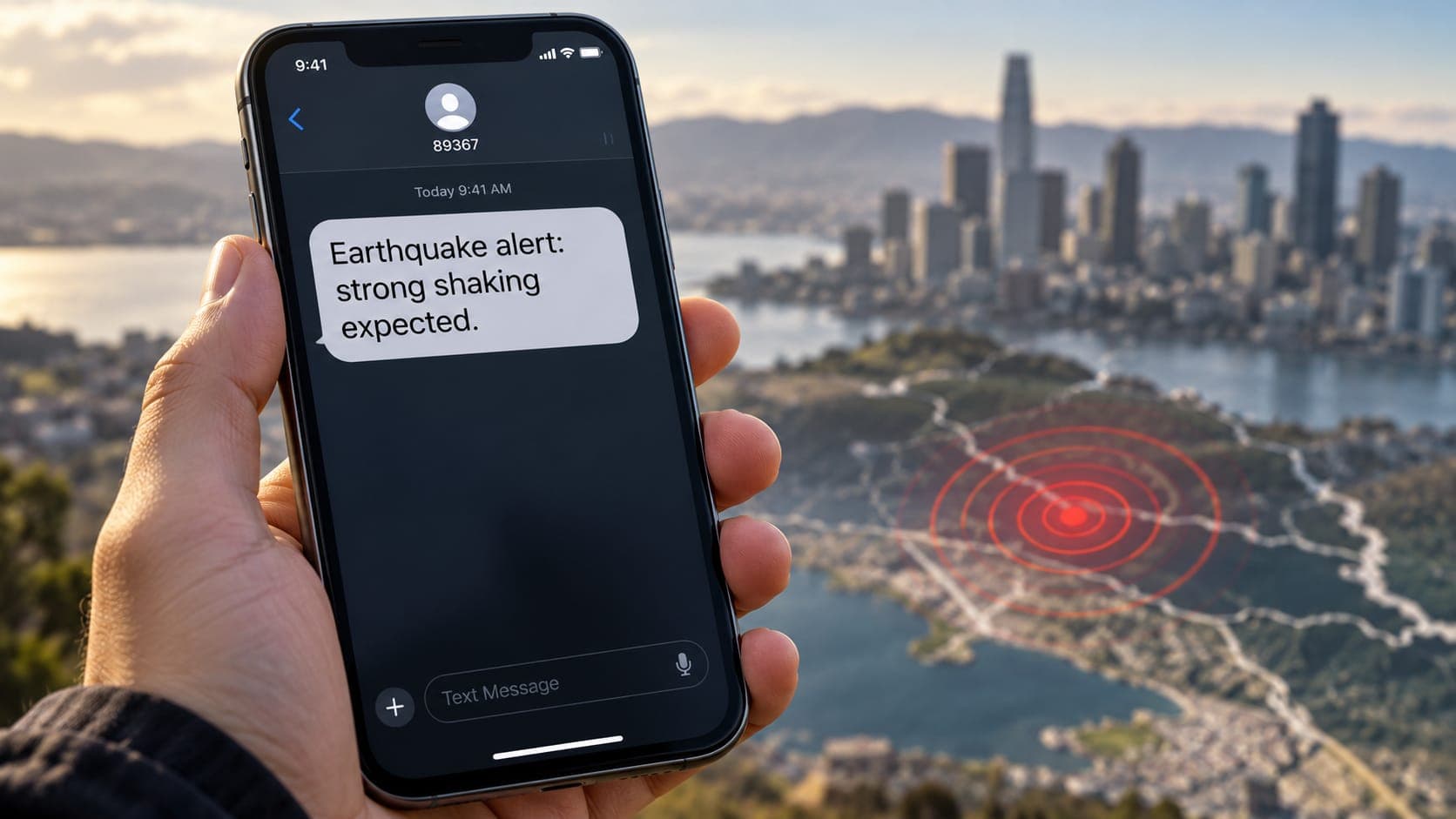
Text messages feel simple and dependable. They work on almost any phone, need no app and show up on the lock screen. That makes SMS a popular way for local governments, schools, utilities and private services to share earthquake information.
But a text message is not a warning before shaking. Understanding how SMS alerts work, and where they fall short, helps you decide whether to sign up and what to expect when a message arrives.
Quick answer
Earthquake SMS alerts are text messages sent after an earthquake has been reported, usually by a service that watches official data feeds and texts subscribers when a quake meets their chosen area and magnitude. They can be delayed by processing and carrier networks, so they are not early warnings. Legitimate services require your opt-in, and you can usually stop them by replying STOP.
How an SMS alert service works
Most earthquake text services follow the same basic chain of steps. Each step takes some time, which is why a text cannot beat the shaking.
- A seismic network detects the earthquake and publishes an automatic location and Magnitude, usually within minutes.
- The service checks the data feed, often every minute or so, and sees the new event.
- It compares the event against each subscriber's settings, such as area and minimum magnitude.
- It sends a text through an SMS provider to the mobile carriers.
- The carriers deliver the message, which can be quick or can queue during busy periods.
Why SMS is not early warning
An earthquake early warning must reach you in seconds, before strong shaking arrives. Systems like ShakeAlert rely on channels designed for speed, such as Wireless Emergency Alerts, which are broadcast to every compatible phone in an area at once, and apps that receive alerts directly.
Ordinary SMS is a different technology. Messages are sent one by one and pass through carrier queues. During a large earthquake, networks are also flooded with calls and texts. A text may arrive in seconds on a quiet day and much later on a busy one. For that reason, treat an SMS as information about an earthquake that has already happened. Our article on the earthquake early warning system explains how real warnings work.
Consent, opt-in and opt-out
In the United States, automated text messages are governed by federal rules, including the Telephone Consumer Protection Act, and by mobile carrier and industry guidelines. The details are complex and change over time, but the general principles are consistent.
- A service should send messages only after you clearly agree, often by texting a keyword or confirming a code sent to your phone.
- The first message should explain who is texting you, roughly how often, and how to stop.
- Replying STOP should end the messages. Replying HELP usually returns contact information.
- Standard message and data rates from your carrier may apply, and the service should say so.
Signs of a trustworthy text service
Government emergency alerts work differently. Wireless Emergency Alerts do not need sign-up, and the most serious national alerts cannot be turned off. Local opt-in systems run by counties or cities usually work like regular SMS services and follow the same consent rules.
If you receive earthquake texts you never signed up for, or messages that ask for payment, personal details or a link click to keep receiving alerts, treat them with suspicion. Reply STOP to legitimate senders and report clear spam to your carrier.
What a useful alert text contains
Text messages are short, so every word matters. A well-designed earthquake SMS answers the basic questions quickly and points to more detail.
| Element | Why it matters |
|---|---|
| Magnitude, marked as preliminary if automatic | Shows size, and warns that it may change |
| Location relative to a known place | Easier to understand than coordinates |
| Time with time zone | Avoids confusion across regions |
| Source, such as USGS | Lets you judge reliability |
| Link to official details | Provides maps, depth and updates |
| Tsunami guidance only from official sources | Prevents false reassurance or false alarm |
Filtering and duplicate updates
The biggest risk with earthquake texts is getting too many. In an active area, small quakes happen often, and a large earthquake can be followed by hundreds of aftershocks. A good service lets you set an area and a minimum magnitude, and you should choose values that only text you about events you would act on or want to know about.
Updates create another problem. An earthquake's magnitude and location are often revised after review, as described on our event updates page. A careful service tracks each event by its official ID and either sends a single correction for a meaningful change or none at all, rather than texting again each time a decimal shifts.
A note about EQRadar
EQRadar does not offer SMS alerts, email or push notifications. Its alerts page shows in-app notices of reported earthquakes near places you save, and only works while the page is open. If you want messages that reach you in the background, the free USGS Earthquake Notification Service sends email, and your county or state may offer opt-in emergency texts. See how to get earthquake alerts for options.
Frequently asked questions
Can I get earthquake alerts by text without a smartphone?
Often, yes. Wireless Emergency Alerts work on many basic phones that support them, and some local opt-in SMS systems work on any phone that can receive texts. Check with your local emergency management agency.
How fast does an earthquake text arrive?
It depends on the data source, the service and the carrier. Many arrive within minutes of an earthquake being reported, but delays can be longer during busy periods. They should never be relied on as a warning before shaking.
How do I stop earthquake text messages?
For legitimate opt-in services, reply STOP to the message. Government Wireless Emergency Alerts are controlled in your phone's settings instead, and some of the most serious alert types cannot be turned off.
Does the USGS send earthquake text messages?
The USGS Earthquake Notification Service sends free email notifications of reported earthquakes. Some people forward these to their phone. For early warning on the U.S. West Coast, use Wireless Emergency Alerts or a ShakeAlert-powered app.
Key takeaway
Earthquake SMS alerts tell you about earthquakes that have already been reported. They are useful for staying informed but too slow to warn you before shaking. Choose services that require opt-in, honor STOP, name their data source and let you filter by area and magnitude.
Sources
- Wireless Emergency Alerts (WEA) — Federal Communications Commission
- Emergency Alerts — Ready.gov (U.S. Department of Homeland Security)
- Earthquake Notification Service — U.S. Geological Survey
- Integrated Public Alert and Warning System — Federal Emergency Management Agency