Earthquake Early Warning System
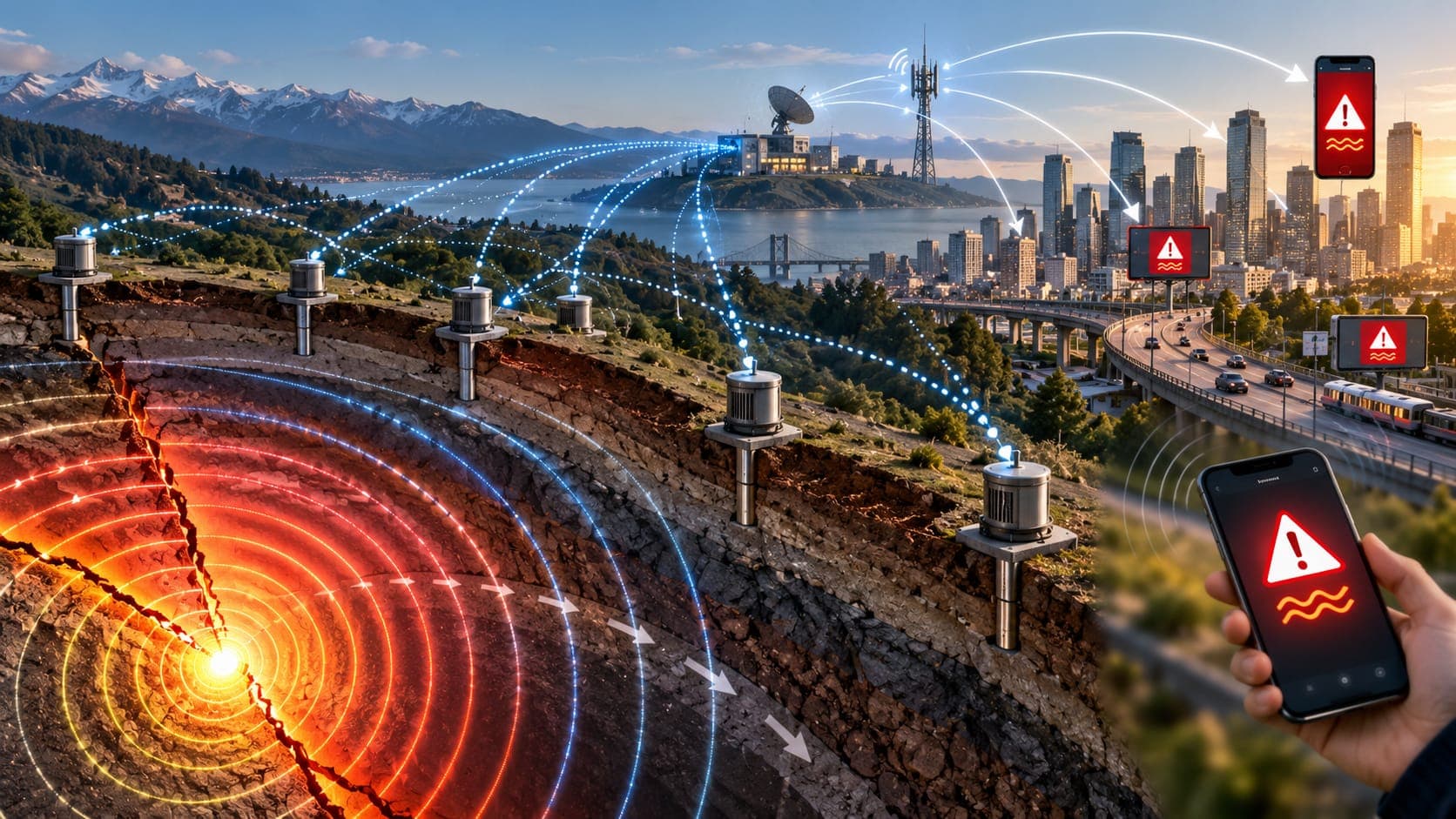
An earthquake early warning system cannot see an earthquake coming before it starts. What it can do is notice an earthquake in its first moments and send an alert faster than the shaking travels. For people some distance away, that can mean a few seconds to a few tens of seconds to take cover, slow a train or pause delicate work.
This article explains how these systems work, why the amount of warning varies so much, how early warning differs from predictions and forecasts, and what the systems can and cannot do.
Quick answer
An earthquake early warning system uses networks of seismic sensors to detect the first, faster waves from an earthquake, quickly estimate its location and size, and send alerts to areas expected to shake. Because alerts travel at the speed of electronic communication while seismic waves are much slower, people farther from the source can get seconds of warning. People very close to the epicenter may get none.
Early warning, notifications and forecasts are different
Three kinds of earthquake information are often confused, and the difference matters.
| Type | When | What it tells you | What to do |
|---|---|---|---|
| Early warning | After a quake starts, seconds before shaking reaches you | Shaking is about to arrive where you are | Drop, Cover and Hold On immediately |
| Notification of a reported earthquake | Minutes or more after the quake | Where and how big a quake was | Check on others; be ready for aftershocks |
| Forecast | Days to decades ahead | Probabilities of earthquakes in a region and time window | Prepare your home and plans |
| Prediction | Not currently possible | A specific time, place and size | Be skeptical of any such claim |
How early warning works, step by step
An earthquake sends out several kinds of seismic waves. The P wave travels fastest but usually causes little damage. The S wave and the surface waves that follow are slower and cause most of the strong shaking. Early warning takes advantage of that gap.
- Seismic stations near the Epicentre record the P wave within a few seconds of the earthquake starting.
- Computers combine data from several stations to estimate the location and Magnitude.
- The system predicts how strong shaking will be at different distances.
- Where expected shaking crosses a threshold, an alert is sent through phones, apps, broadcast systems or direct connections to equipment.
- The system keeps updating its estimates for as long as the earthquake continues to grow.
A race between the alert and the waves
P waves travel through rock at roughly 6 to 7 kilometers per second near the surface, and S waves at roughly half that speed. Electronic alerts move almost instantly by comparison. So the farther you are from the epicenter, the bigger the head start the alert has over the damaging waves.
Close to the epicenter, strong shaking can arrive before the system finishes its calculations and delivers the alert. This area is often called the late alert zone. It is not a flaw that can be fully engineered away, because the system has to wait for the earthquake to be detected at all. Delays in phone networks and app delivery can make the late alert zone larger.
Warning times therefore range from none at all near the source to a few tens of seconds for distant locations, depending on depth, distance, the size of the quake and how alerts are delivered.
What can be done with a few seconds
A few seconds is not enough to evacuate a building, but it is enough for many protective actions, especially automated ones that do not depend on a person reading a message.
- People can Drop, Cover and Hold On before strong shaking reaches them.
- Trains can automatically slow down or stop, reducing the risk of derailment.
- Elevators can be programmed to stop at the nearest floor and open their doors.
- Surgeons and dentists can pause delicate procedures.
- Factories can stop sensitive processes, and utilities can close valves.
- Schools can trigger announcements so students take cover.
Early warning around the world
In the United States, ShakeAlert is operated by the USGS with state and university partners and covers California, Oregon and Washington. Alerts reach the public through Wireless Emergency Alerts, the MyShake app, the Android Earthquake Alerts System and other partners. Our ShakeAlert guide covers it in detail.
Japan's Meteorological Agency runs a nationwide Earthquake Early Warning service that reaches the public through television, radio and phones. Mexico's SASMEX broadcasts public alerts, including through speakers in Mexico City. Several other countries operate or are developing systems.
Google's Android Earthquake Alerts System takes a different approach. It uses the motion sensors in many Android phones as a large, distributed detection network, and it operates in many countries. Where official systems exist, such as on the U.S. West Coast, it delivers alerts based on those systems.
Limits you should know
Early warning systems work with very little data in a very short time, so they have real limits.
- No warning close to the epicenter, where shaking is often strongest.
- Very large earthquakes can rupture for a minute or more, and early estimates may underestimate their final size.
- Alerts may overestimate or underestimate shaking at your exact location, because local soil and buildings matter.
- False alerts and missed alerts can occur, though operators work to reduce both.
- Coverage depends on dense sensor networks, which many regions do not yet have.
What to do when you receive an early warning
Act immediately. Drop, Cover and Hold On, or if you are driving, slow down and pull over when it is safe. Do not try to run outside, and do not stop to read the alert carefully. If the shaking turns out to be light, you have lost only a few seconds. For more on phone alerts, see earthquake alert on phone.
Frequently asked questions
Can an early warning system predict earthquakes?
No. Early warning starts only after an earthquake has begun. It detects the quake quickly and warns people before the strongest shaking arrives. It does not know about earthquakes ahead of time.
How much warning time can I expect?
Anywhere from none to a few tens of seconds. It depends mostly on how far you are from the epicenter. Near the source there may be no warning at all.
Why are early warning systems only in some places?
They need dense networks of seismic stations, fast communications and agreements with alert channels such as phone carriers and app makers. Building and running these takes years of investment.
Does early warning help with tsunamis?
Tsunami warnings are a separate system run by tsunami warning centers. Near the coast, strong or long shaking is itself a natural warning to move to high ground. See EQRadar's tsunami page for official NOAA alerts.
Key takeaway
An earthquake early warning system detects an earthquake in its first seconds and sends alerts faster than the damaging waves travel. It cannot predict quakes and gives little or no warning near the epicenter, but a few seconds is enough to take cover, slow trains and protect equipment.
Sources
- Earthquake Early Warning Overview — U.S. Geological Survey
- ShakeAlert — ShakeAlert (USGS and partners)
- Android Earthquake Alerts — Google Crisis Response
- MyShake — UC Berkeley Seismology Lab