Earthquake Probability in California
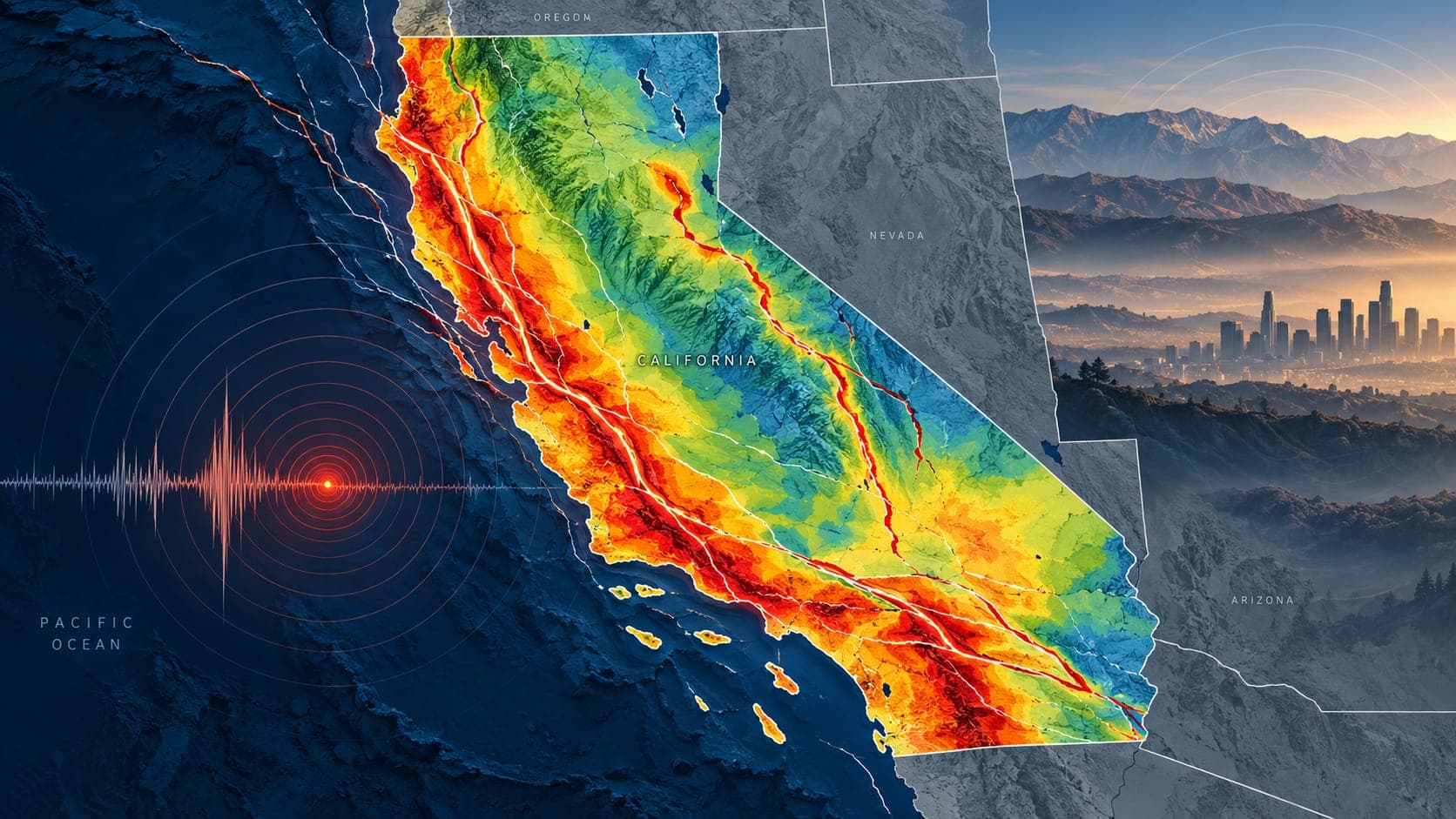
California is one of the most earthquake-active places in the United States. Thousands of earthquakes are recorded there every year, most too small to feel. People who live there often wonder how likely a large, damaging earthquake really is.
Scientists cannot say when the next big one will happen, but they can estimate the chances over the coming decades. This article explains the main official forecast, what its numbers mean and how to use them.
Quick answer
According to the USGS UCERF3 forecast published in 2015, there is a greater than 99 percent chance of at least one magnitude 6.7 or larger earthquake somewhere in California within 30 years, and about a 7 percent chance of a magnitude 8 or larger. These are probabilities, not predictions. They mean a damaging earthquake in the state is almost certain over a generation, but no one knows when or exactly where.
See recent earthquakes in CaliforniaThe official forecast: UCERF3
The Uniform California Earthquake Rupture Forecast, version 3, known as UCERF3, was developed by the USGS together with the Southern California Earthquake Center and the California Geological Survey. Its 30-year probabilities were published in 2015. It combines information on hundreds of faults, how fast they slip, past earthquakes found in the geologic record, GPS measurements of the ground slowly moving, and the record of modern earthquakes.
A key improvement in UCERF3 was allowing earthquakes to rupture across several connected faults at once. This helped scientists better estimate the chance of very large earthquakes.
Key numbers
These figures are from the UCERF3 forecast for the 30 years following its release. They describe the chance of at least one earthquake of that size or larger.
| Area | Magnitude | Chance in 30 years |
|---|---|---|
| California (statewide) | 6.7 or larger | More than 99% |
| California (statewide) | 8 or larger | About 7% |
| Los Angeles region | 6.7 or larger | About 60% |
| San Francisco Bay region | 6.7 or larger | About 72% |
What a 30-year probability means
A 30-year probability is a statement about chances over a long window, a bit like the chance of rain over a whole season rather than on one afternoon. A 99 percent chance in 30 years does not mean the earthquake is overdue or that it will happen this year. It means that over a generation, a magnitude 6.7 or larger somewhere in the state is almost certain.
The chance in any single year is much lower than the 30-year figure. But because the earthquake could come at any time, preparation should not wait. Thirty years is used because it is roughly the length of a typical home mortgage, which makes it practical for planning.
It is not just the San Andreas
The San Andreas Fault gets most of the attention, and it is capable of very large earthquakes. But California has hundreds of known faults, and many of them can produce damaging quakes. Faults such as the Hayward Fault in the East Bay and the many faults beneath the Los Angeles basin run right through densely populated areas.
Several of the state's most damaging recent earthquakes, including the 1994 Northridge earthquake, did not happen on the San Andreas. Some occurred on faults that had not been mapped at the surface beforehand. That is why hazard maps consider the whole fault system, not one famous fault. Learn more in earthquake fault lines in California.
Short-term changes after big quakes
Long-term probabilities do not change from day to day. But right after a large earthquake, the chance of more quakes nearby is temporarily much higher. The USGS issues aftershock forecasts for those periods, and EQRadar shows these official forecasts for active sequences on the risk page.
The EQRadar outlook offers a statistical estimate of earthquake chances based on past rates and, after large quakes, USGS aftershock models. Like UCERF3, it describes probabilities and is not a prediction.
Early warning in California
California is covered by ShakeAlert, the earthquake early warning system for the U.S. West Coast operated by the USGS with state and university partners. Once an earthquake has started, ShakeAlert can send alerts that may arrive seconds before strong shaking.
Californians can receive these alerts through Wireless Emergency Alerts, the MyShake app and Android phones' built-in earthquake alerts. Early warning does not predict earthquakes, but a few seconds is enough to Drop, Cover and Hold On. See ShakeAlert earthquake warning.
Turning probability into preparation
With a damaging quake nearly certain somewhere in the state over the coming decades, the most useful response is steady, practical preparation.
- Secure heavy furniture, water heaters and items that could fall.
- Store water, food, medicines and supplies for several days.
- Make a household plan with an out-of-area contact.
- Practice Drop, Cover and Hold On, for example during the annual Great ShakeOut drill.
- If you own an older home, ask a professional whether it needs a seismic retrofit.
- Near the coast, learn your tsunami evacuation route. If you feel strong or long shaking, move to high ground right away.
Frequently asked questions
Is California overdue for a big earthquake?
Scientists generally avoid the word overdue because faults do not run on a schedule. Some fault sections have gone longer than their average time between large quakes, which raises their probability, but no one can say when they will rupture.
Will California fall into the ocean?
No. The San Andreas Fault mainly moves sideways, with the Pacific Plate sliding northwest past the North American Plate. Earthquakes there cannot make California break off and sink.
Which part of California has the highest earthquake risk?
Hazard is high in many parts of the state, including the Bay Area, the Los Angeles region and the far north coast near the Cascadia subduction zone. Risk also depends on local soil, building type and population. The USGS hazard maps show detail for each area.
Has the forecast been updated since UCERF3?
The USGS periodically updates its national hazard models with new data. UCERF3 remains a widely cited source for California probabilities, and you can check the USGS Earthquake Hazards Program for the latest work.
Key takeaway
The USGS UCERF3 forecast puts the chance of a magnitude 6.7 or larger earthquake somewhere in California within 30 years at more than 99 percent. That is not a prediction of when, but it is a strong reason for every California household to prepare now.
Sources
- UCERF3: A New Earthquake Forecast for California's Complex Fault System — U.S. Geological Survey
- Earthquake Hazards Program — U.S. Geological Survey
- ShakeAlert — ShakeAlert (USGS and partners)
- Earthquake Country Alliance — Earthquake Country Alliance