ShakeAlert Earthquake Warning
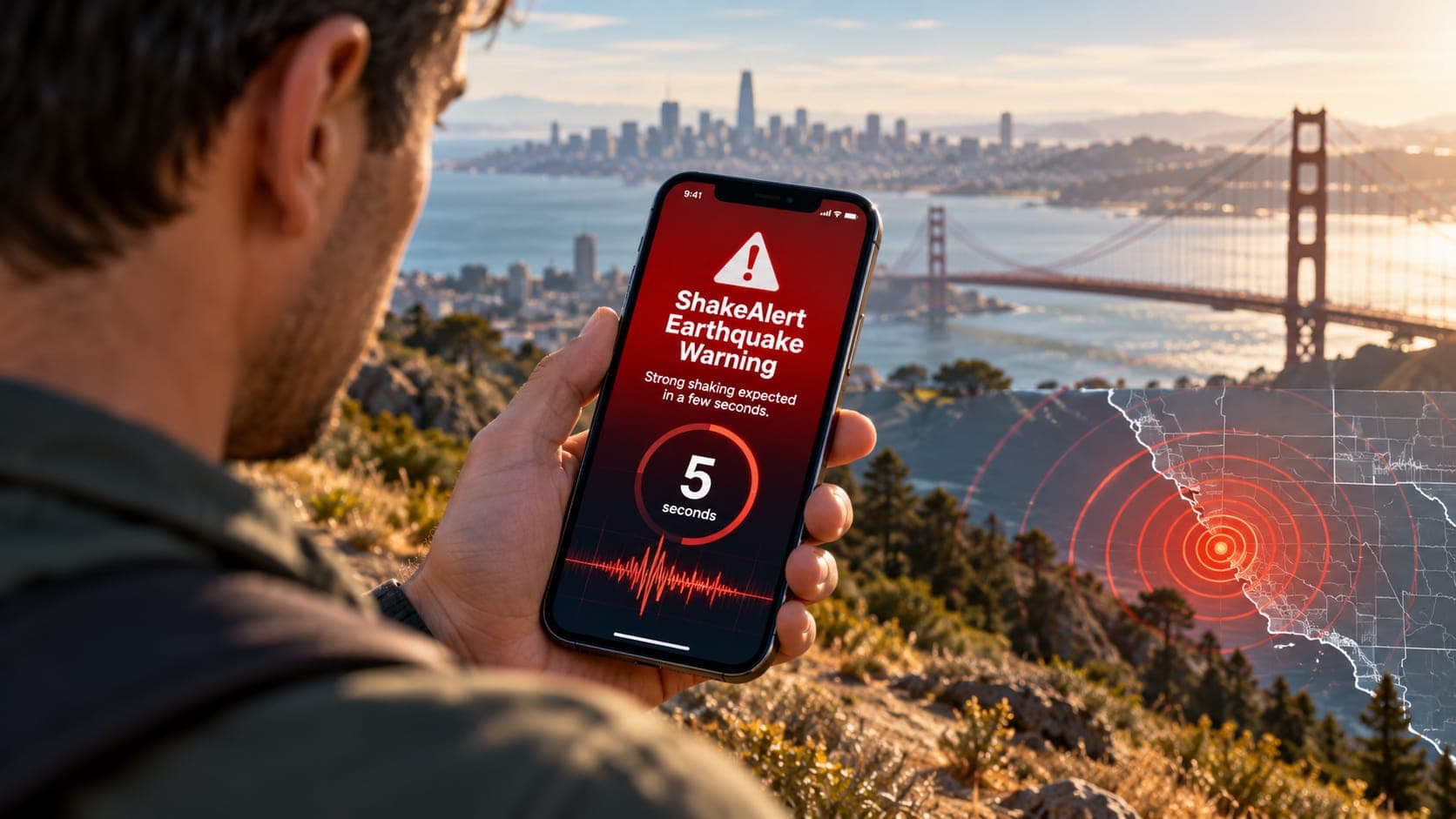
If you live in California, Oregon or Washington, you may already have seen a ShakeAlert-powered message on your phone. ShakeAlert is the public earthquake early warning system for the U.S. West Coast. It does not predict earthquakes. It detects them as they start and tries to warn people before strong shaking arrives.
This article focuses on ShakeAlert itself: who runs it, how its alerts reach you, what they mean and how to make sure you can receive them.
Quick answer
ShakeAlert is an earthquake early warning system operated by the U.S. Geological Survey with state and university partners in California, Oregon and Washington. It detects earthquakes using a network of seismic stations and sends alerts through partners such as Wireless Emergency Alerts, the MyShake app and Android phones. Warnings range from none near the epicenter to tens of seconds farther away. When you get one, Drop, Cover and Hold On.
Who runs ShakeAlert
ShakeAlert is managed by the USGS and developed with universities and state agencies, including the emergency management offices of California, Oregon and Washington. Seismic networks run by universities and the USGS supply the data. The system went into public use in stages, starting in California and later expanding to Oregon and Washington.
ShakeAlert is the detection and alerting engine. It does not send messages to you directly. Instead, it produces alert messages that licensed partners deliver to the public and to organizations.
How ShakeAlert detects an earthquake
Hundreds of seismic stations across the three states continuously stream data. When several stations near each other record the first P wave of an earthquake, ShakeAlert's algorithms estimate the location and Magnitude and predict how strong shaking will be in surrounding areas. Estimates are updated repeatedly while the earthquake continues.
The general idea of early warning, including why there is a late alert zone near the epicenter, is explained in our earthquake early warning system article.
How ShakeAlert alerts reach you
Different delivery partners use different thresholds. In general, apps alert for lighter expected shaking than government emergency alerts do, so you may get an app alert for a moderate earthquake that does not trigger a Wireless Emergency Alert. Exact thresholds have changed over time and may change again.
| Channel | What you need | Alert level, in general |
|---|---|---|
| Wireless Emergency Alerts (WEA) | A compatible phone with emergency alerts turned on | Larger expected shaking, over a wider area |
| MyShake app | The free app installed, with location and notifications allowed | Lighter shaking than WEA |
| Android Earthquake Alerts System | An Android phone with earthquake alerts on | Lighter shaking than WEA; uses ShakeAlert data in these states |
| Institutional users | Systems at transit agencies, hospitals, schools and businesses | Set by each organization for its own actions |
Alerts that act automatically
Some of ShakeAlert's most valuable uses do not involve a person at all. Organizations can connect equipment directly to alert feeds through technical partners. Examples of actions that partners have built or explored include slowing trains, opening fire station doors, stopping elevators at the nearest floor and triggering public address announcements in schools. Automated actions can begin in a fraction of the time it takes a person to read a message.
What to do when you get a ShakeAlert message
A ShakeAlert-powered message usually tells you an earthquake has been detected and to take protective action. Do not wait to feel shaking and do not read the whole message first.
- Drop to your hands and knees.
- Cover your head and neck, under a sturdy table if one is close.
- Hold On until shaking stops.
- If driving, slow down and pull over when it is safe; set the parking brake.
- If in bed, stay there and cover your head with a pillow.
- After shaking stops, check for injuries and hazards, and expect aftershocks.
False, missed and late alerts
ShakeAlert makes fast decisions using little data, so it is not perfect. It may send an alert when shaking turns out to be lighter than expected, or occasionally for an event that was misidentified. It may fail to alert, or alert late, if you are near the epicenter, if expected shaking at your location was below a channel's threshold, or if delivery was slow. For very large earthquakes, first estimates of magnitude can be too low while the Fault is still breaking.
If you felt shaking but got no alert, that does not necessarily mean the system failed. You may have been in the late alert zone, or below the threshold for your channel. The USGS and ShakeAlert publish information about how the system performed for notable earthquakes.
How to check that you can receive alerts
There is no button to send yourself a real ShakeAlert message, but you can make sure each channel is ready. Confirm emergency alerts are enabled in your phone settings. Open MyShake, and check its notification and location permissions. On Android, look for the earthquake alerts setting and make sure it is on.
Drills such as the annual Great ShakeOut are a good time to practice, and some apps send test messages during them. The ShakeAlert website also explains what alerts look like and how to respond. For device-specific steps, see how to get earthquake alerts and how to enable earthquake alerts on iPhone.
Frequently asked questions
Does ShakeAlert work outside California, Oregon and Washington?
No. ShakeAlert covers only those three states. Elsewhere you may be covered by other systems, such as Android Earthquake Alerts or national systems abroad, or you can get notifications of reported earthquakes from the USGS.
Do I need an app to receive ShakeAlert warnings?
Not necessarily. Wireless Emergency Alerts reach compatible phones without an app, but only for larger expected shaking. Installing MyShake or keeping Android alerts on can give you alerts at lower shaking levels too.
Is ShakeAlert the same as MyShake?
No. ShakeAlert is the detection system run by the USGS and partners. MyShake is a free app, developed at UC Berkeley, that delivers ShakeAlert-powered alerts to your phone.
Why did I get a ShakeAlert message but feel almost nothing?
Alerts are based on estimates made in seconds. Shaking at your exact location depends on distance, soil and your building, so it can be lighter than predicted. Taking cover briefly is still the right response.
Key takeaway
ShakeAlert is the USGS-operated early warning system for California, Oregon and Washington. It detects earthquakes and passes alerts to phones, apps and equipment through partners. Turn on emergency alerts, consider MyShake, and when an alert arrives, Drop, Cover and Hold On.
Sources
- ShakeAlert — ShakeAlert (USGS and partners)
- Earthquake Early Warning Overview — U.S. Geological Survey
- MyShake — UC Berkeley Seismology Lab
- Wireless Emergency Alerts (WEA) — Federal Communications Commission