Can AI Predict Earthquakes?
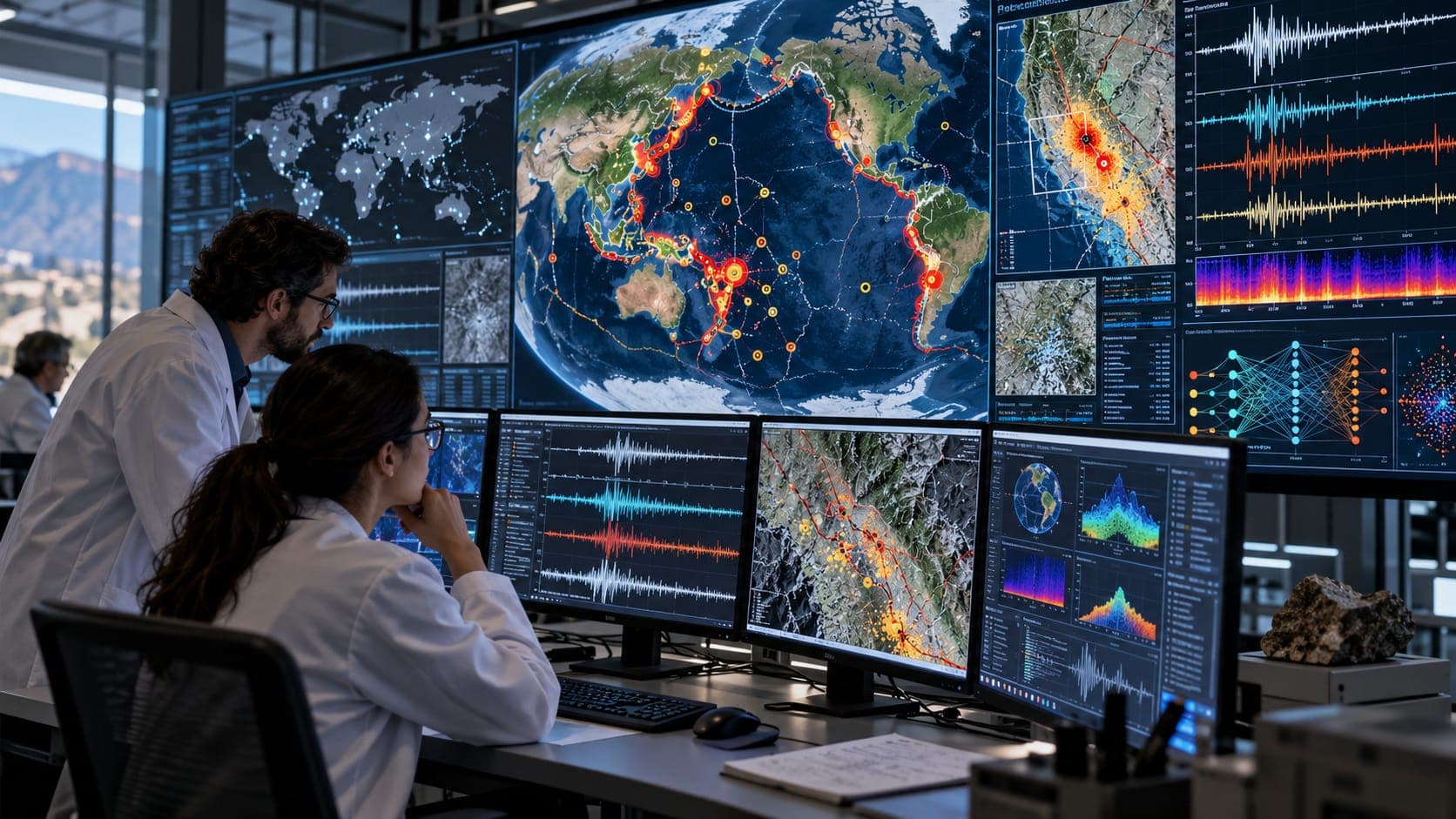
Artificial intelligence has made headlines in almost every field, and earthquakes are no exception. Every so often a story claims that a new AI model can predict earthquakes. Some of these stories describe genuine and exciting research, but the headlines often promise far more than the research shows.
This article explains what machine learning really does in seismology today, why predicting large earthquakes remains out of reach even with AI, and how to tell a serious claim from hype.
Quick answer
No AI system can currently predict the time, place and size of a large earthquake, and none has been validated to do so. AI is, however, very useful in seismology: it helps detect and locate many more small earthquakes, picks seismic wave arrivals quickly, builds more complete catalogs and may help improve early warning. Researchers also use it to study laboratory earthquakes, but those results have not carried over to predicting real ones.
The short answer
A real earthquake prediction must say when, where and how big, as explained in earthquake prediction today. No method, including AI, has been shown to do that reliably. The USGS position that no one has ever predicted a major earthquake still stands.
That does not mean AI is unimportant. It is changing how seismologists handle data, and some of those changes make monitoring and warning systems better.
What machine learning does well
Seismic networks record huge amounts of data around the clock. Machine learning is good at finding patterns in large datasets, and this is where it shines.
- Phase picking: identifying the arrival times of P-waves and S-waves on seismograms, a task once done largely by hand or with simpler automatic methods.
- Detecting small earthquakes: finding tiny quakes hidden in noisy records, often revealing many more events than older methods found.
- Building catalogs: producing more complete lists of earthquakes, which help scientists map faults and see how sequences evolve.
- Telling earthquakes from other signals: separating real quakes from noise such as traffic, quarry blasts or instrument glitches.
- Supporting early warning: research into faster, more accurate estimates of magnitude and shaking in the first seconds of an earthquake.
Why better catalogs matter
Earthquake catalogs are the foundation for forecasts. When AI tools reveal thousands of small earthquakes that were previously missed, scientists can see fault structures in sharper detail and watch how aftershocks and swarms spread underground.
This kind of detail improves our understanding of how earthquakes interact. Over time it may help refine probability-based forecasts, such as aftershock forecasts. That is a real benefit, even though it is not the same as predicting the next big quake.
Lab earthquakes: promising, but different
Some of the most talked-about AI research uses laboratory earthquakes. Scientists squeeze and slide blocks of material together in a machine until they slip, creating small, repeating stick-slip events. Machine learning trained on the sounds and signals from these experiments has shown skill at estimating when the next lab slip will happen.
Real faults are far more complicated. They are miles long, buried deep underground, uneven and influenced by many other faults. Large real earthquakes on any one fault are rare, so there is little data to train on. Researchers are working to see whether lab lessons carry over to real faults, but so far that has not produced a working prediction method.
Why AI struggles with prediction
Machine learning learns from examples. For predicting large earthquakes, the examples are scarce, and the key information may simply not be in the data. Instruments sit at the surface, while earthquakes start miles below, where stress cannot be measured directly.
There is also a risk of fooling ourselves. A model can appear to work on past data by picking up on quirks of that data rather than real physics. The true test is whether it works on future earthquakes it has never seen, announced in advance, with few false alarms. No AI method has passed that test for large earthquakes.
How to evaluate an AI earthquake claim
When you see a headline about AI predicting earthquakes, these questions help separate solid research from hype.
- Is it really prediction, or detection, early warning or forecasting described with the wrong word?
- Were the forecasts made in advance and checked against later earthquakes, or only tested on past data?
- How many false alarms did it produce, and how many earthquakes did it miss?
- Was it a lab experiment, a simulation or real faults?
- Has it been published and independently tested, and do agencies such as the USGS use it?
Frequently asked questions
Has AI ever predicted a real earthquake?
There is no validated case of AI predicting the time, place and magnitude of a large real earthquake in advance. Some research projects have reported encouraging results in tests, but none has become a proven, reliable prediction method.
Is AI used in earthquake early warning?
Researchers are studying ways machine learning could make early warning faster or more accurate. Early warning itself detects quakes that have already started; it does not predict them. See the earthquake early warning system.
Does EQRadar use AI to predict earthquakes?
No. EQRadar shows earthquakes reported by the USGS, official USGS aftershock forecasts and a statistical outlook based on past earthquake rates. None of these is a prediction.
Could AI predict earthquakes in the future?
No one can rule it out, but many seismologists think the more likely gains are better catalogs, better forecasts and faster warnings rather than exact predictions.
Key takeaway
AI is a powerful tool for finding and studying earthquakes, and it is improving catalogs and may improve early warning. It cannot predict large earthquakes today, so treat any claim that it can with healthy skepticism and keep relying on preparedness.
Sources
- Can you predict earthquakes? — U.S. Geological Survey
- Earthquake Hazards Program — U.S. Geological Survey
- Earthquake Early Warning Overview — U.S. Geological Survey