San Andreas Fault Earthquake
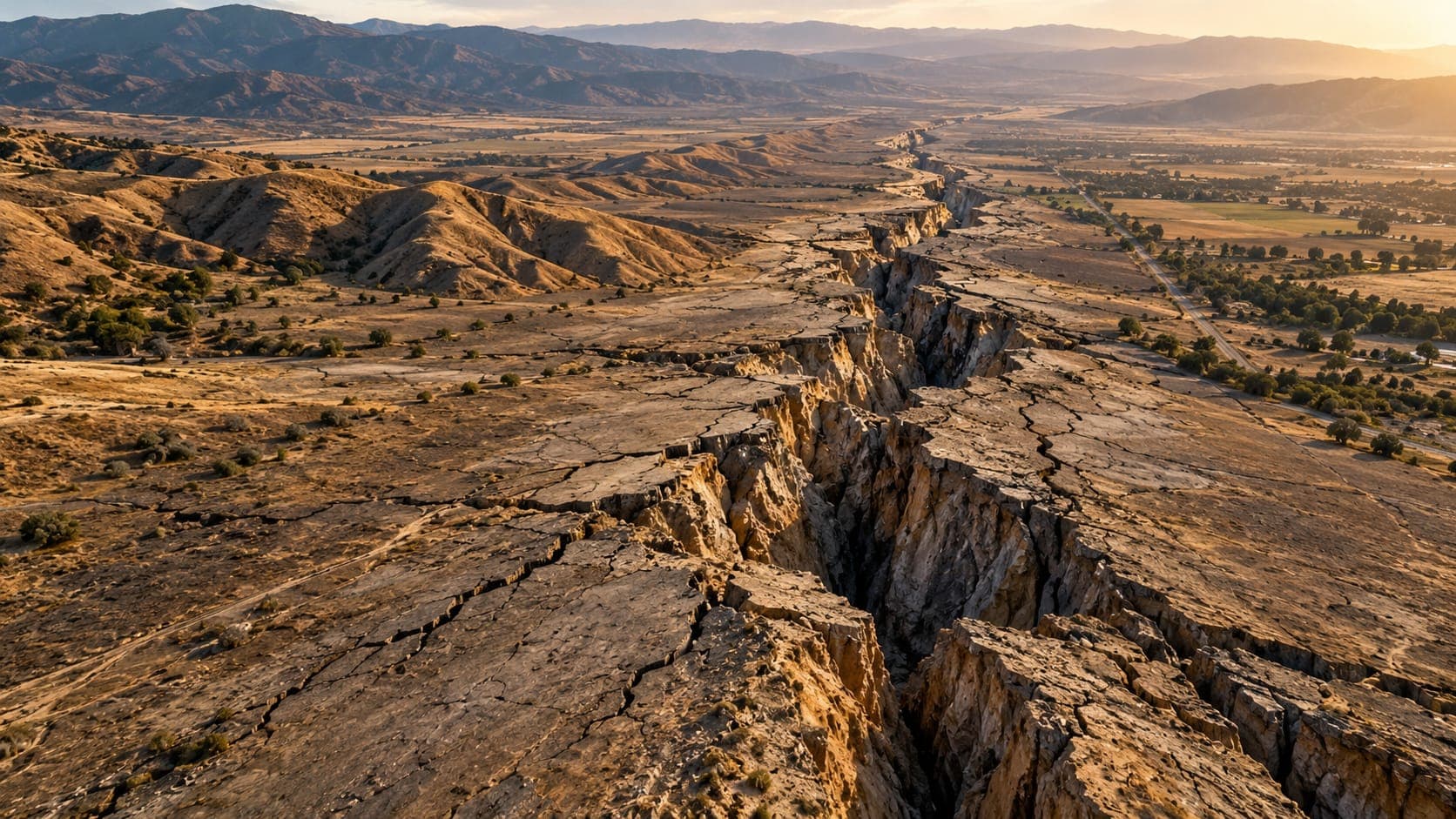
The San Andreas Fault is the best-known Fault in North America and one of the most studied faults on Earth. It runs for about 1,200 kilometers (roughly 750 miles) through California, from the Salton Sea area in the south to Cape Mendocino on the north coast, where it heads out to sea.
This article looks at how earthquakes on the San Andreas actually behave: which parts of the fault have broken in large earthquakes, which parts move in smaller, more frequent events, and which part barely produces large earthquakes at all.
Quick answer
A San Andreas Fault earthquake happens when stress built up by the slow sideways motion of the Pacific and North American plates is released as sudden slip on the fault. The fault does not behave the same everywhere: some sections have broken in great earthquakes of about magnitude 7.9 (1857 and 1906), the Parkfield section has repeated magnitude 6 events, and a central section creeps slowly with few large quakes.
Earthquakes along the San Andreas FaultWhat kind of fault is the San Andreas?
The San Andreas is a strike-slip fault. The ground on each side moves mostly sideways rather than up or down. If you stand on one side and look across, the other side moves to your right over time, so geologists call it a right-lateral fault. The land west of the fault, which is part of the Pacific Plate, moves northwest relative to the land east of it, which is part of the North American Plate.
Across the whole plate boundary, the two plates slide past each other at roughly 3 to 5 centimeters per year, about as fast as fingernails grow. The San Andreas carries a large share of that motion, and other faults carry the rest. Most of the time the fault is locked by friction, so the rocks bend and store strain. When the strain overcomes friction, the fault slips suddenly and the stored energy radiates out as seismic waves.
The fault's main sections
Scientists usually describe the San Andreas in sections, because different stretches have different earthquake histories. The boundaries are approximate, and a large earthquake can break through more than one section.
| Section | Rough location | Typical behavior |
|---|---|---|
| Northern | Cape Mendocino to near San Juan Bautista, including the San Francisco Peninsula | Locked; broke in the great 1906 earthquake |
| Creeping | San Juan Bautista to Parkfield, central California | Slips slowly and steadily; few large earthquakes |
| Parkfield | Around the small town of Parkfield | Repeated magnitude 6 earthquakes |
| South-central (Big Bend area) | Cholame through the Carrizo Plain to the Cajon Pass area | Locked; broke in the great 1857 earthquake |
| Southern | San Bernardino Mountains to the Salton Sea | Locked; no large rupture in roughly three centuries |
The two great historic earthquakes
On January 9, 1857, the Fort Tejon earthquake, about magnitude 7.9, ruptured the fault from near Parkfield southeast toward Cajon Pass, a length of roughly 350 kilometers. The region was thinly settled, so there were few deaths, but the ground in the Carrizo Plain was offset sideways by several meters.
On April 18, 1906, the San Francisco earthquake, also about magnitude 7.9, ruptured the northern section for several hundred kilometers, from near San Juan Bautista to Cape Mendocino. Shaking and the fires that followed destroyed much of San Francisco. Our article on the 1906 San Francisco earthquake covers it in detail.
Both earthquakes show what a long, locked section can do: when it fails, slip can spread along hundreds of kilometers within a minute or two, producing strong shaking along the whole length rather than around a single point.
Parkfield: moderate earthquakes on repeat
Near Parkfield, the fault has produced magnitude 6 earthquakes again and again, including events in 1934, 1966 and 2004. Because they looked fairly regular, scientists in the 1980s expected the next one by about the early 1990s and filled the area with instruments to catch it.
The earthquake came in 2004, more than a decade later than expected. That delay is an important lesson. Even the most repetitive section of the San Andreas does not keep a reliable schedule, which is why scientists talk about long-term probabilities rather than due dates. The Parkfield records still produced some of the best close-up observations of a fault rupture ever collected.
The creeping section
Between San Juan Bautista and Parkfield, the fault creeps. Instead of locking and then lurching, it slides slowly and fairly steadily, producing many small earthquakes but storing much less strain. In towns built across this stretch, such as Hollister, you can see curbs, fences and walls being gradually pulled out of line.
Creep is one reason a single earthquake rupturing the entire San Andreas from end to end is considered unlikely. A rupture coming from the north or south would have to push through a section that does not store much energy.
Why the southern section gets so much attention
Paleoseismic studies, in which geologists dig trenches across the fault and date the disturbed layers, show that the southern San Andreas has broken in large earthquakes many times over the past thousand years or so. The stretch through the Coachella Valley has not had a large rupture in roughly three hundred years, longer than many of the intervals between past events found in those trenches.
That does not mean the fault is overdue. Intervals between large earthquakes vary widely, and a long quiet period does not set a date. It does mean that a large southern San Andreas earthquake is a realistic possibility that emergency planners take seriously. Our article on the Big One explains the scenarios used for planning.
Watching the San Andreas today
Seismometers along the fault record small earthquakes every day, and GPS stations measure how the land on each side is moving. Most of the small events are too weak to feel. You can see recent activity near the fault on the EQRadar live map, which shows earthquakes reported by the USGS. EQRadar does not draw fault lines, so the map shows where earthquakes happened rather than where the fault is.
If you live near the fault, the practical steps are the same as anywhere in earthquake country: secure heavy furniture, keep supplies, and practice Drop, Cover and Hold On.
Frequently asked questions
When was the last major San Andreas Fault earthquake?
The last great earthquakes on the San Andreas were in 1857 in central and southern California and 1906 in northern California, both about magnitude 7.9. The Parkfield section had a magnitude 6 earthquake in 2004. The 1989 Loma Prieta earthquake struck in the Santa Cruz Mountains very close to the San Andreas, on a closely related fault.
Could the whole San Andreas Fault break at once?
Scientists consider an end-to-end rupture very unlikely, partly because the creeping section in central California does not store enough strain to carry a rupture easily. Large earthquakes usually break one or a few sections.
How big can a San Andreas earthquake get?
Historic ruptures reached about magnitude 7.9. Scientific models allow for somewhat larger events if several sections break together, but a magnitude 9 or 10 is not considered possible on this fault, because it is not long or wide enough.
Does the San Andreas cause most California earthquakes?
No. California has many active faults, and most of its earthquakes, including many damaging ones, happen on other faults. See our article on earthquake fault lines in California.
Key takeaway
The San Andreas is not one uniform fault but a chain of sections with different behavior: locked sections that produced great earthquakes in 1857 and 1906, a Parkfield section with repeated magnitude 6 events, and a creeping section with few large quakes. It will produce large earthquakes again, but not on a predictable schedule.
Sources
- Earthquake Hazards Program — U.S. Geological Survey
- Faults — U.S. Geological Survey
- California Geological Survey — California Department of Conservation