The Big One Earthquake California
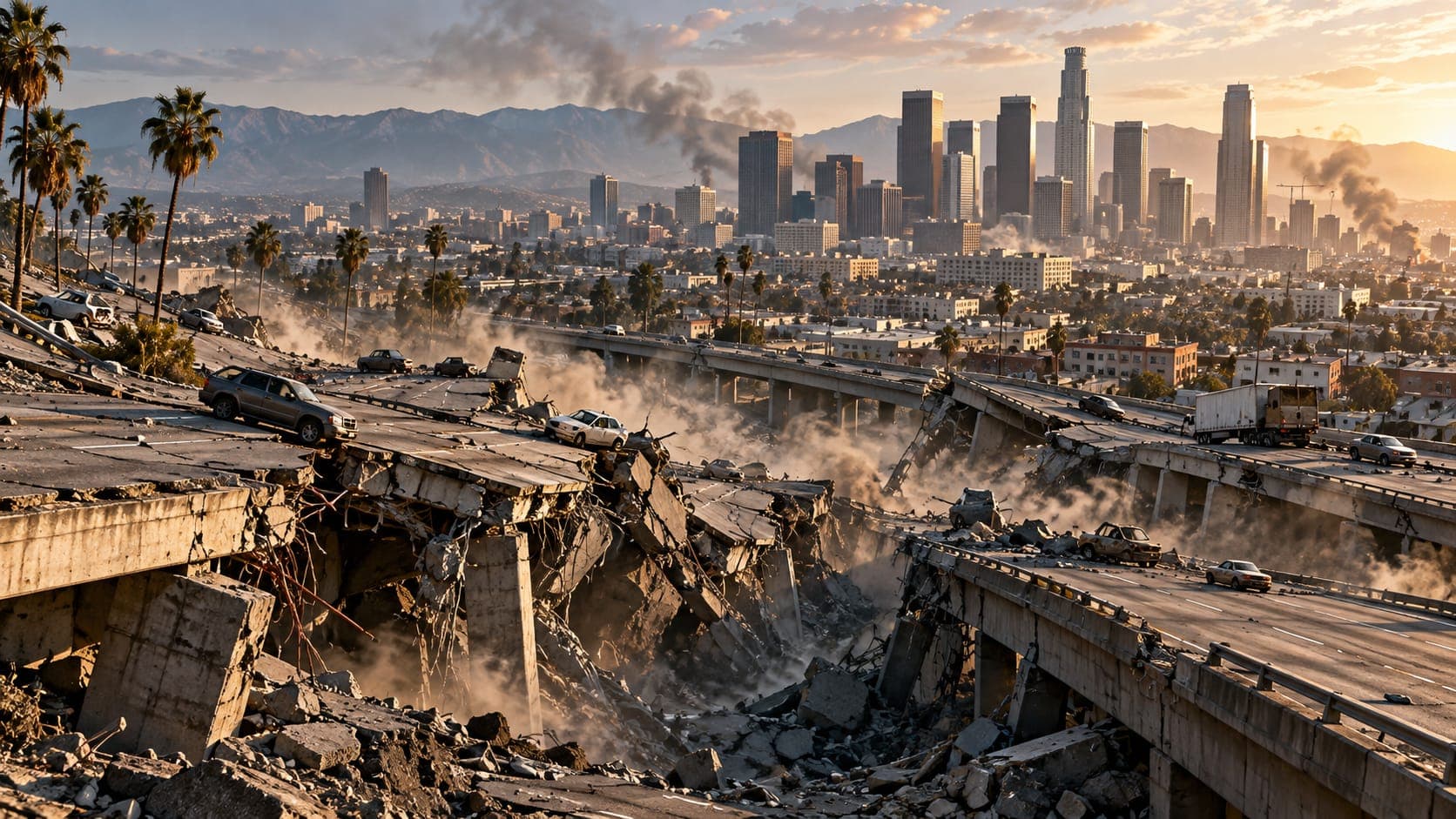
Californians have talked about the Big One for decades. The phrase shows up in news stories, movies and everyday conversation, usually meaning a huge earthquake that will someday hit the state's big cities.
It is not a scientific term, though, and it carries a lot of myths along with it. This article explains what the phrase usually refers to, what the main planning scenarios actually describe, and what the Big One is not.
Quick answer
The Big One is a popular name for a very large, damaging California earthquake, most often imagined as a magnitude 7.8 or larger rupture of the southern San Andreas Fault. Scientists cannot say when it will happen, but statewide models show a large earthquake somewhere in California within the next few decades is very likely. The best response is steady preparation, not fear.
Recent earthquakes in CaliforniaWhat the phrase usually means
There is no official definition, but people usually mean an earthquake of around Magnitude 7.5 to 8 on a major fault close to a large city. Most often that is the southern San Andreas Fault, which runs within roughly 50 to 100 kilometers of much of the Los Angeles area and directly through parts of the Inland Empire and Coachella Valley.
In the San Francisco Bay Area, the phrase often refers to a large earthquake on the Hayward Fault or a repeat of the 1906 rupture on the northern San Andreas. In the Pacific Northwest, people use it for a great Cascadia earthquake. So there is not just one Big One; there are several possible large earthquakes that would each be a major disaster for the region they hit.
The ShakeOut scenario: a planning picture
In 2008, the USGS and many partners published the ShakeOut Scenario, a detailed study of a hypothetical magnitude 7.8 earthquake on the southern San Andreas Fault. In the scenario, the fault breaks for roughly 300 kilometers (about 200 miles), from near the Salton Sea northwest past Palm Springs, through the Cajon Pass and along the north side of the San Gabriel Mountains.
Scientists modeled how the shaking would spread, then engineers, emergency managers and economists estimated the effects. The study estimated roughly 1,800 deaths, about 50,000 injuries and around 200 billion dollars in damage and economic losses, along with major disruption to water, power, roads, pipelines and communications that cross the fault.
The scenario also gave its name to the Great ShakeOut earthquake drills, now held every year in many states and countries, where millions of people practice Drop, Cover and Hold On.
A scenario is not a forecast
It is important to read the ShakeOut study correctly. It does not say this earthquake will happen on a certain date, or that it is the worst possible case. It was designed as a realistic, plausible event so that agencies, businesses and households could plan against something specific instead of vague fear.
Real earthquakes will differ. The rupture could start at a different end, be shorter or longer, or happen on a different fault. Scenarios help answer the question, what would we need to cope with? They do not answer, when?
How likely is a large California earthquake?
The best long-term estimates for California come from UCERF3, the Uniform California Earthquake Rupture Forecast, developed by the USGS and partners. It found that the chance of at least one earthquake of magnitude 6.7 or larger somewhere in California in a 30-year period is greater than 99 percent. The chance of very large earthquakes, such as magnitude 8 or larger, is much lower but not negligible.
These are probabilities over decades, not predictions. No scientist can name the day, month or year of the next large earthquake. Our article on earthquake probability in California explains these numbers in more detail.
Why overdue is the wrong word
You may hear that the southern San Andreas is overdue because it has not had a large rupture in roughly three centuries, longer than some past intervals. But faults do not run on timetables. The time between large earthquakes on the same section varies a lot, as the Parkfield section showed when its expected earthquake arrived more than a decade late.
A long quiet period does raise the long-term concern, which is why the southern San Andreas gets so much attention. It does not mean an earthquake is imminent, and it does not make one more likely next week than last week in any useful, day-to-day sense.
What the Big One is not
Movies and social media have spread several ideas that do not match the science:
- California will not fall into the ocean. The San Andreas is a sideways fault; the land on each side slides horizontally past the other.
- The ground will not open into a giant chasm that swallows cities. Surface cracks and offsets happen along the fault, but not bottomless gaps.
- A magnitude 10 is not possible on the San Andreas. The fault is not long or wide enough for anything near that size.
- There is no earthquake weather or season. Large earthquakes happen in any weather, at any time of day.
- Small earthquakes do not reliably relieve enough stress to prevent a large one; it would take an enormous number of them.
What actually helps
The Big One is a reason to prepare steadily, not to panic. Secure heavy furniture and water heaters, keep water and supplies for several days, make a family plan, and practice Drop, Cover and Hold On. If you own an older home, ask whether it needs seismic retrofitting. Earthquake early warning through ShakeAlert can give some people a few seconds of notice before strong shaking arrives.
You can follow current activity on the EQRadar live map, and our preparedness guide walks through each step.
Frequently asked questions
Has the Big One already happened?
California has had very large earthquakes, including the 1857 Fort Tejon and 1906 San Francisco earthquakes, both about magnitude 7.9. Many people would call those Big Ones. The phrase today usually refers to the next such event, especially on the southern San Andreas.
How long would the shaking last in a magnitude 7.8 earthquake?
Strong shaking in a long rupture like the ShakeOut scenario could last a minute or more in many places, much longer than in moderate earthquakes, because the fault keeps breaking for well over a minute.
Will we get a warning before the Big One?
There is no way to predict the date. ShakeAlert, the West Coast earthquake early warning system, can detect an earthquake that has already begun and send alerts that may arrive seconds before strong shaking. People close to the rupture may get little or no warning.
Would the Big One cause a tsunami?
A San Andreas earthquake is mainly on land and moves sideways, so it is not expected to cause a large ocean-wide tsunami. A great Cascadia earthquake off the Pacific Northwest, by contrast, would cause a major tsunami.
Key takeaway
The Big One is a popular name, not a scientific one, for a very large California earthquake, most often pictured as a magnitude 7.8 on the southern San Andreas. Planning scenarios show what such an event could do; probability models show a large earthquake in California within decades is very likely; and no one can name the date.
Sources
- Earthquake Hazards Program — U.S. Geological Survey
- Earthquake Country Alliance — Earthquake Country Alliance
- Earthquakes — Ready.gov (U.S. Department of Homeland Security)