1906 San Francisco Earthquake
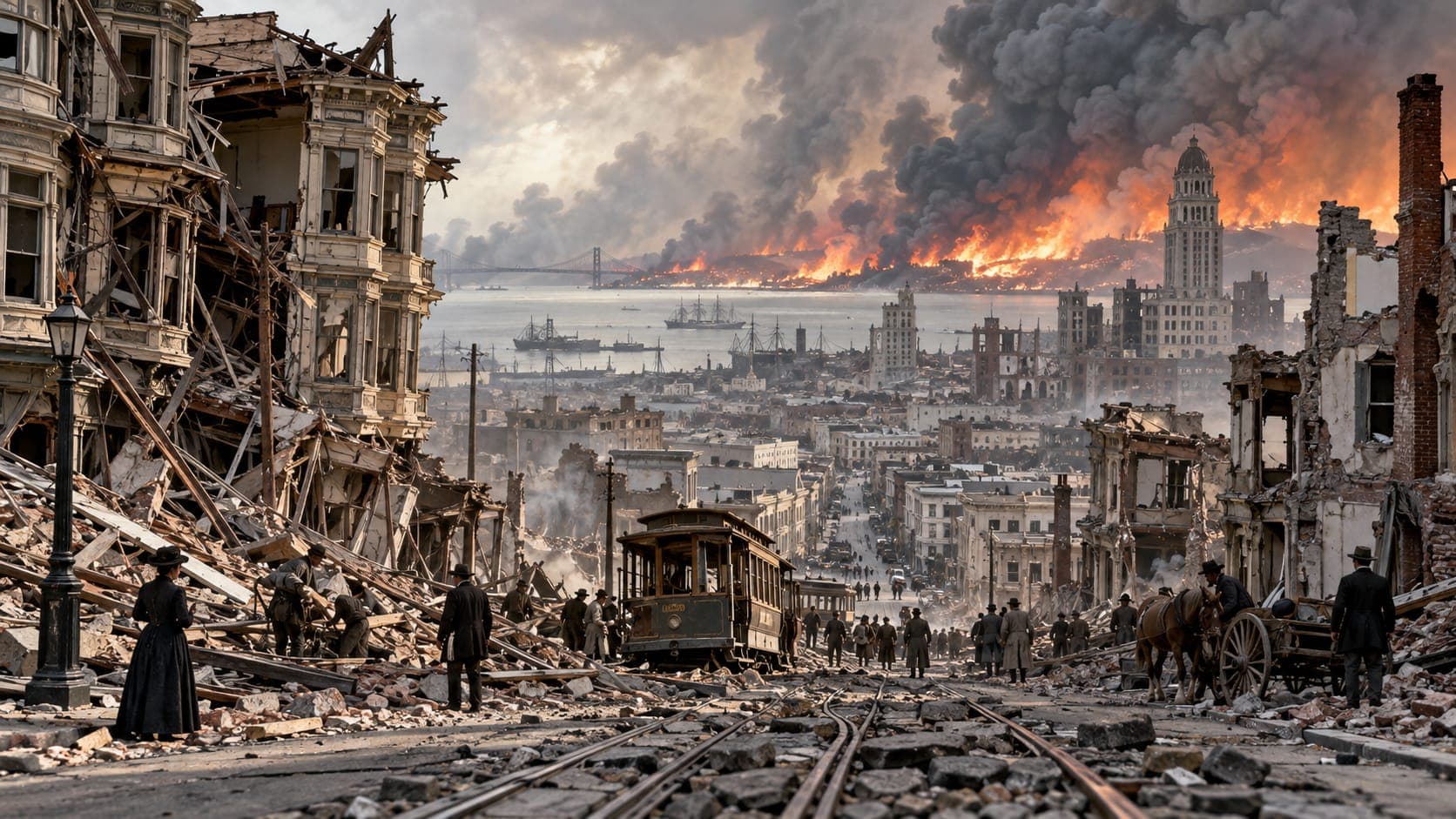
Early on the morning of April 18, 1906, a powerful earthquake shook San Francisco and much of Northern California. The shaking lasted less than a minute, but the fires that followed burned for days and destroyed a large part of the city.
The 1906 earthquake is one of the most important events in the history of earthquake science. Studying it led directly to a new understanding of how faults store and release energy. This article covers what happened, why the fires were so destructive and what the event taught scientists and engineers.
Quick answer
The 1906 San Francisco earthquake struck at about 5:12 a.m. on April 18, 1906, with an estimated magnitude of about 7.9. The San Andreas Fault ruptured for roughly 470 km (about 296 miles). Shaking damaged buildings across Northern California, and fires burned for several days, causing much of the destruction in San Francisco. Deaths are estimated at around 3,000 or more.
San Francisco Bay AreaThe morning of April 18, 1906
At about 5:12 a.m., a Foreshock was felt in San Francisco, followed seconds later by violent shaking from the main earthquake. Its Epicentre was close to San Francisco, near the coast. Strong shaking in the city lasted roughly 45 seconds to a minute.
Because it was so early, many people were still asleep at home. Chimneys toppled, brick walls fell into the streets and buildings on filled land near the bay were badly damaged as soft ground shook harder and in places settled or flowed through Liquefaction. Damage extended well beyond San Francisco, with heavy destruction in places such as Santa Rosa, San Jose and the Stanford University campus.
A 470-kilometer rupture of the San Andreas Fault
The earthquake ruptured the northern part of the San Andreas Fault for roughly 470 km (about 296 miles), from near San Juan Bautista in the south to Cape Mendocino in the north. The San Andreas is a strike-slip Fault, where the Pacific Plate moves northwest relative to the North American Plate, so the ground on either side slid sideways past each other.
Along the fault, fences, roads and rows of trees were offset by several meters. Some of the largest offsets were measured in Marin County, north of San Francisco. Its estimated Magnitude of about 7.9 is based on modern analysis of historical records, since modern magnitude methods did not yet exist.
Fire: the greatest destroyer
Fires began almost immediately, started by broken chimneys, overturned stoves and damaged gas and electrical lines. The earthquake had broken water mains across the city, leaving firefighters with little water. Attempts to create firebreaks with explosives sometimes started new fires instead.
The fires burned for several days and destroyed a large part of the city, including the downtown and many neighborhoods. Much of the destruction in San Francisco was caused by fire rather than shaking. Roughly half or more of the city's residents were left homeless, and many lived in tents and temporary camps in parks for months.
The human toll
Early official counts listed only a few hundred deaths. Later research by historians found that many deaths, including those in poorer neighborhoods and Chinatown, were never officially recorded. Today, deaths are estimated at around 3,000 or more, which makes it the deadliest earthquake in U.S. history.
How 1906 changed earthquake science
Shortly after the earthquake, the State of California formed a commission led by geologist Andrew Lawson to investigate it. Its detailed findings, published in what is known as the Lawson report, documented the fault rupture, the pattern of damage and the effects of ground conditions. It remains one of the most important studies of a single earthquake.
Using survey measurements from before and after the earthquake, Harry Fielding Reid developed the elastic rebound theory. He proposed that the rocks on either side of a locked fault slowly bend as the plates move, storing strain like a stretched spring, until the fault suddenly slips and the rocks snap back. This idea is still the basic explanation for how most earthquakes happen. Our article on how earthquakes happen explains it further.
- Showed clearly that a large earthquake can rupture hundreds of kilometers of fault at once.
- Revealed that soft, filled ground near the bay shook much harder than nearby rock.
- Demonstrated how fire after an earthquake can cause more damage than the shaking.
- Laid foundations for the scientific study of earthquake hazards in California.
Could it happen again?
Yes. The San Andreas Fault and other faults in the Bay Area will produce large earthquakes in the future, though no one can say when. The region is far better prepared today, with stronger building codes, earthquake early warning and a much better understanding of hazards, but many older buildings remain vulnerable.
If you live in the region, our article on earthquake probability in California explains the long-term forecasts, and you can follow current activity on the EQRadar live map or look up historic earthquakes on the history page.
Frequently asked questions
How strong was the 1906 San Francisco earthquake?
It is estimated at about magnitude 7.9. That makes it one of the largest earthquakes recorded in California, with a rupture roughly 470 km long.
Was the 1906 earthquake on the San Andreas Fault?
Yes. It ruptured the northern section of the San Andreas Fault, from near San Juan Bautista to Cape Mendocino.
Why did so much of San Francisco burn?
The shaking started many fires and broke the water mains firefighters depended on. With little water and fires spreading through densely built neighborhoods, the blazes burned for several days.
How many people died in the 1906 earthquake?
Early official counts were only a few hundred, but later research suggests deaths were around 3,000 or more. The exact number is unknown because many victims were never recorded.
Key takeaway
The 1906 San Francisco earthquake ruptured about 470 km of the San Andreas Fault, and the fires that followed destroyed much of the city. It led to the elastic rebound theory and remains a key lesson in why fire safety and strong buildings matter after large earthquakes.
Sources
- The Great 1906 San Francisco Earthquake — U.S. Geological Survey
- Earthquake Hazards Program — U.S. Geological Survey
- Earthquakes — Ready.gov (U.S. Department of Homeland Security)