How Do Earthquakes Happen?
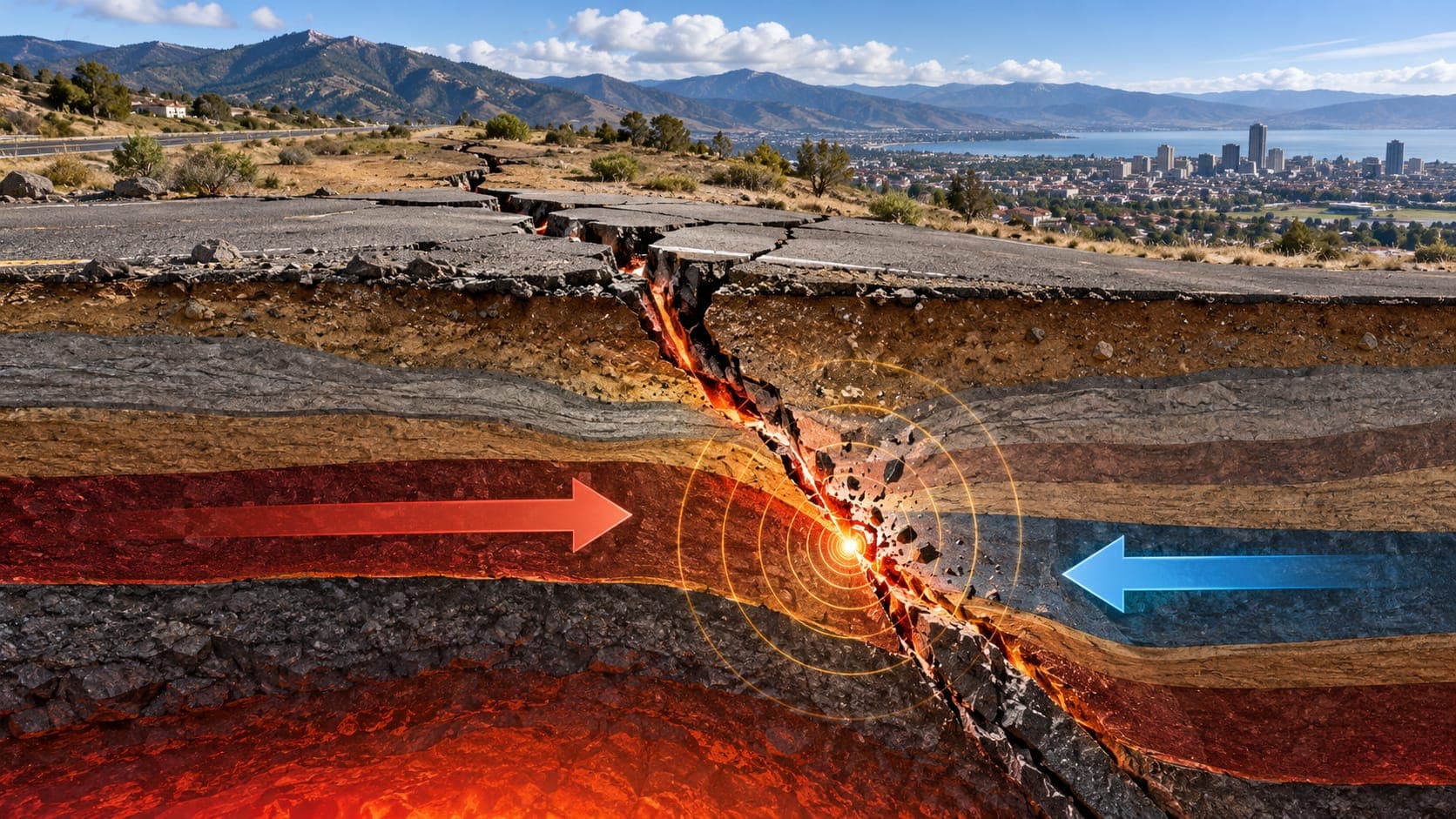
Most people know that earthquakes have something to do with faults and moving plates. But what actually happens, second by second, when an earthquake strikes? The process follows a clear sequence, from a single point deep underground to shaking that can be felt hundreds of miles away.
This article follows that sequence step by step. If you want to know why the stress builds up in the first place, see our companion article on why earthquakes happen.
Quick answer
An earthquake happens when stress on a fault becomes too great and the rock suddenly slips. The slip starts at one point, called the hypocenter, and spreads along the fault surface at a few kilometers per second. As the fault slips, it sends out seismic waves: fast P waves arrive first, then stronger S waves, then surface waves that roll along the ground. When the rupture stops, the main shaking fades, though aftershocks often follow.
Step 1: Stress builds on a locked fault
Every earthquake begins long before the shaking. Rocks on either side of a Fault are pushed or pulled by the slow motion of tectonic plates, but friction keeps the fault locked. Over years, decades or centuries, the rocks deform slightly and store energy, like a stretched rubber band.
Nothing visible happens at the surface during this phase. Scientists can measure the slow bending with precise GPS stations and satellite data, which tells them which faults are building up strain. It does not tell them the exact day a fault will break.
Step 2: The rupture starts at the hypocenter
At some point, the stress at one spot on the fault becomes greater than the friction holding it. The rock there breaks and starts to slip. That starting point is called the Hypocentre (focus), or focus. It can be a few kilometers deep or, in some regions, hundreds of kilometers deep.
The point on the Earth's surface directly above the hypocenter is the Epicentre. News reports and earthquake maps usually give the epicenter, along with the Depth of the hypocenter. Our article on what an epicenter is explains how they are located.
Step 3: The rupture spreads along the fault
An earthquake is not a single crack at one point. Once slip begins, it spreads outward across the fault surface, a bit like a tear spreading through fabric. The rupture front typically travels at a few kilometers per second.
How far the rupture spreads largely decides how big the earthquake becomes. A small earthquake may rupture a patch of fault less than a kilometer across and last a fraction of a second. A great earthquake can rupture hundreds of kilometers of fault, and the slipping can go on for a minute or more. The rupture stops when it reaches rock that is stronger, less stressed, or where the fault bends or ends.
Step 4: Seismic waves radiate outward
As each part of the fault slips, it releases energy as seismic waves. These waves travel through the Earth in all directions. There are three main kinds, and they arrive at a given place in a predictable order.
| Wave | How it moves | What you notice |
|---|---|---|
| P wave (primary) | Pushes and pulls rock in the direction the wave travels; fastest wave | Often a sudden jolt or thump; arrives first |
| S wave (secondary) | Shakes rock side to side or up and down; slower than P waves; cannot travel through liquid | Usually stronger shaking that arrives after the P wave |
| Surface waves | Travel along the ground's surface, causing rolling and swaying | Often the longest-lasting shaking, especially far from large quakes |
Step 5: The ground shakes
When the waves reach the surface, the ground moves. Close to a small earthquake, people may feel a quick jolt. Farther from a large one, the motion can feel like a long, slow rolling. How strong the shaking feels depends on the earthquake's Magnitude, the distance from the rupture, the depth, and the local ground. Soft soils, for example, can amplify shaking compared with solid rock.
The gap between the P wave and the stronger S wave is the basis for earthquake early warning. Systems such as ShakeAlert detect the first waves near the fault and send alerts that can reach some people seconds before the strongest shaking arrives. Learn more in our article on the earthquake early warning system.
Step 6: The rupture stops and the fault adjusts
When the rupture stops spreading, the fault stops slipping and the main shaking dies away as the waves pass. But the fault and the rocks around it have been rearranged. Stress has been released in some places and increased in others.
The crust adjusts to those changes through aftershocks, smaller earthquakes in the same area. They are most frequent right after the Mainshock and become less frequent over days, weeks and sometimes years. Over the long term, the fault locks again and the slow cycle of stress building begins once more.
- Stress builds on a locked fault over many years.
- Rock breaks at the hypocenter.
- The rupture spreads across the fault surface.
- Seismic waves travel outward: P waves, then S waves, then surface waves.
- The ground shakes where the waves reach the surface.
- The rupture stops, aftershocks follow and stress starts building again.
How scientists watch it happen
Networks of seismometers record the waves from every earthquake. By comparing when the waves arrive at different stations, scientists find the hypocenter within minutes. By studying the size and shape of the waves, they estimate the magnitude and work out how the fault moved. For larger earthquakes, the USGS also produces a ShakeMap showing the estimated shaking across the region.
You can explore recent events on the live map, see shaking maps on the shaking page, and view how deep earthquakes occur in the 3D depth explorer.
Frequently asked questions
How long does an earthquake last?
It depends mostly on the size of the rupture. Small earthquakes last a second or less at the source. Very large earthquakes can rupture for a minute or more, and shaking at a given place can last longer because waves keep arriving and bouncing through the ground.
Why do I sometimes feel a jolt and then stronger shaking?
The first jolt is usually the P wave, which travels fastest. The stronger shaking that follows is usually the S wave and surface waves. The farther you are from the earthquake, the longer the gap between them.
Does the ground open up and swallow people during an earthquake?
No. This is a common movie myth. Shallow cracks and ground failures such as landslides can occur, and a fault can offset the surface, but the ground does not open into a gaping pit and close again.
Does every earthquake break the surface?
No. Most earthquakes, including many damaging ones, rupture only underground. Surface rupture is most common in large, shallow earthquakes, where the slip on the fault reaches the ground and can offset roads, fences and streams.
Key takeaway
An earthquake is a process: stress builds on a locked fault, the rock breaks at the hypocenter, the rupture races along the fault, seismic waves spread out and shake the ground, and then the fault settles with aftershocks before stress begins to build again.
Sources
- What is an earthquake and what causes them to happen? — U.S. Geological Survey
- Earthquake Hazards Program — U.S. Geological Survey
- ShakeMap — U.S. Geological Survey
- ShakeAlert — ShakeAlert (USGS and partners)