Deadliest Earthquakes in History
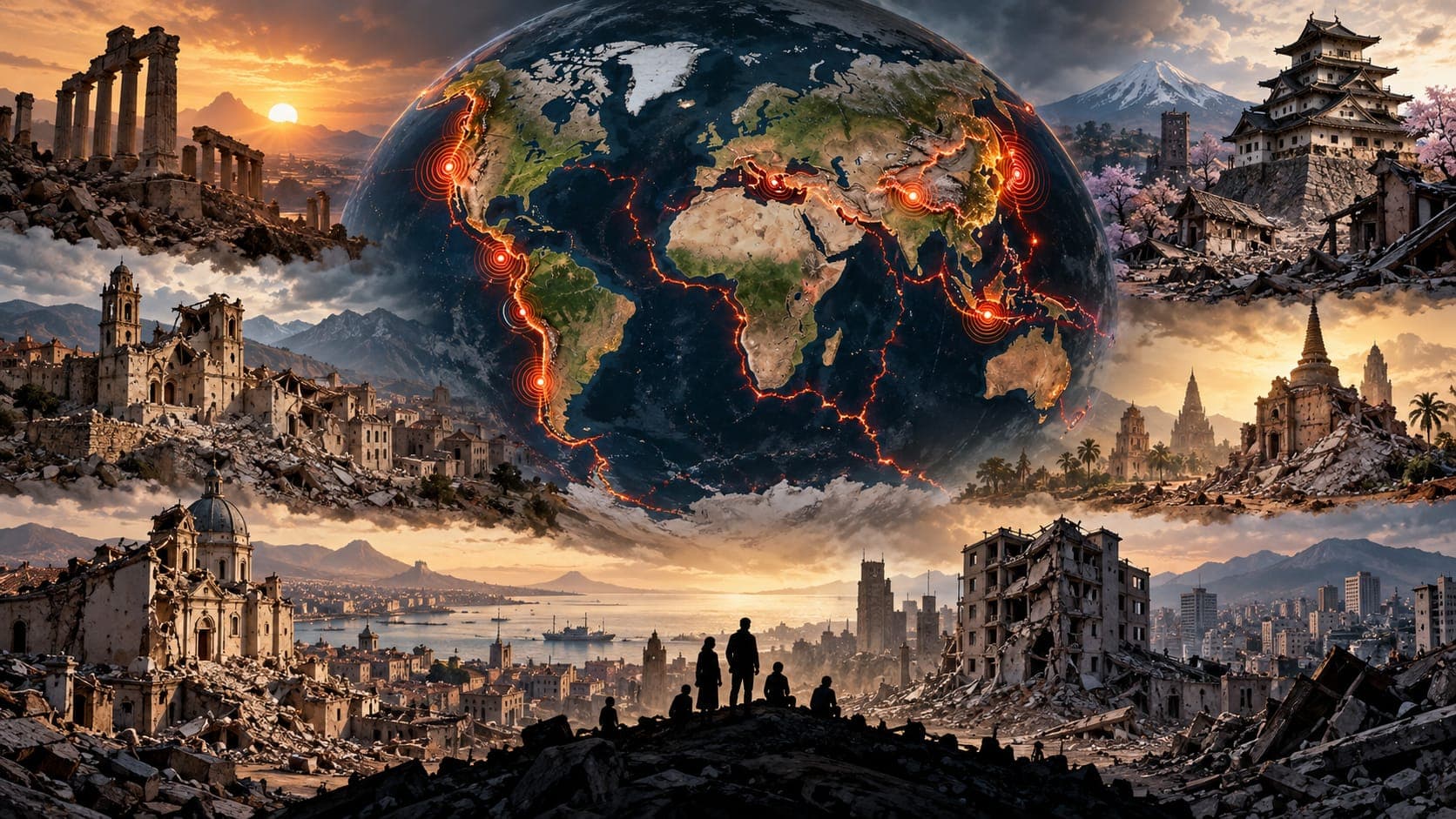
Behind every number in this article are families and communities that lost loved ones, homes and livelihoods. Looking at the deadliest earthquakes in history is not about ranking tragedies. It is about understanding why some earthquakes take so many lives, so that future losses can be reduced.
Death tolls for large disasters are hard to count, especially for historical events, and estimates often differ widely between sources. The figures below are rounded and described as estimates for that reason.
Quick answer
The deadliest earthquake on record is generally considered the 1556 Shaanxi earthquake in China, with a historical estimate of around 830,000 deaths. Other very deadly events include the 1976 Tangshan earthquake in China, the 2004 Indian Ocean earthquake and tsunami, the 2010 Haiti earthquake and the 2023 Türkiye–Syria earthquakes. In nearly every case, vulnerable buildings and secondary hazards such as tsunamis and fires caused most of the deaths.
Some of the deadliest earthquakes on record
The table lists several of the most deadly earthquakes for which estimates are widely cited. It is not a complete ranking, and different sources order these events differently because the estimates vary so much.
| Year | Location | Approximate magnitude | Estimated deaths |
|---|---|---|---|
| 1556 | Shaanxi, China | Estimated around 8 | Around 830,000 (historical estimate) |
| 1923 | Kantō region, Japan | About 7.9 | More than 100,000 |
| 1976 | Tangshan, China | About 7.5 to 7.8 | About 242,000 officially; other estimates higher |
| 2004 | Indian Ocean (off Sumatra) | 9.1 | More than 225,000 across many countries |
| 2010 | Haiti | 7.0 | More than 100,000; estimates vary widely |
| 2023 | Türkiye and Syria | 7.8 | More than 50,000 |
1556 Shaanxi, China
The earthquake of January 23, 1556, struck the Wei River valley region of northern China. Historical records describe enormous destruction across a wide area. Many people in the region lived in artificial caves dug into soft loess cliffs, a fine wind-blown soil. These dwellings collapsed or were buried by landslides during the shaking, which is believed to be a major reason the toll was so high.
Because it happened centuries before modern record keeping, the commonly quoted figure of around 830,000 deaths is a historical estimate, and its accuracy cannot be checked the way modern counts can.
1923 Kantō and 1976 Tangshan
The Great Kantō earthquake struck near Tokyo and Yokohama on September 1, 1923, around midday, when many households were cooking over open flames. Fires broke out across the densely built wooden neighborhoods and spread rapidly, driven by strong winds. Fire, rather than shaking alone, caused a large share of the more than 100,000 deaths.
The Tangshan earthquake struck an industrial city in northeastern China in the early morning of July 28, 1976, while most people were asleep. Many buildings were unreinforced masonry that collapsed. The official death toll is about 242,000, and some other estimates are considerably higher.
2004 Indian Ocean earthquake and tsunami
On December 26, 2004, a magnitude 9.1 earthquake ruptured the Subduction zone off the island of Sumatra, Indonesia. It generated a Tsunami that struck coastlines around the Indian Ocean, including Indonesia, Sri Lanka, India and Thailand, and reached as far as East Africa. More than 225,000 people died across many countries.
Most of the deaths were caused by the tsunami, not the shaking. At the time, there was no tsunami warning system for the Indian Ocean, and many people did not recognize the natural warning signs. One lasting result was the creation of a regional warning system. Our article on whether an earthquake can cause a tsunami explains those warning signs.
2010 Haiti and 2023 Türkiye–Syria
The magnitude 7.0 earthquake of January 12, 2010, struck close to Port-au-Prince, Haiti's crowded capital. It was shallow, and many buildings were not designed to resist earthquakes. Estimates of the death toll differ widely between sources, from around 100,000 to considerably higher official figures, and the true number remains uncertain.
On February 6, 2023, a magnitude 7.8 earthquake struck southern Türkiye near the Syrian border, followed hours later by a magnitude 7.5 earthquake nearby. Together they caused widespread collapse of buildings across a large region in both countries, and more than 50,000 people died. You can read about the region's seismic setting in our Türkiye earthquake article.
What makes an earthquake deadly
Magnitude alone does not determine the toll. Only the 2004 event appears among the very largest earthquakes ever recorded, and the deadliest of all was estimated around magnitude 8. Across history, the same factors appear again and again:
- Building vulnerability: collapse of unreinforced masonry, adobe, weak concrete and other non-resistant buildings causes most earthquake deaths.
- Population density: a strong earthquake near a large city affects far more people than one in a remote region.
- Time of day: earthquakes at night catch people asleep indoors, as in Tangshan.
- Secondary hazards: tsunamis, fires, landslides and Liquefaction can cause more deaths than the shaking itself.
- Preparedness and response: warning systems, emergency services and public awareness affect how many people survive.
Reducing future losses
The most effective way to reduce earthquake deaths is safer construction: enforcing building codes and strengthening vulnerable older buildings. Tsunami warning systems, public education and personal preparation also save lives. For individuals, that means knowing to Drop, Cover and Hold On, securing heavy objects at home and, on the coast, moving to high ground immediately after strong or long shaking. Our preparation guide is a good place to start.
Frequently asked questions
Why are earthquake death tolls so uncertain?
After a major disaster, records may be destroyed, many people may be missing and counting methods differ between governments and organizations. For historical earthquakes, figures often come from old written accounts that cannot be checked.
Is the deadliest earthquake also the biggest?
No. The largest recorded earthquake, the 1960 Chilean earthquake of magnitude 9.5, was not the deadliest. See our article on the biggest earthquake ever recorded.
What causes most deaths in earthquakes?
In most earthquakes, the collapse of buildings causes the majority of deaths. In some events, tsunamis, fires or landslides have caused more deaths than the shaking itself.
Are earthquakes becoming deadlier?
The number of large earthquakes each year has stayed roughly steady over the instrumental record. Losses depend on how many people live in exposed areas and how well buildings are built, which is why safer construction matters so much.
Key takeaway
The deadliest earthquakes in history were not always the largest. Collapsing buildings, tsunamis, fires and landslides, together with where and when an earthquake strikes, explain most of the loss of life, and safer construction is the most powerful way to reduce it.
Sources
- Lists, Maps, and Statistics — U.S. Geological Survey
- Earthquake Hazards Program — U.S. Geological Survey
- Tsunami Safety — National Weather Service (NOAA)