Why Do Earthquakes Happen?
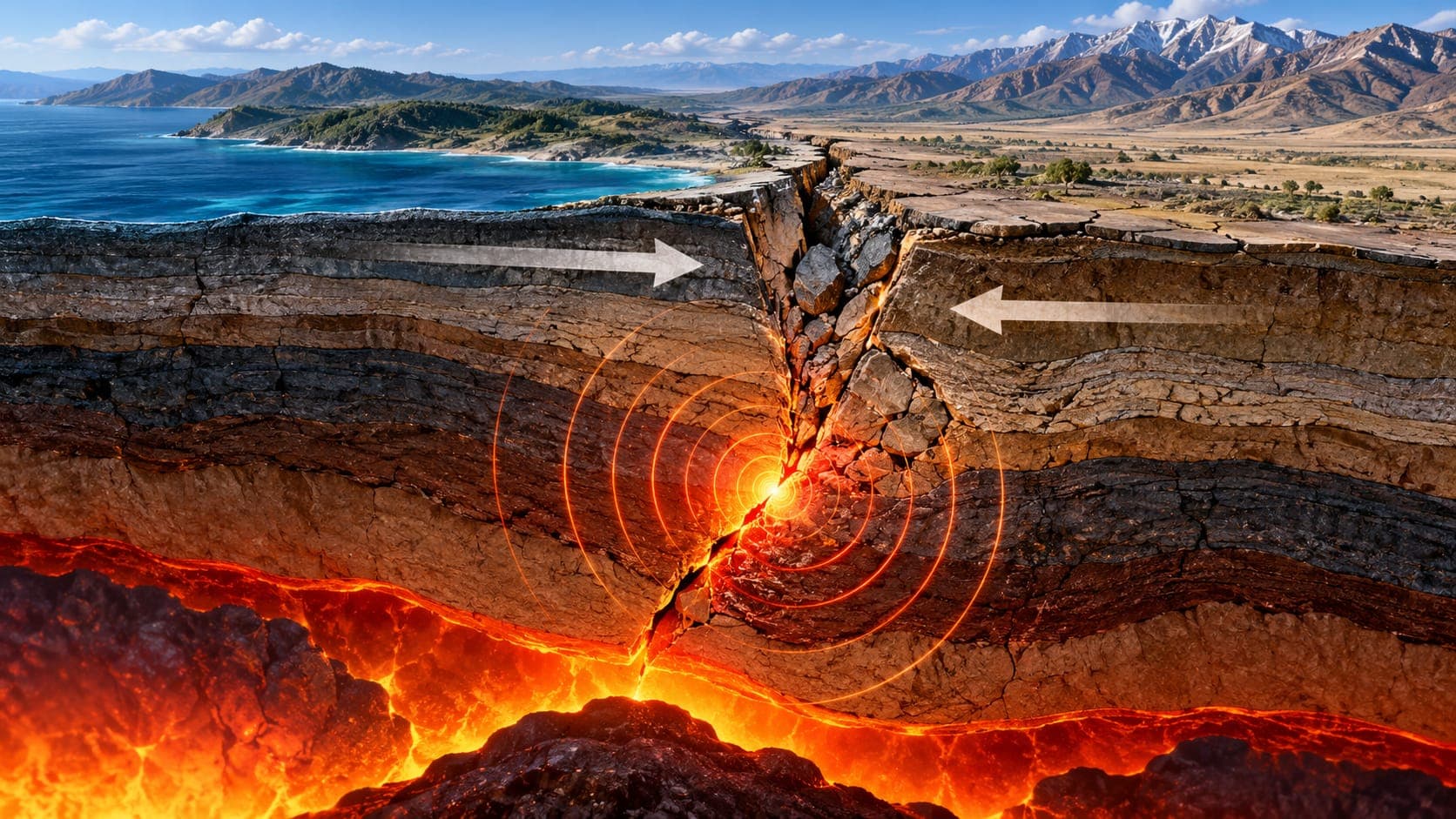
The ground under our feet feels solid and still, but the outer shell of the Earth is always moving. Most of the time that motion is far too slow to notice. Earthquakes are the moments when that slow, steady motion suddenly catches up all at once.
This article explains the main reason earthquakes happen, the idea scientists use to describe it, and the less common causes such as volcanoes and human activity.
Quick answer
Earthquakes happen because the Earth's tectonic plates keep moving, but the rocks along faults stick together because of friction. Stress builds up in the rocks over years to centuries. When the stress becomes greater than the friction holding the fault, the rocks slip suddenly and release stored energy as seismic waves, which we feel as shaking. A smaller number of earthquakes are caused by volcanic activity or by human activities such as deep wastewater injection.
The Earth's surface is always moving
The outer layer of the Earth is broken into large pieces called tectonic plates. They slide very slowly over hotter, softer rock below, usually at a few centimeters per year, about as fast as your fingernails grow. This process is called plate tectonics.
Where plates meet, they pull apart, push together or slide past each other. Those boundaries are where most of the world's earthquakes happen. For example, along the San Andreas Fault in California, the Pacific Plate moves northwest past the North American Plate at roughly two inches (about 5 centimeters) per year, according to the USGS. Our article on tectonic plates explains the plates in more detail.
Faults get stuck
A Fault is a break in the rock where the two sides can move relative to each other. If rock on both sides slid smoothly all the time, there would be few earthquakes. But rock surfaces are rough, and friction holds them in place, so many faults stay locked for long periods while the plates around them keep moving.
Because the plates keep moving while the fault stays locked, the rocks near the fault slowly bend and store energy, a bit like a spring being wound up or a ruler being bent. This stored energy is called elastic strain.
Elastic rebound: the snap that makes an earthquake
Eventually the stress on the fault becomes greater than the friction holding it. At that moment the fault slips suddenly. The bent rocks on each side spring back toward their unstrained shape, moving past each other by anything from a fraction of an inch to many feet. Scientists call this the elastic rebound theory. It was proposed by geologist Harry Fielding Reid after studying how the ground moved in the 1906 San Francisco earthquake.
The energy released by the slip travels outward through the ground as seismic waves. When those waves reach the surface, the ground shakes. After the slip, the fault locks again and the slow build-up of stress begins once more. This repeating pattern is sometimes called the earthquake cycle.
- Plates move slowly and steadily.
- A locked fault holds the rocks in place, so strain builds up.
- Stress overcomes friction and the fault slips suddenly.
- Stored energy is released as seismic waves that shake the ground.
- The fault locks again and the cycle repeats.
Why earthquakes do not happen on a schedule
If stress built up at a steady rate and faults always broke at the same level of stress, earthquakes would be perfectly regular. In reality, they are not. Faults interact with each other, rock strength varies from place to place, and one earthquake can add stress to nearby faults while relieving it on others.
That is why scientists talk about the probability of earthquakes over years or decades rather than giving exact dates. You can read more in our article on earthquake prediction today.
Other causes: volcanoes and human activity
Not every earthquake comes directly from plate motion on a major fault. Volcanoes produce earthquakes when molten rock (magma) moves underground and cracks the surrounding rock, or when pressure changes inside the volcano. These quakes are usually small, but swarms of them can be an important sign that a volcano is restless. See the volcanoes page for more.
Human activities can also trigger earthquakes. The USGS calls these induced earthquakes. The most common cause in the United States is the deep injection of wastewater, often from oil and gas production, which raises the fluid pressure in rocks and can make existing faults slip more easily. The USGS has linked a sharp rise in earthquakes in parts of the central United States, especially Oklahoma, over the past decade or so to this practice. Filling large reservoirs, mining and some geothermal projects can also cause earthquakes, though usually small ones.
| Cause | How it works | How common |
|---|---|---|
| Tectonic (plate motion) | Stress from moving plates builds on faults until they slip | By far the most common, including nearly all large quakes |
| Volcanic | Moving magma and gas crack rock beneath volcanoes | Common near active volcanoes, usually small |
| Induced (human activity) | Fluid injection, reservoirs or mining change stress on faults | Local; most are small, a few have been damaging |
Where earthquakes happen most
Because most earthquakes are caused by plate motion, they cluster along plate boundaries. The band around the Pacific Ocean, often called the Ring of Fire, has a large share of the world's earthquakes, including the biggest ones. Earthquakes also happen inside plates, far from boundaries, but less often.
Small earthquakes happen constantly around the world, many too small for anyone to feel. You can see this for yourself on the live earthquake map, which shows earthquakes reported by the USGS, or search past events in the earthquake history view.
Frequently asked questions
What is the main cause of earthquakes?
The main cause is the slow movement of tectonic plates. That movement builds stress on faults, and when the stress overcomes friction, the fault slips suddenly and releases energy as seismic waves.
Can weather or hot days cause earthquakes?
No. There is no such thing as earthquake weather. Earthquakes start miles underground, where surface temperature and weather have no meaningful effect, and they happen in all seasons and at all times of day.
Can people cause earthquakes?
Yes, in some cases. Deep wastewater injection, filling large reservoirs, mining and some geothermal operations can trigger earthquakes. Most induced earthquakes are small, but a few have been strong enough to cause damage.
Why do some places have earthquakes and others almost never do?
Places near active plate boundaries, such as California, Alaska, Japan and Chile, have much more stress building on faults. Areas in the middle of stable plates have fewer earthquakes, though moderate and occasionally large ones can still happen there.
Key takeaway
Earthquakes happen because moving plates build stress on locked faults until the rock suddenly slips and springs back, releasing energy as seismic waves. Volcanoes and some human activities cause a smaller number of earthquakes, mostly small ones.
Sources
- What is an earthquake and what causes them to happen? — U.S. Geological Survey
- Induced Earthquakes — U.S. Geological Survey
- This Dynamic Earth: The Story of Plate Tectonics — U.S. Geological Survey
- Earthquake Hazards Program — U.S. Geological Survey