Earthquake Prediction Today: What Is Really Possible?
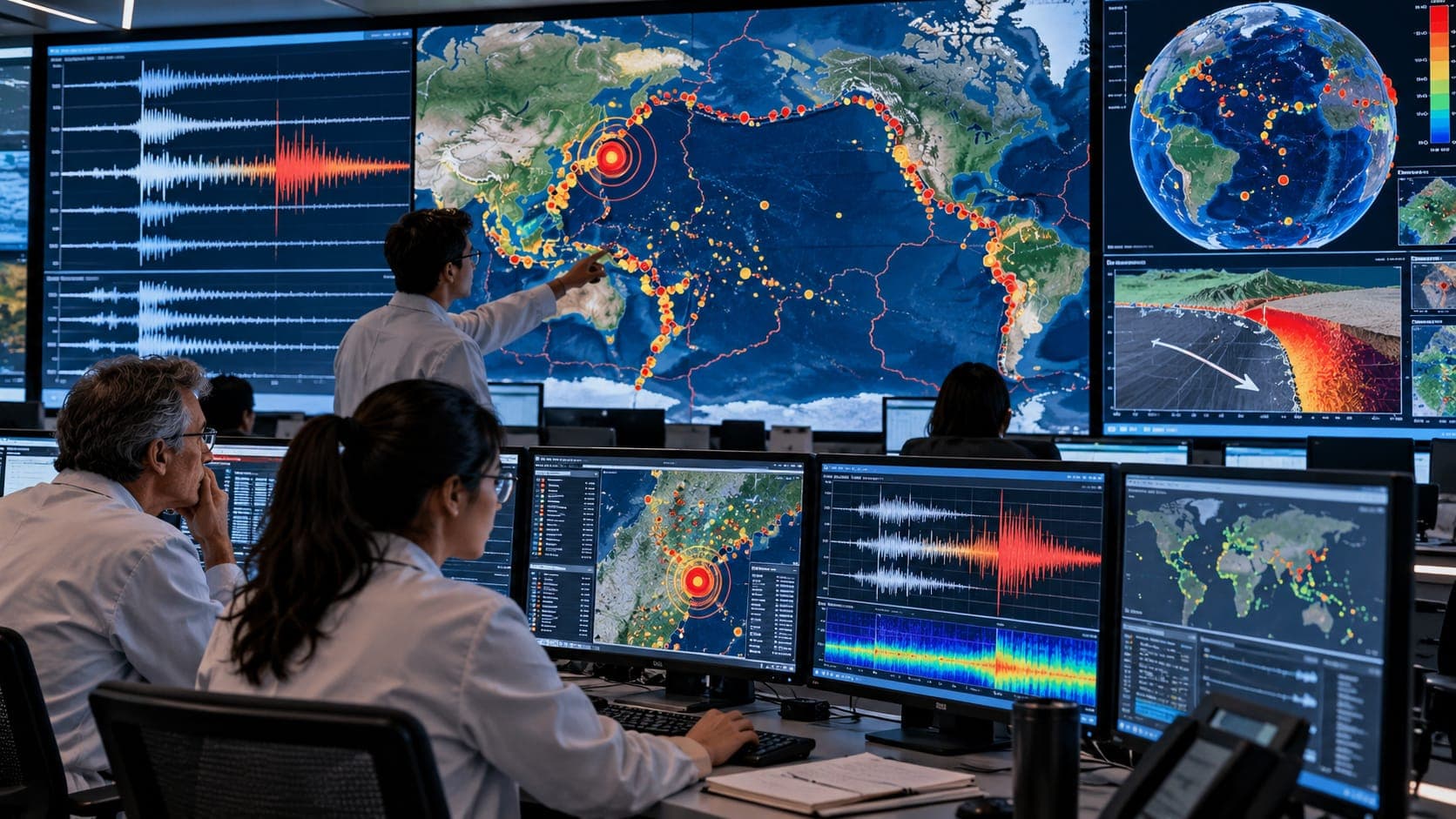
Headlines about earthquake prediction appear every few months, and social media posts regularly claim that a big quake is coming on a certain day. It is natural to wonder how much of this is real. The honest answer is that science can say a lot about where earthquakes are likely and how often they happen, but it cannot tell you the date and time of the next big one.
This article sorts out the three different things people often lump together as prediction, explains which ones work today and shows how to use each of them in everyday life.
Quick answer
Today no one can predict earthquakes in the strict sense: naming the date and time, the location and the magnitude in advance. What science can do is estimate long-term probabilities for a region, issue short-term aftershock forecasts after a large quake, and send early warnings seconds before shaking arrives once an earthquake has already started.
What counts as an earthquake prediction
The U.S. Geological Survey (USGS) uses a strict definition. A real earthquake prediction must give three things: the date and time, the location, and the magnitude. It also needs to be specific enough to check. A statement like "a big earthquake will hit California someday" is not a prediction, because it is always true and helps no one plan.
By that standard, the USGS states that neither it nor any other scientists have ever predicted a major earthquake, and that they do not expect to know how in the foreseeable future. That is a clear, official position, and it is the right starting point for judging any claim you see online.
Prediction, forecast and early warning are different things
Much of the confusion comes from mixing up three ideas that sound alike but work on very different time scales.
| Tool | What it says | Time scale | Available today? |
|---|---|---|---|
| Prediction | A specific quake at a stated time, place and size | Hours to days ahead | No |
| Forecast | The probability of quakes of a certain size in an area over a period | Days to decades | Yes |
| Early warning | Shaking from a quake that has already started is on its way | Seconds | Yes, in some regions |
What works: long-term probabilities
Scientists study fault slip rates, past earthquakes recorded in the geology, GPS measurements of the ground slowly moving, and the record of modern quakes. From these they estimate how likely strong shaking is in a region over 30 or 50 years. In the United States, the USGS National Seismic Hazard Model and California forecasts such as UCERF3 are examples.
These forecasts are the basis for building codes, insurance and emergency planning. They will not tell you about next Tuesday, but they do tell you whether earthquakes are a realistic part of life where you live. For an example, see earthquake probability in California.
What works: aftershock forecasts
Right after a large earthquake, the chance of more earthquakes nearby is much higher than normal. Aftershocks follow well-studied statistical patterns, so the USGS can estimate how many are likely over the next day, week, month and year, and the chance of one large enough to cause damage.
These forecasts are updated as the sequence unfolds. EQRadar shows official USGS aftershock forecasts for active sequences on the risk page. Our article on what aftershocks are explains the patterns behind them.
What works: early warning
Earthquake early warning does not predict anything. It detects an earthquake that has just begun, using the fast but weaker P-waves, and sends an alert before the slower, stronger S-waves and surface waves reach places farther away. The warning time is usually a few seconds to a few tens of seconds, and people very close to the Epicentre may get little or no warning.
A few seconds is enough to Drop, Cover and Hold On, slow a train or stop a surgeon's work. In the U.S. West Coast states, this system is called ShakeAlert. Read more in the earthquake early warning system.
Why true prediction is still out of reach
Earthquakes start several miles underground, where no one can measure stress directly. Faults are rough and complicated, and a small rupture can stop quickly or grow into a large one depending on conditions along the fault that we cannot see. So far, no signal has been found that reliably appears before large earthquakes and not at other times.
Many possible warning signs have been studied, including foreshocks, gas releases and animal behavior. Some show up before a few quakes, but none show up consistently enough to issue a dependable warning. The article can scientists predict earthquakes? covers the history of these attempts.
How to use what is possible
Because the timing is unknown, the useful response is the same every day: be prepared in advance and know what to do when shaking starts.
- Use long-term hazard information to decide how much to invest in securing your home and supplies.
- After a large quake nearby, check the official aftershock forecast and expect more shaking. Drop, Cover and Hold On during each aftershock.
- If you live in an area with early warning, turn on alerts on your phone and practice reacting within a second or two.
- Treat any post that names a specific date for a big quake as unreliable, no matter how confident it sounds.
Frequently asked questions
Has any earthquake ever been successfully predicted?
Not by the standard of a specific time, place and magnitude announced in advance and confirmed by a repeatable method. One evacuation before the 1975 Haicheng earthquake in China is often cited, but it relied on a burst of foreshocks, and the method failed to anticipate the far deadlier Tangshan earthquake the next year.
Is the EQRadar outlook a prediction?
No. The EQRadar outlook is a statistical probability estimate based on past earthquake rates and, after large quakes, USGS aftershock models. It describes chances, not a specific coming earthquake.
Why can scientists forecast hurricanes but not earthquakes?
Weather forecasters can watch a storm form and track it with satellites and radar. Earthquakes begin miles underground with no visible build-up that we can measure reliably, and the final moments before rupture leave no consistent signal at the surface.
Can early warning tell me an earthquake is coming tomorrow?
No. Early warning only works after an earthquake has begun. It gives seconds of notice that shaking is on its way, not hours or days.
Key takeaway
No one can predict the date, place and size of a coming earthquake. Long-term forecasts, aftershock forecasts and early warning are real, useful tools, and together with everyday preparedness they are the best protection available.
Sources
- Can you predict earthquakes? — U.S. Geological Survey
- Aftershock Forecast — U.S. Geological Survey
- Earthquake Early Warning Overview — U.S. Geological Survey
- Earthquakes — Ready.gov (U.S. Department of Homeland Security)