What Are Tectonic Plates?
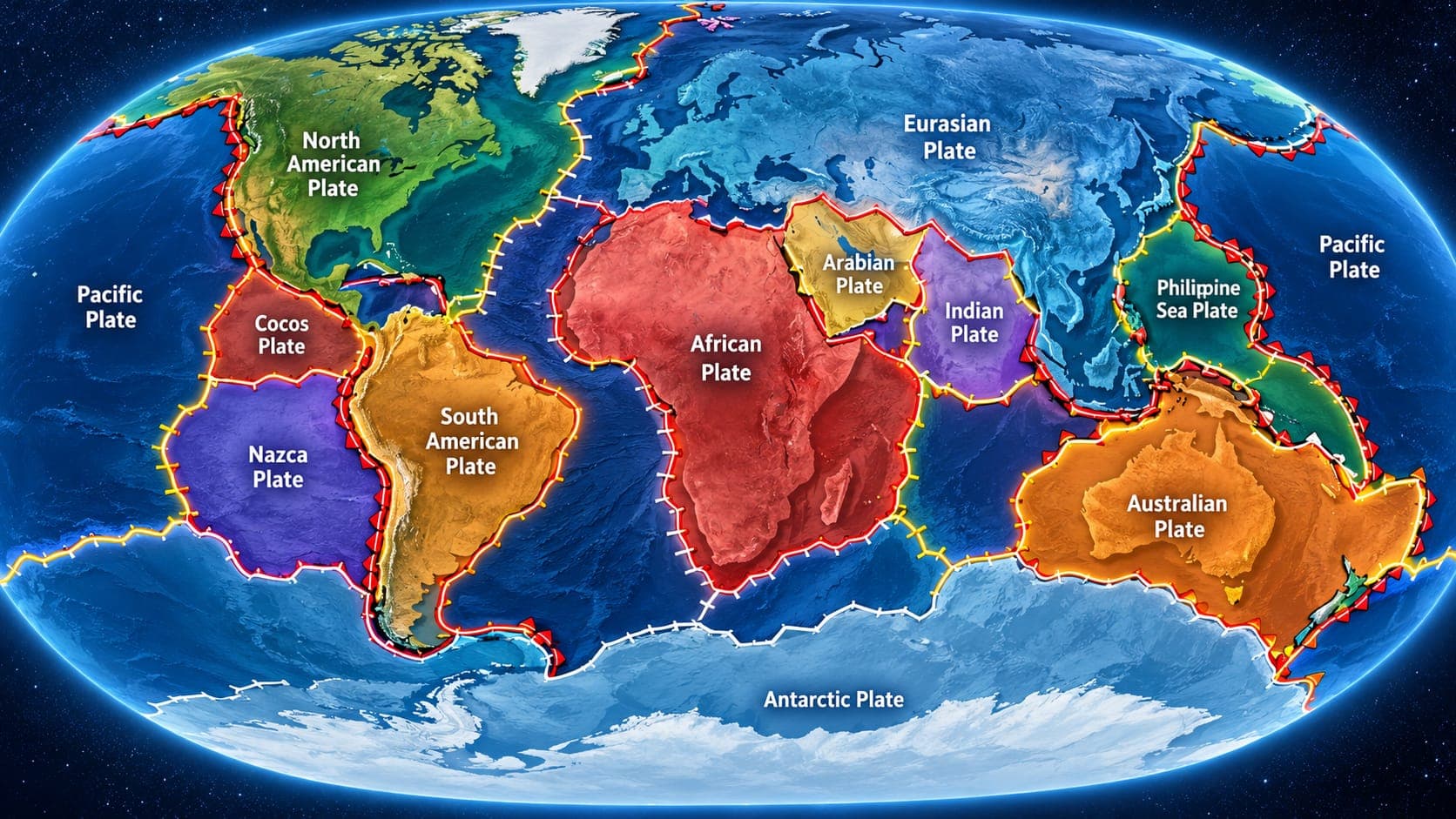
Earth's surface looks fixed on a map, but the continents and ocean floors are carried along on giant slabs of rock that move a little every year. These slabs are called tectonic plates, and their motion explains where most earthquakes, volcanoes and mountain ranges are found.
This article explains what plates are made of, how many there are, how they move and what happens at the different kinds of boundaries between them.
Quick answer
Tectonic plates are huge, rigid pieces of Earth's outer shell, called the lithosphere, which includes the crust and the top of the mantle. There are seven or eight major plates and many smaller ones. They move slowly over a hotter, softer layer called the asthenosphere, typically a few centimeters per year. Where plates pull apart, collide or slide past each other, they create most of the world's earthquakes and volcanoes.
Earth's layers: where plates fit in
Earth is built in layers. At the center is the iron-rich core. Around it is the thick mantle, made of hot rock. On top is the thin crust, the layer we live on. Oceanic crust under the sea floor is thinner and denser than the continental crust that makes up the continents.
For understanding plates, a different division is more useful. The lithosphere is the cold, rigid outer layer: the crust plus the uppermost mantle. It is often around 100 kilometers thick, thinner under young ocean floor and thicker under old continents. Beneath it lies the asthenosphere, a hotter part of the mantle that is solid but weak enough to flow very slowly over long periods. The lithosphere is broken into plates that move over the asthenosphere.
The major plates
Geologists generally recognize seven or eight major plates, plus many medium and small ones. Plates do not match continents: most carry both continental and oceanic crust. The North American Plate, for example, includes most of North America, part of Siberia and the western half of the North Atlantic Ocean floor.
- Pacific Plate, the largest, mostly beneath the Pacific Ocean
- North American Plate
- South American Plate
- Eurasian Plate
- African Plate
- Antarctic Plate
- Indo-Australian Plate (often split into the Indian and Australian plates)
- Smaller plates include the Nazca, Cocos, Philippine Sea, Arabian, Caribbean and Juan de Fuca plates
How fast do plates move?
Plates move at a few centimeters per year, about the speed at which fingernails grow. Some move faster, up to roughly 10 centimeters or more per year in parts of the Pacific, while others move only a centimeter or two.
That sounds tiny, but it adds up. Over a million years, a plate moving 5 centimeters per year travels about 50 kilometers. Over hundreds of millions of years, plate motion has assembled and broken apart whole supercontinents, including Pangaea. Today, scientists measure plate motion directly using GPS and other satellite techniques.
Why plates move
Plates move because Earth is slowly losing heat from its interior. Heat keeps the mantle churning very slowly, and the plates are part of that system. A major driving force is slab pull: old, cold ocean plate is dense, and where it sinks into the mantle at a Subduction zone, it drags the rest of the plate behind it. At mid-ocean ridges, new hot plate forms and slides away from the higher ridge, which also helps push plates along.
Scientists still study exactly how much each force contributes, but the overall picture of plate tectonics is very well established.
Three kinds of plate boundaries
Most of the action happens at the edges of plates. There are three main types of boundaries, each with its own kinds of earthquakes and landforms.
| Boundary | Motion | What forms there | Example |
|---|---|---|---|
| Divergent | Plates move apart | Mid-ocean ridges, rift valleys, new crust; mostly small to moderate quakes | Mid-Atlantic Ridge (Iceland), East African Rift |
| Convergent | Plates move toward each other | Subduction zones, deep trenches, volcanic arcs, mountain ranges; the largest and deepest quakes | Japan, Chile, Cascadia, Himalayas |
| Transform | Plates slide past each other sideways | Long strike-slip faults; shallow, sometimes large quakes | San Andreas Fault, California |
What happens when plates collide
Convergent boundaries come in different forms. When an ocean plate meets a continental plate, the denser ocean plate sinks beneath it. This creates a deep ocean trench, a chain of volcanoes on the overriding plate, and the potential for very large megathrust earthquakes. The Cascadia Subduction Zone off Oregon and Washington is an example.
When two continents collide, neither sinks easily, so the crust crumples and thickens. The collision of India with Asia has built the Himalayas and the Tibetan Plateau and causes large earthquakes across the region, such as the 2015 Nepal earthquake.
Plates and earthquakes
If you look at a map of earthquakes, the plate boundaries stand out as bright lines of activity. The ring of boundaries around the Pacific Ocean, often called the Ring of Fire, is the most active. Earthquakes also happen inside plates, but less often.
You can see this pattern on the live earthquake map, and the 3D depth explorer shows how earthquakes get deeper as they follow sinking plates down into the mantle. For an interactive explanation, try the lesson on how plates move.
Frequently asked questions
How many tectonic plates are there?
There are seven or eight major plates, depending on whether the Indian and Australian plates are counted separately, plus dozens of smaller plates and microplates. The exact count varies between sources because some small plates are still being studied.
Can we feel tectonic plates moving?
No. The steady motion of a few centimeters per year is far too slow to feel. What we feel are earthquakes, when stress built up by that motion is released suddenly on a fault.
What plate is the United States on?
Most of the United States is on the North American Plate. A thin strip of coastal California west of the San Andreas Fault system, including Los Angeles and San Diego, is on the Pacific Plate, and Hawaii sits in the middle of the Pacific Plate.
Will the continents keep moving?
Yes. Plate motion has been going on for hundreds of millions of years and continues today. Over many millions of years, oceans will open and close and continents will change position, but the change within a human lifetime is only a few meters at most.
Key takeaway
Tectonic plates are rigid slabs of Earth's outer shell that move a few centimeters per year over softer mantle rock. Where they pull apart, collide or slide past each other, they build mountains and volcanoes and produce most of the world's earthquakes.
Sources
- This Dynamic Earth: The Story of Plate Tectonics — U.S. Geological Survey
- What is an earthquake and what causes them to happen? — U.S. Geological Survey
- Earthquake Hazards Program — U.S. Geological Survey