Types of Earthquakes
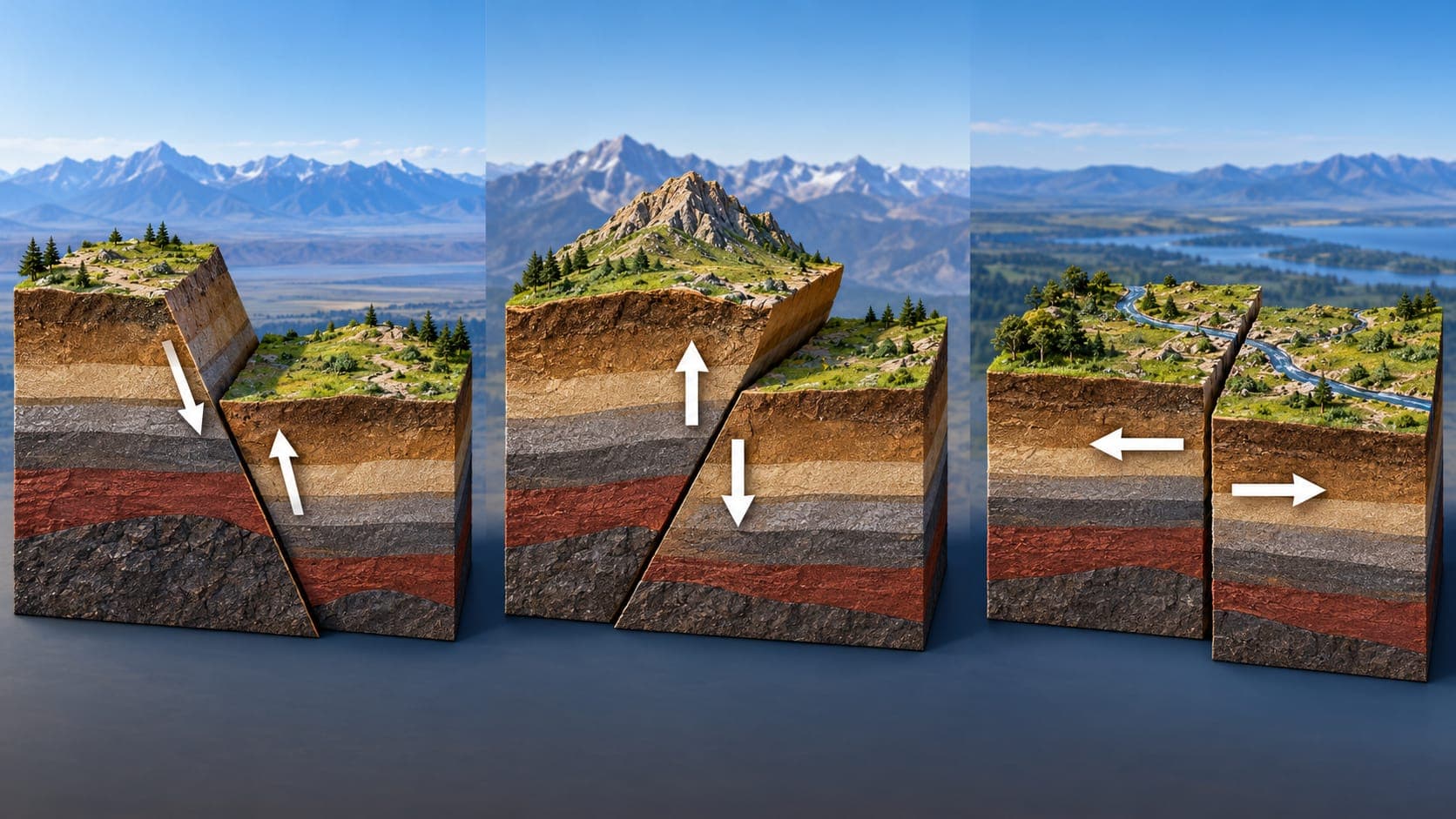
Not all earthquakes are alike. Scientists group them in two main ways: by how the rock moves along the fault, and by the geological setting where they happen. Knowing the type helps explain why some earthquakes cause tsunamis, why some are felt over huge areas, and why some regions face larger earthquakes than others.
This guide covers both ways of sorting earthquakes, with simple descriptions and real-world examples.
Quick answer
By fault motion, earthquakes are strike-slip (blocks slide past each other sideways), normal (the crust is pulled apart and one block drops down) or reverse/thrust (the crust is squeezed and one block is pushed up over the other). By setting, they include interplate quakes at plate boundaries, intraplate quakes inside plates, subduction megathrust quakes, deep quakes within sinking plates, volcanic quakes and induced quakes caused by human activity.
Sorting earthquakes by fault motion
Every tectonic earthquake is slip on a Fault. Geologists describe the slip by which way the two blocks of rock move relative to each other. There are three basic styles, and many real earthquakes are a mix of two of them.
| Type | Force on the crust | How the blocks move | Example |
|---|---|---|---|
| Strike-slip | Sideways shearing | Blocks slide horizontally past each other | San Andreas Fault, California |
| Normal | Stretching (pulling apart) | Upper block slides down the fault | Basin and Range region, Nevada and Utah |
| Reverse / thrust | Squeezing (compression) | Upper block is pushed up and over; thrust faults are low-angle reverse faults | 1994 Northridge earthquake, California; subduction zones |
Strike-slip earthquakes
On a strike-slip fault, the fault plane is usually close to vertical and the two sides move horizontally. If you stand on one side and the other side moves to your right, it is called right-lateral; if it moves to your left, it is left-lateral. The San Andreas Fault is a right-lateral strike-slip fault.
Strike-slip earthquakes can be very damaging on land because they are often shallow and can rupture long stretches of fault. Because they move the sea floor mostly sideways rather than up or down, they generally do not cause large tsunamis.
Normal and reverse (thrust) earthquakes
Normal faults form where the crust is being stretched, such as in rift valleys and across much of Nevada. One block slides down relative to the other, and over millions of years this can create mountain ranges separated by valleys.
Reverse faults form where the crust is being squeezed, so one block is pushed up over the other. When the fault is at a shallow angle, it is called a thrust fault. Thrust faults build mountain ranges such as the Himalayas. Thrust earthquakes under the sea can lift or drop the sea floor suddenly, which is why the largest ones can generate tsunamis.
Sorting earthquakes by setting
The second way to classify earthquakes is by where they happen in relation to tectonic plates, and what is driving them. This view explains much about how big and how deep earthquakes can be in a given region.
| Type | Where it happens | Typical features |
|---|---|---|
| Interplate | Along the boundary between two plates | Most of the world's earthquakes; includes the largest |
| Subduction megathrust | On the boundary where one plate dives under another | Can reach magnitude 9; can cause major tsunamis |
| Intraslab (intermediate and deep) | Inside the sinking plate, from about 70 km to about 700 km down | Felt over wide areas; deep ones rarely cause much damage |
| Intraplate | Inside a plate, away from boundaries | Less frequent; can surprise areas with little recent activity |
| Volcanic | Beneath and around active volcanoes | Usually small; often occur in swarms |
| Induced | Near human activities such as deep fluid injection | Usually small; some have caused damage |
Megathrust and deep earthquakes
At a Subduction zone, an ocean plate slides beneath another plate. The contact between them, the megathrust, can stay locked over a very large area. When it slips, the result can be the biggest earthquakes on Earth, such as the 1960 Chile earthquake (about magnitude 9.5), the 1964 Alaska earthquake (about 9.2) and the 2011 Tohoku, Japan earthquake (about 9.0–9.1). The Cascadia Subduction Zone off the U.S. Pacific Northwest is capable of this kind of earthquake.
As the sinking plate descends into the mantle, it continues to produce earthquakes inside the slab itself. These intraslab quakes can be intermediate depth (roughly 70–300 km) or deep (roughly 300–700 km). Because the waves lose strength on the long trip to the surface, deep earthquakes usually cause less damage than shallow quakes of the same magnitude. See how deep earthquakes can occur.
Intraplate earthquakes
Some earthquakes happen far from any plate boundary. The New Madrid Seismic Zone in the central United States produced a series of large earthquakes in 1811–1812, and the 2011 magnitude 5.8 earthquake in central Virginia was felt across much of the eastern United States.
Intraplate earthquakes are less frequent, but shaking travels farther in the older, colder rock of the eastern and central United States than in the West, so a moderate quake there can be felt over a much larger area.
Volcanic and induced earthquakes
Volcanic earthquakes are caused by magma and gas moving underground and by stress changes in and around a volcano. Monitoring these quakes is one of the main ways scientists track volcanic unrest; see the volcanoes page.
Induced earthquakes are triggered by human activities. In the United States, the USGS has found that deep injection of wastewater is the main cause of the large increase in earthquakes in parts of the central U.S. since about 2009, especially in Oklahoma. Reservoir filling, mining and geothermal projects can also trigger quakes.
Frequently asked questions
Which type of earthquake is the most dangerous?
It depends on the setting. Subduction megathrust earthquakes can be the largest and can cause tsunamis, but shallow strike-slip or thrust earthquakes close to cities can also be very destructive. Distance, depth, soil and building quality all matter.
What type of fault is the San Andreas?
The San Andreas is a right-lateral strike-slip fault. The Pacific Plate on the west side moves northwest relative to the North American Plate on the east side.
Which types of earthquakes cause tsunamis?
Mostly large, shallow earthquakes under the sea that move the sea floor up or down, usually thrust earthquakes on subduction zones. Strike-slip earthquakes and deep earthquakes rarely cause large tsunamis, though landslides triggered by any strong quake can.
How do scientists know what type of fault moved?
They analyze the pattern of seismic waves recorded around the world to calculate a focal mechanism, which shows the fault orientation and the direction of slip. Field mapping of any surface rupture adds more detail.
Key takeaway
Earthquakes can be classified by how the fault moves (strike-slip, normal or reverse/thrust) and by where they happen (plate boundaries, subduction zones, deep slabs, plate interiors, volcanoes or human activity). The type helps explain an earthquake's size, depth and tsunami potential.
Sources
- Faults — U.S. Geological Survey
- Determining the Depth of an Earthquake — U.S. Geological Survey
- Induced Earthquakes — U.S. Geological Survey
- This Dynamic Earth: The Story of Plate Tectonics — U.S. Geological Survey