Why Are Some Earthquakes Stronger Than Others?
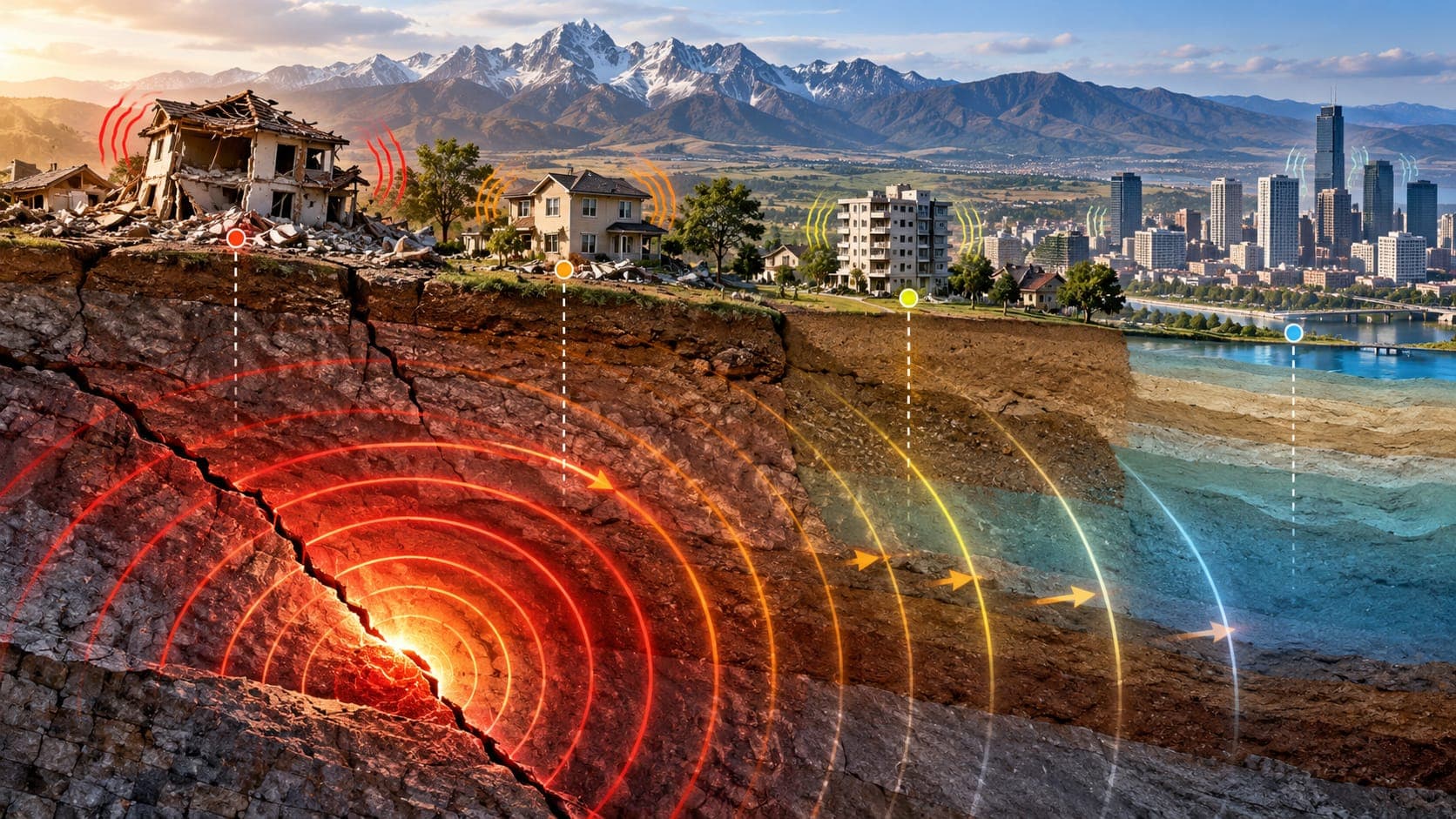
Some earthquakes pass almost unnoticed, while others reshape coastlines. And sometimes a moderate earthquake causes more damage than a much bigger one elsewhere. Both puzzles have clear explanations.
There are really two questions here. First, why do some earthquakes release far more energy than others? Second, why does the shaking people feel vary so much, even for earthquakes of the same size? This article answers both.
Quick answer
An earthquake's size, or magnitude, depends mainly on how large an area of fault slips and how far it slips. Long faults that can rupture over large areas, such as subduction zones, can produce the biggest earthquakes. How strong the shaking feels in a given place depends on more than magnitude: distance from the rupture, depth, local soil, the direction the rupture traveled and the type of building you are in all make a big difference.
Size comes from rupture area and slip
Seismologists measure earthquake size with moment magnitude. It is based on three things: the area of the fault that slipped, the average distance the two sides moved, and the stiffness of the rock. Bigger area and more slip mean a bigger earthquake.
This explains the enormous range of earthquake sizes. A magnitude 4 might slip a few centimeters on a patch of fault around a kilometer across. A magnitude 7 might rupture a fault for tens of kilometers with a few meters of slip. The largest earthquakes, around magnitude 9, can rupture hundreds of kilometers of a subduction zone, with slip of tens of meters in places.
| Magnitude | Typical rupture length | Energy compared with magnitude 5 |
|---|---|---|
| About 5 | A few kilometers | 1× |
| About 7 | Tens of kilometers | About 1,000× |
| About 9 | Hundreds of kilometers or more | About 1,000,000× |
Why some places get bigger earthquakes
A fault can only produce an earthquake as large as the area that can slip at once. That is why the world's largest earthquakes happen on subduction zone megathrusts. These gently sloping plate boundaries are very long and very wide, so a single rupture can involve an enormous area. The 1960 Chile (about magnitude 9.5), 1964 Alaska (about 9.2), 2004 Sumatra (about 9.1) and 2011 Japan (about 9.0–9.1) earthquakes all happened on subduction zones.
Strike-slip faults like the San Andreas are nearly vertical and extend only some 15 to 20 kilometers deep, which limits their width. They can still produce very large earthquakes, roughly magnitude 7 to 8, because they can be very long. The 1906 San Francisco earthquake was about magnitude 7.9.
How much stress the fault has stored and how strong the rock is also matter. A fault that has stayed locked for a long time while the plates kept moving may have built up enough strain for a large rupture. Whether a rupture stops early or keeps going depends on details of the fault, such as bends, gaps and how stress is distributed along it, which is part of why exact predictions are not possible.
Big magnitude does not always mean strong shaking
Magnitude describes the earthquake at its source. What people feel is Intensity, the strength of shaking at their location. Several factors affect intensity, which is why two earthquakes of the same magnitude can have very different effects. For the basics, see magnitude vs intensity.
- Distance: shaking weakens as waves spread out, so people near the rupture feel much more than people far away.
- Depth: a shallow earthquake puts the source close to the surface; a deep one is far from everyone.
- Local ground: soft soils, river deposits and filled land can amplify shaking compared with solid rock, and saturated sandy soils can suffer liquefaction.
- Directivity: when a rupture travels mainly in one direction, shaking tends to be stronger in that direction.
- Basins: deep sediment-filled valleys can trap and prolong shaking.
- Buildings: building height, design, age and construction quality strongly affect both how shaking feels and how much damage occurs.
Depth and distance in practice
A shallow magnitude 6 directly beneath a town can cause heavier shaking there than a magnitude 8 that is very deep or far offshore. Deep earthquakes, which happen inside sinking plates hundreds of kilometers down, are often felt over large areas but rarely cause serious damage. Read more in how deep earthquakes can occur.
Soil, basins and a famous example
Local geology can matter as much as distance. In the 1985 Mexico City earthquake, the epicenter was off the Pacific coast, roughly 350 kilometers away, yet Mexico City suffered severe damage. Much of the city is built on soft sediments of an old lake bed, which amplified the shaking, especially for buildings of certain heights.
Closer to home, filled land along parts of San Francisco Bay shook strongly and suffered liquefaction in the 1989 Loma Prieta earthquake, while nearby sites on rock fared better. These lessons are built into today's hazard maps and building codes.
How to see what shaking an earthquake caused
For significant earthquakes, the USGS publishes a ShakeMap, which estimates shaking intensity across the affected area using instruments, public reports and models. These maps often show irregular shapes rather than neat circles, reflecting differences in soil, depth and rupture direction. You can browse them on the shaking maps page and find recent earthquakes on the live map.
Because shaking depends so much on where you are and the building you are in, the same safety steps apply wherever you live: secure heavy objects, know how to Drop, Cover and Hold On, and have a plan. See how to prepare for an earthquake.
Frequently asked questions
What makes an earthquake bigger in magnitude?
A larger area of fault slipping, and more slip on that area. Long, wide faults such as subduction zone megathrusts can host the largest ruptures.
Why did a smaller earthquake cause more damage than a bigger one?
Damage depends on shaking intensity and building quality, not magnitude alone. A smaller earthquake that is shallow and close to a city, especially one on soft ground or with vulnerable buildings, can do more harm than a larger one that is deep or far away.
Can the San Andreas Fault produce a magnitude 9 earthquake?
Scientists consider this very unlikely. The San Andreas is a strike-slip fault that is long but relatively narrow in depth, so it does not have enough fault area for a magnitude 9. Its largest earthquakes are expected to be roughly in the magnitude 7 to 8 range.
Does a longer earthquake mean a bigger one?
Generally, yes. Larger earthquakes rupture longer stretches of fault, which takes more time, so they shake for longer. Shaking at a given place can also last longer on soft soils and in sediment-filled basins.
Key takeaway
Magnitude depends on how much fault area slips and how far, which is why long subduction zones host the largest earthquakes. The shaking you feel also depends on distance, depth, local soil, rupture direction and your building, so a smaller nearby quake can be more damaging than a larger distant one.
Sources
- Earthquake Magnitude, Energy Release, and Shaking Intensity — U.S. Geological Survey
- Moment magnitude, Richter scale - what are the different magnitude scales, and why are there so many? — U.S. Geological Survey
- ShakeMap — U.S. Geological Survey
- Earthquake Hazards Program — U.S. Geological Survey