How Powerful Is a 7.0 Earthquake?
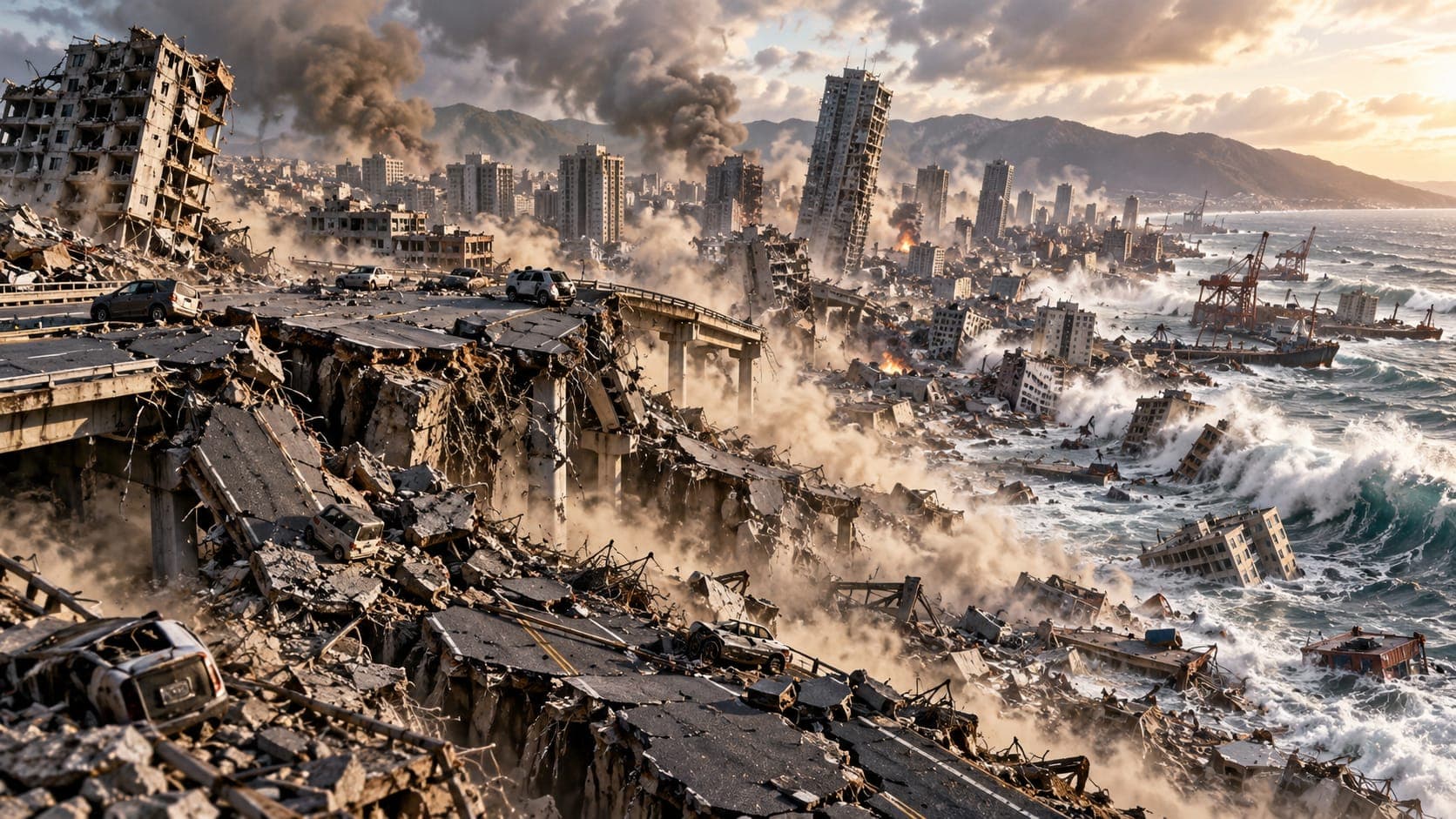
A magnitude 7.0 is a major earthquake. It is the size at which an earthquake can cause serious damage over a large region, and several of the most tragic disasters of recent decades were around this size. Yet 7.0 is far from the largest possible: the biggest recorded earthquakes are more than 9.
To understand how powerful a 7.0 really is, it helps to understand how the magnitude scale works. This article explains the scale step by step, then looks at what a 7.0 typically does and why the outcome varies so much from place to place.
Quick answer
A 7.0 earthquake releases roughly 1,000 times more energy than a 5.0 and about 32 times more than a 6.0. Fault slip can extend for several tens of kilometers, and strong shaking can affect a wide area. In populated areas a shallow 7.0 can cause serious damage and loss of life, but the impact depends heavily on depth, distance, soil and building quality. USGS estimates roughly 15 earthquakes of magnitude 7 to 7.9 happen worldwide each year.
How the magnitude scale works
Magnitude numbers are logarithmic, not linear. That means each whole step represents a multiplication, not an addition. Two separate things grow with each step, and it is easy to mix them up.
First, the amplitude of ground motion recorded on a seismograph goes up about 10 times for each whole step. Second, the energy released goes up about 32 times for each whole step. Because 32 multiplied by 32 is roughly 1,000, two steps mean about 1,000 times more energy. Half a step, such as from 6.5 to 7.0, is still a bit more than five times more energy.
Modern agencies such as the U.S. Geological Survey mainly report moment magnitude, which is based on the size of the fault area that slipped and how far it moved. The old Richter scale used a similar logarithmic idea but did not work well for very large earthquakes. Our article on the Richter scale tells that story.
| Magnitude | Common description | Energy compared with a 5.0 |
|---|---|---|
| 5.0 | Moderate | 1 times |
| 6.0 | Strong | About 32 times |
| 7.0 | Major | About 1,000 times |
| 8.0 | Great | About 32,000 times |
| 9.0 | Great | About 1,000,000 times |
The size of the fault that slips
Bigger earthquakes come from bigger ruptures. In a 7.0, the slipping part of the Fault commonly stretches for several tens of kilometers, sometimes on the order of 50 to 100 km, and the two sides can move a few meters past each other. The rupture itself can take tens of seconds to spread along the fault.
Because the source is so large, strong shaking is not limited to one town. A shallow 7.0 can produce damaging shaking across a region, trigger many landslides in hilly terrain and cause Liquefaction in soft, wet soils. If it happens under the sea on a Subduction zone, it may also cause a Tsunami.
Typical effects of a shallow 7.0
On the Modified Mercalli Intensity scale, a shallow 7.0 commonly produces intensities of VIII to IX, and sometimes higher, near the rupture. Reports at these levels describe:
- Shaking so strong that people cannot stand or walk.
- Heavy damage to vulnerable buildings, including partial or total collapse.
- Damage to some well-built structures, especially on soft ground.
- Broken water, gas and power lines, which can lead to fires and long outages.
- Landslides, rockfalls and ground cracking.
- Shaking felt hundreds of kilometers away.
Why some 7.0 earthquakes are far deadlier than others
The magnitude alone does not decide the human toll. The 2010 Haiti earthquake, a magnitude 7.0, was shallow and struck close to the densely populated capital, Port-au-Prince, where many buildings were not designed to resist earthquakes. It was devastating, with deaths estimated at more than 100,000, though figures differ widely between sources.
By contrast, some much larger earthquakes have caused far fewer deaths. The 2010 Chile earthquake of magnitude 8.8 released roughly 500 times more energy than the Haiti earthquake, yet deaths were in the hundreds, in part because Chile enforces strict building codes. A deep 7.0 hundreds of kilometers below the surface may cause little damage at all. Depth, distance from cities, ground conditions, construction quality and time of day all matter. See our article on why some earthquakes are stronger than others.
How often 7.0 earthquakes happen
According to USGS estimates based on records since 1900, roughly 15 earthquakes of magnitude 7.0 to 7.9 happen worldwide in a typical year, and about 1 of magnitude 8 or larger. Some years have noticeably more or fewer, which is normal natural variation rather than a sign that earthquakes are increasing.
Most major earthquakes occur along plate boundaries, especially around the Pacific Ring of Fire. You can see recent large events on the EQRadar live map and search past ones on the history page.
Staying safe in a major earthquake
When strong shaking begins, Drop, Cover and Hold On until it stops. If you are on a coast and feel strong or long-lasting shaking, move to high ground or inland as soon as you can walk safely, without waiting for an official warning. Expect aftershocks, some of which can be large enough to cause further damage after a 7.0.
Frequently asked questions
Is a 7.0 twice as powerful as a 3.5?
No, it is enormously more powerful. Each whole step is about 32 times more energy, so 3.5 magnitude steps add up to roughly 180,000 times more energy.
How much stronger is a 7.0 than a 6.0?
A 7.0 produces about 10 times larger ground motion amplitude on a seismograph and releases roughly 32 times more energy than a 6.0. It also ruptures a much larger area of fault, so strong shaking covers a bigger region.
Can a building survive a 7.0 earthquake?
Yes. Buildings designed and constructed to modern seismic codes are intended to protect the people inside, even if the building is damaged. The most serious losses usually involve older or poorly built structures.
Does a 7.0 always cause a tsunami?
No. A tsunami needs significant vertical movement of the sea floor. A 7.0 on land or on a mainly sideways-moving fault is unlikely to cause one. Official tsunami alerts are shown on our tsunami page.
Key takeaway
Each whole magnitude step means about 10 times more ground motion and about 32 times more energy, so a 7.0 releases roughly 1,000 times more energy than a 5.0. Its impact ranges from minor to catastrophic depending on depth, location and how well buildings are built.
Sources
- Earthquake Magnitude, Energy Release, and Shaking Intensity — U.S. Geological Survey
- Lists, Maps, and Statistics — U.S. Geological Survey
- Earthquake Hazards Program — U.S. Geological Survey