How Deep Can Earthquakes Occur?
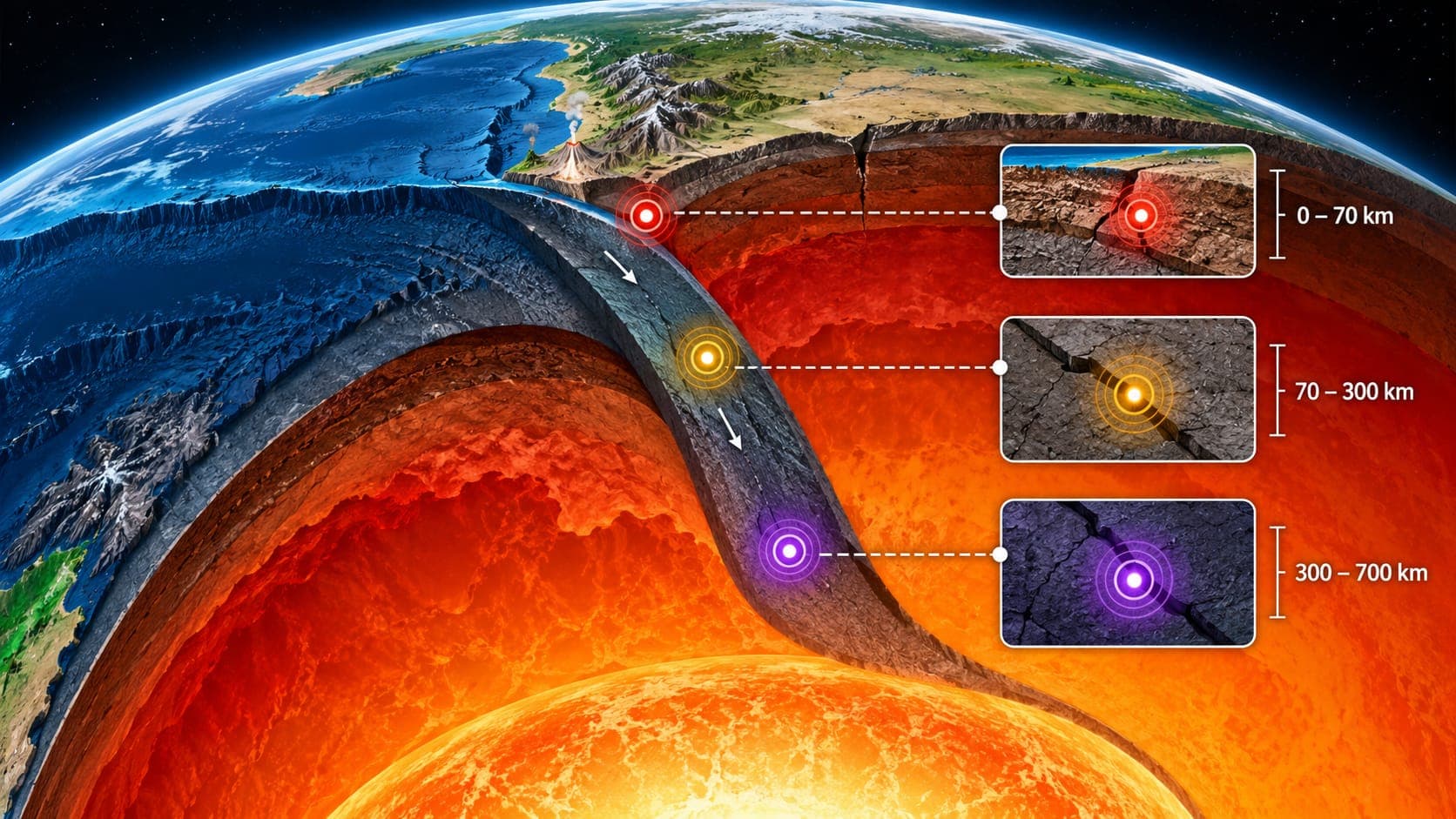
Most earthquakes start only a few kilometers beneath our feet, but a small number begin hundreds of kilometers down, deep inside the Earth's mantle. Depth is listed for every earthquake in USGS reports, and it has a big effect on how strongly the shaking is felt.
This article explains how deep earthquakes can be, why they happen at those depths, how depth is measured, and what it means for shaking at the surface.
Quick answer
Earthquakes can occur from near the surface down to about 700 kilometers (about 435 miles) deep. Seismologists group them as shallow (0–70 km), intermediate (70–300 km) and deep (300–700 km). Most earthquakes, including most damaging ones, are shallow. All earthquakes deeper than about 70 km happen inside slabs of ocean plate sinking into the mantle at subduction zones. Below about 700 km, earthquakes are not observed.
Shallow, intermediate and deep earthquakes
The USGS divides earthquakes into three depth ranges based on the depth of the Hypocentre (focus), where the rupture begins. This depth is called the focal depth.
| Class | Depth range | Where they occur | Typical effects |
|---|---|---|---|
| Shallow | 0–70 km (0–43 miles) | Crust and uppermost mantle, at all kinds of plate boundaries and within plates | Most earthquakes; strongest shaking near the epicenter |
| Intermediate | 70–300 km (43–186 miles) | Inside sinking ocean plates at subduction zones | Felt over wide areas; shaking usually weaker for their size |
| Deep | 300–700 km (186–435 miles) | Deep in sinking plates, mainly around the western Pacific and South America | Rarely damaging, though large ones can be felt far away |
Most earthquakes are shallow
The great majority of earthquakes are shallow. In places like California, most earthquakes start within roughly the top 20 kilometers of the crust. Below that, the rock is hot enough that it tends to flow slowly rather than break suddenly, so ordinary faults stop producing earthquakes.
Shallow earthquakes are also the most damaging, because the waves have only a short distance to travel to the surface. Large subduction-zone megathrust earthquakes, the biggest on Earth, also start at shallow depths, typically within a few tens of kilometers.
Why some earthquakes happen so deep
If the deep Earth is hot and soft, how can earthquakes happen hundreds of kilometers down? The answer is Subduction. At subduction zones, cold, rigid ocean plate sinks into the mantle. Because it heats up slowly, the slab stays cold and brittle enough to produce earthquakes far deeper than the surrounding mantle could.
Earthquakes inside the slab trace its path into the mantle. Plotted in cross-section, they form a sloping band called a Wadati–Benioff zone, which shows the shape of the sinking plate. You can see this pattern for yourself in the 3D depth explorer.
Exactly how earthquakes happen at the greatest depths is still studied, because the high pressure there should make ordinary frictional sliding difficult. Scientists have proposed several mechanisms, such as mineral changes inside the slab, but there is no single agreed explanation yet.
The deepest earthquakes
Earthquakes are recorded down to roughly 700 kilometers, near the boundary between the upper and lower mantle. Below that depth, earthquakes are not observed.
Deep earthquakes can be large. Two well-known examples are the 1994 Bolivia earthquake, about magnitude 8.2 at a depth of roughly 630 km, and the 2013 Sea of Okhotsk earthquake, about magnitude 8.3 at a depth of roughly 600 km. Both were felt at great distances, but because of their depth they caused relatively little damage for their size.
Why depth matters for shaking
Depth changes how an earthquake is felt in a few important ways.
- Distance: a deep earthquake is far from everyone at the surface, so the waves weaken before they arrive. A shallow earthquake of the same magnitude usually causes much stronger shaking close to the epicenter.
- Spread: shaking from deeper earthquakes is often more evenly spread over a wide area, so they may be felt across a larger region but less intensely.
- Aftershocks: shallow earthquakes usually produce many more aftershocks than deep ones of similar size.
- Tsunamis: tsunamis are generated mainly by large, shallow undersea earthquakes that move the sea floor. Deep earthquakes rarely cause them.
How depth is measured
Depth is found along with the epicenter by comparing wave arrival times at many seismometers. It is usually less certain than the epicenter, especially when no station is close to the earthquake. For distant earthquakes, seismologists also look for a wave that reflects off the Earth's surface above the source, called pP, which arrives a short time after the direct P wave; the gap between them depends on the depth.
When depth cannot be resolved, networks sometimes assign a fixed default value, such as 10 km. If you see many earthquakes listed at exactly the same round depth, that is often why. Learn more in the lesson on why depth matters.
Frequently asked questions
What is the deepest earthquake ever recorded?
Earthquakes have been recorded down to about 700 kilometers below the surface, inside sinking plates beneath places such as the western Pacific. Exact depths for the very deepest events vary between studies, so scientists usually describe the limit as roughly 700 km.
Are deep earthquakes more dangerous than shallow ones?
Usually not. For the same magnitude, shallow earthquakes typically cause much stronger shaking near the epicenter. Deep earthquakes can still be felt over very large areas.
Why do so many earthquakes show a depth of 10 km?
When the data cannot pin down the depth, especially for distant or poorly recorded events, a default depth such as 10 km is often assigned. It is a placeholder, not a precise measurement.
Can a deep earthquake cause a tsunami?
Rarely. Tsunamis are mainly caused by large, shallow earthquakes that suddenly move the sea floor. Deep earthquakes do not move the sea floor much.
Key takeaway
Earthquakes occur from near the surface to about 700 km deep. Most are shallow and these cause most damage. Intermediate and deep earthquakes happen only inside sinking plates at subduction zones, and their depth spreads and weakens the shaking that reaches the surface.
Sources
- Determining the Depth of an Earthquake — U.S. Geological Survey
- Earthquake Magnitude, Energy Release, and Shaking Intensity — U.S. Geological Survey
- This Dynamic Earth: The Story of Plate Tectonics — U.S. Geological Survey