Earthquake Magnitude vs Intensity
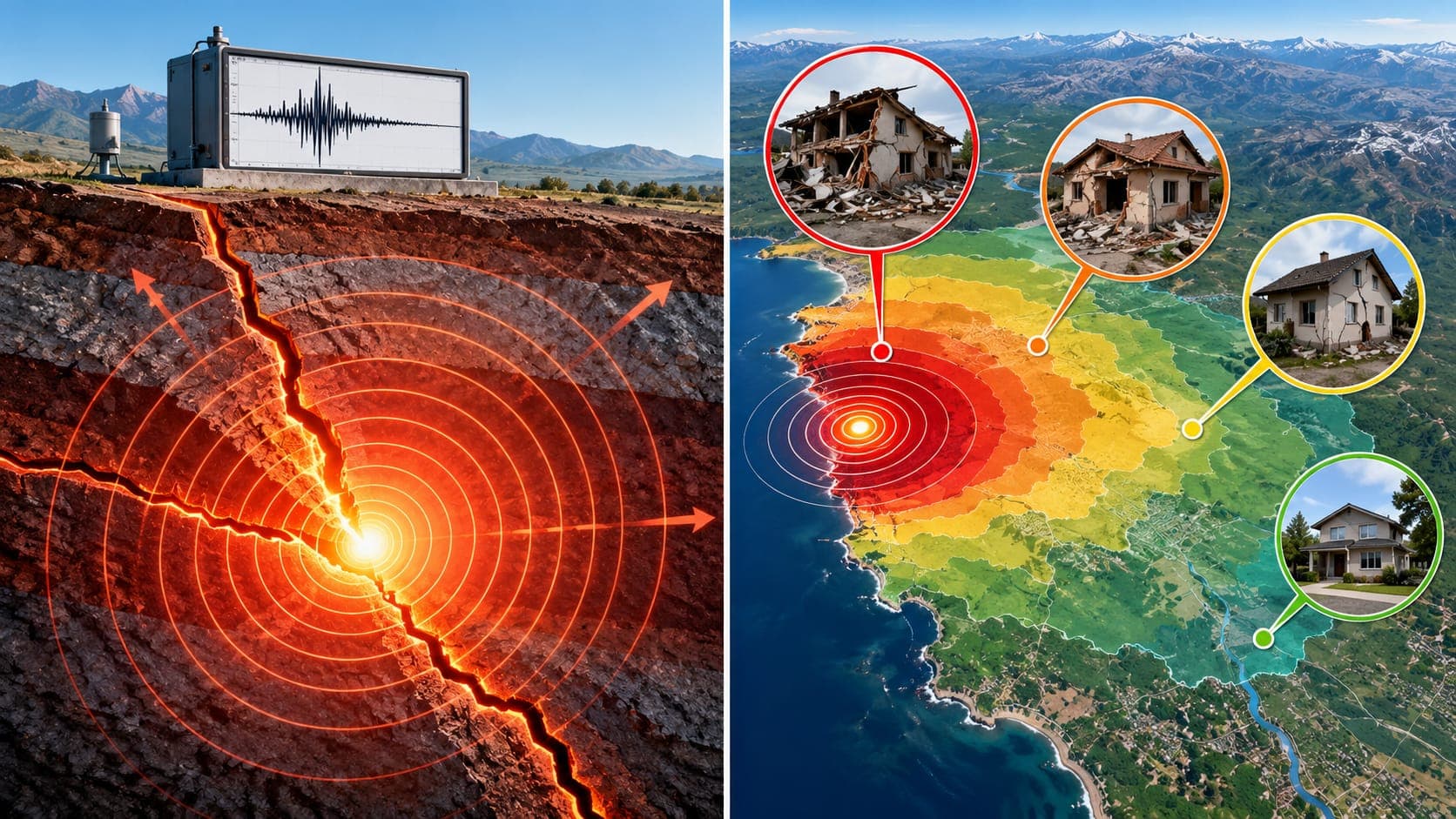
When an earthquake makes the news, the first number you hear is usually its magnitude. But two people who felt the same earthquake can describe very different experiences, one barely noticing it and the other watching shelves empty onto the floor. That difference is the gap between magnitude and intensity.
This article explains what each one measures, how they are reported, and how to use both to understand what an earthquake meant for a particular place.
Quick answer
Magnitude measures the size of the earthquake at its source, and each earthquake has one magnitude value. Intensity measures how strong the shaking was at a particular place, so one earthquake has many intensity values. In the United States, intensity is described with the Modified Mercalli Intensity (MMI) scale, written in Roman numerals from I (not felt) to XII. Each whole step up in magnitude means about 10 times more ground motion on a seismogram and about 32 times more energy.
Magnitude: the size of the earthquake
Magnitude describes how much energy an earthquake released at its source. It is calculated from recordings of seismic waves on instruments called seismometers. Today the USGS mostly reports moment magnitude (Mw), which is based on the area of the fault that slipped and how far it slipped.
Magnitude is a single number for the whole earthquake. Whether you are 5 miles or 500 miles away, the magnitude of that earthquake is the same. Early estimates can change slightly in the first minutes or hours as more data comes in, which is normal.
Why a small change in magnitude is a big deal
Magnitude scales are logarithmic. Each whole-number step up means the ground motion recorded on a seismogram is about 10 times larger and the energy released is about 32 times greater. Two steps up means about 1,000 times more energy.
| Compared with a magnitude 5.0 | Ground motion amplitude | Energy released |
|---|---|---|
| Magnitude 6.0 | About 10 times larger | About 32 times more |
| Magnitude 7.0 | About 100 times larger | About 1,000 times more |
| Magnitude 8.0 | About 1,000 times larger | About 32,000 times more |
Intensity: the shaking where you are
Intensity describes the effects of an earthquake at a specific location: how strongly people felt it, how objects moved and how much damage buildings suffered. Because shaking changes from place to place, one earthquake produces a whole map of different intensities.
In the United States, intensity is measured on the Modified Mercalli Intensity scale. It was developed in 1931 by Harry Wood and Frank Neumann and uses Roman numerals so it is not confused with magnitude.
- I: Not felt except by very few people under especially favorable conditions.
- II–III: Felt by a few people at rest, especially on upper floors; hanging objects may swing.
- IV–V: Felt by many or most people; dishes and windows rattle, some objects fall or break.
- VI–VII: Felt by all; heavy furniture may move, plaster can crack, damage is slight in well-built buildings and considerable in poorly built ones.
- VIII–IX: Considerable to great damage, especially in poorly built structures; well-designed buildings can also be damaged.
- X–XII: Severe destruction across many structures.
Why intensity varies so much
Several factors decide how strong the shaking is at a particular place. Distance from the fault rupture is the biggest one: shaking weakens as waves spread out. Depth matters too, because a deep earthquake is farther from everyone at the surface. Local ground conditions are also important. Soft soils and filled land can amplify shaking compared with nearby solid rock, and in some cases can lead to Liquefaction.
This is why a moderate, shallow earthquake directly beneath a town can cause more damage there than a much larger earthquake far offshore or very deep. Our article on why some earthquakes are stronger than others goes into more detail.
Magnitude and intensity side by side
This comparison sums up the key differences.
| Feature | Magnitude | Intensity |
|---|---|---|
| What it measures | Size of the earthquake at its source | Strength of shaking and effects at one place |
| Values per earthquake | One | Many, varying across the area |
| How it is written | Decimal number, such as 6.4 | Roman numeral, such as VII |
| How it is found | Calculated from seismometer recordings | From instruments, damage surveys and reports from people |
| Best for | Comparing earthquakes with each other | Understanding impact in a specific town or neighborhood |
Did You Feel It? and ShakeMap
The USGS gathers intensity information in two main ways. Did You Feel It? collects reports from the public through a short online questionnaire, then turns them into intensity values by area. Anyone can submit a report, including people who felt nothing, which helps define where shaking was too weak to notice.
ShakeMap combines readings from seismic instruments, Did You Feel It? reports and models of how shaking spreads, to produce a map of estimated intensity for significant earthquakes. Emergency responders use these maps to see where damage is most likely. You can explore them on the shaking maps page, or take the lesson on reading a ShakeMap.
Frequently asked questions
Is a magnitude 6 twice as strong as a magnitude 3?
No, it is much stronger than that. Because the scale is logarithmic, a magnitude 6 produces about 1,000 times more ground motion on a seismogram and releases roughly 32,000 times more energy than a magnitude 3.
Why did my friend feel the earthquake more strongly than I did?
Intensity depends on distance from the rupture, the type of ground under each of you, the building you were in, which floor you were on and what you were doing at the time. Upper floors and soft soils often make shaking feel stronger.
Which number tells me about damage risk where I live?
Intensity is the better guide, because it describes shaking at your location. A ShakeMap or Did You Feel It? map for the earthquake shows estimated intensity by area.
Why did the magnitude change after the first report?
The first magnitude is often calculated within minutes from limited data. As more stations are analyzed, seismologists refine it, and it may be updated by a few tenths. This is a normal part of how earthquakes are reported.
Key takeaway
Magnitude is one number for the size of an earthquake at its source; intensity describes the shaking in each place and varies with distance, depth and ground conditions. Use magnitude to compare earthquakes and intensity to understand what happened where you are.
Sources
- Earthquake Magnitude, Energy Release, and Shaking Intensity — U.S. Geological Survey
- The Modified Mercalli Intensity Scale — U.S. Geological Survey
- Did You Feel It? — U.S. Geological Survey
- ShakeMap — U.S. Geological Survey