Cascadia Subduction Zone Earthquake
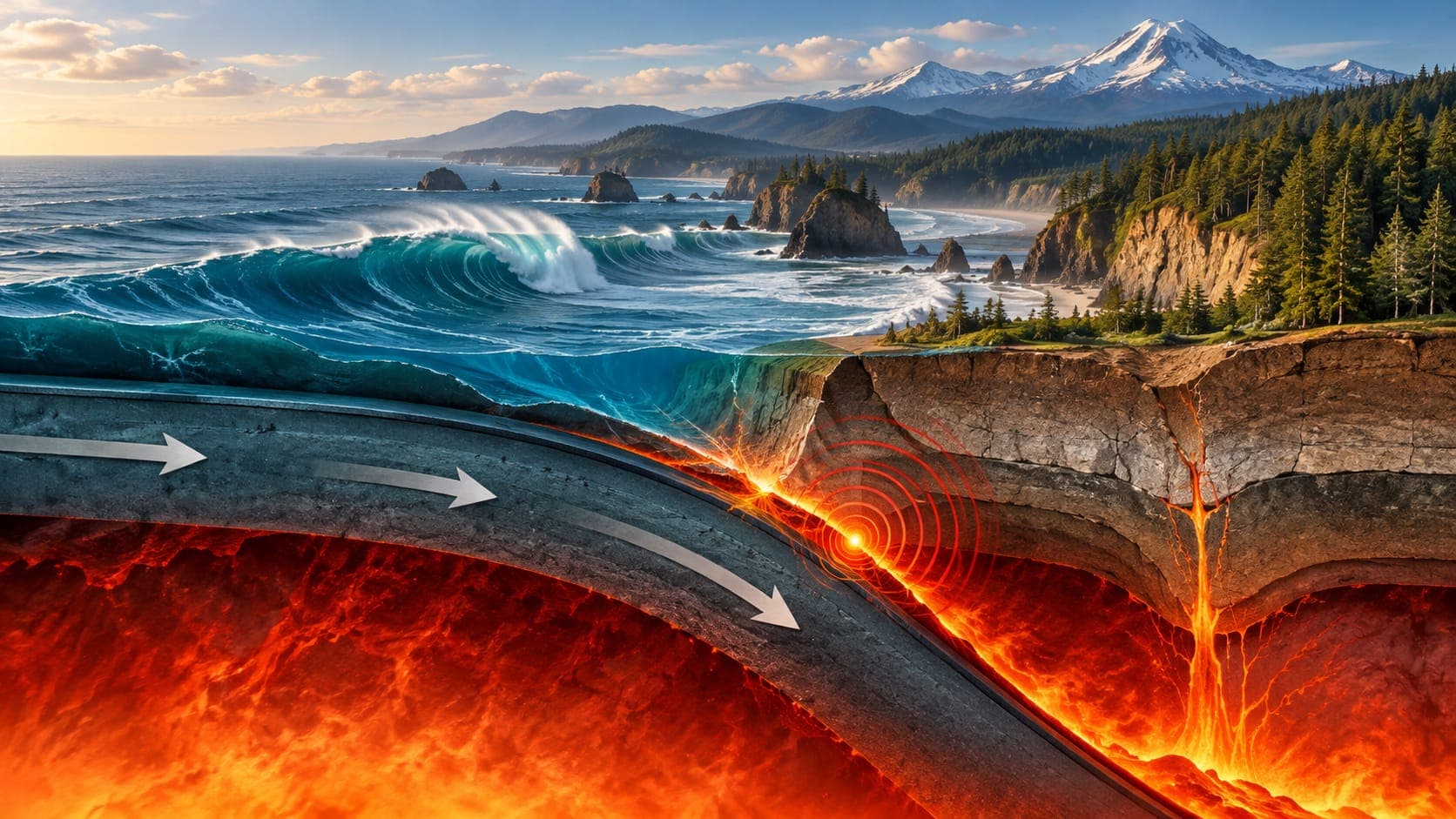
Off the coast of the Pacific Northwest lies one of the largest earthquake sources in North America: the Cascadia Subduction Zone. It stretches about 1,000 kilometers from northern California to Vancouver Island, and it is capable of magnitude 9 earthquakes and major tsunamis.
Because its last great earthquake struck before written records in the region, Cascadia's hazard was recognized only in the late twentieth century. Today it shapes building codes, tsunami planning and early warning across Washington, Oregon, northern California and British Columbia.
Quick answer
A Cascadia Subduction Zone earthquake happens when the locked boundary between the Juan de Fuca Plate and the North American Plate suddenly slips. The last great one, about magnitude 9, struck on January 26, 1700, and sent a tsunami across the Pacific to Japan. Future great earthquakes are expected but cannot be predicted; on the coast, strong or long shaking means move to high ground right away.
Earthquakes along the Cascadia Subduction ZoneHow the subduction zone works
At a Subduction zone, one tectonic plate sinks beneath another. Off the Northwest coast, the small Juan de Fuca Plate, along with the Gorda and Explorer plates at its ends, moves east and dives under the North American Plate at a few centimeters per year.
The shallow part of the boundary, offshore, is stuck. As the ocean plate keeps moving, it drags the edge of North America down and squeezes it inland, slowly storing strain. GPS measurements show the coast being pushed and bent today. When the locked zone finally breaks, the coast snaps back westward and upward offshore, and parts of the coastline suddenly drop. That sudden motion of the sea floor is what creates a Tsunami.
You can see how earthquakes deepen as the plate descends in EQRadar's 3D depth view.
The great earthquake of January 26, 1700
Several kinds of evidence point to a great earthquake about 300 years ago. Along the coast of Washington and Oregon, scientists found ghost forests of dead trees and buried marsh soils where the land suddenly dropped and was flooded by seawater. Tree rings in the dead trees showed they died after the growing season of 1699.
The exact date came from Japan. Historical records there describe a tsunami in January 1700 that arrived with no earthquake felt locally, an orphan tsunami. By working back from the arrival times and the size of the waves, scientists concluded that a Cascadia earthquake of about magnitude 9 struck on the evening of January 26, 1700, Pacific time. Oral traditions of coastal Native American and First Nations peoples also describe great shaking and flooding.
A long record of great earthquakes
Offshore sediment cores record underwater landslides that spread across the sea floor when strong shaking struck. Together with coastal evidence, they show that Cascadia has produced many great earthquakes over the past ten thousand years. Some ruptured the entire length of the zone, and others broke only the southern part, which appears to have large earthquakes more often.
The time between great earthquakes has varied widely, from a few centuries to many centuries. That irregularity is why scientists express Cascadia's hazard as a probability over coming decades and avoid calling it overdue. The quiet since 1700 is within the range seen before.
Three kinds of Northwest earthquakes
The subduction zone produces more than one kind of earthquake, and each feels different:
| Type | Where it happens | What to expect |
|---|---|---|
| Megathrust | The plate boundary offshore | The largest events, up to about magnitude 9; minutes of shaking and a major tsunami |
| Deep (intraslab) | Inside the sinking plate, tens of kilometers down | Widely felt moderate to large quakes, such as the 2001 Nisqually earthquake (about M6.8) |
| Shallow crustal | Faults in the North American Plate, such as the Seattle Fault | Smaller than megathrust events, but very strong shaking close to the fault |
What a great Cascadia earthquake would be like
A full-length magnitude 9 rupture would produce strong shaking along hundreds of kilometers of coast and inland to cities such as Portland, Seattle and Vancouver. Because the fault would keep breaking for a long time, shaking in many places could last several minutes, far longer than in most earthquakes people have experienced.
Tsunami waves would reach the nearest beaches within minutes to tens of minutes, often before any official warning could arrive. The waves would continue for many hours. Many aftershocks, some large, would follow for months to years. See our article on whether an earthquake can cause a tsunami for how this works.
Staying safe on the coast and inland
When shaking starts, Drop, Cover and Hold On. If you are on the coast and the shaking is strong or lasts a long time, treat it as your tsunami warning: as soon as the shaking stops, go on foot to high ground or inland, and do not wait for an official alert. Stay away from the shore until officials say it is safe.
Learn whether your home, work or favorite beaches are in a tsunami hazard zone and practice the walking route. ShakeAlert earthquake early warning operates in Washington, Oregon and California and may give a few seconds of notice before strong shaking. EQRadar's tsunami page shows official tsunami messages when they are issued.
Frequently asked questions
When will the next Cascadia earthquake happen?
No one can say. Geologic records show great earthquakes recur at irregular intervals of a few centuries to many centuries. Scientists estimate a meaningful chance of a large Cascadia earthquake in the coming decades, which is why the region prepares for it.
How do we know the 1700 earthquake was about magnitude 9?
The size of the tsunami recorded in Japan, together with the length of coastline that suddenly dropped in North America, requires a very long rupture with large slip. Only an earthquake of roughly magnitude 9 fits that evidence.
Is Cascadia the same as the San Andreas Fault?
No. The San Andreas is a sideways (transform) fault on land in California. Cascadia is a subduction zone offshore from northern California to British Columbia, where one plate dives beneath another, so it can produce much larger earthquakes and big tsunamis.
Do small earthquakes happen on Cascadia now?
The locked megathrust itself is unusually quiet, with few small earthquakes. Most current small to moderate earthquakes in the region happen in the sinking plate or in shallow crustal faults. Instruments also detect slow slip events deep on the boundary that cause no shaking.
Key takeaway
The Cascadia Subduction Zone can produce magnitude 9 earthquakes and major tsunamis, as it did on January 26, 1700. Its great earthquakes come at irregular intervals, so the focus is on preparation: Drop, Cover and Hold On, and on the coast, move to high ground as soon as strong or long shaking stops.
Sources
- Pacific Northwest Seismic Network — University of Washington and University of Oregon
- Earthquake Hazards Program — U.S. Geological Survey
- Earthquakes — Ready.gov (U.S. Department of Homeland Security)