Nevada Earthquake Today
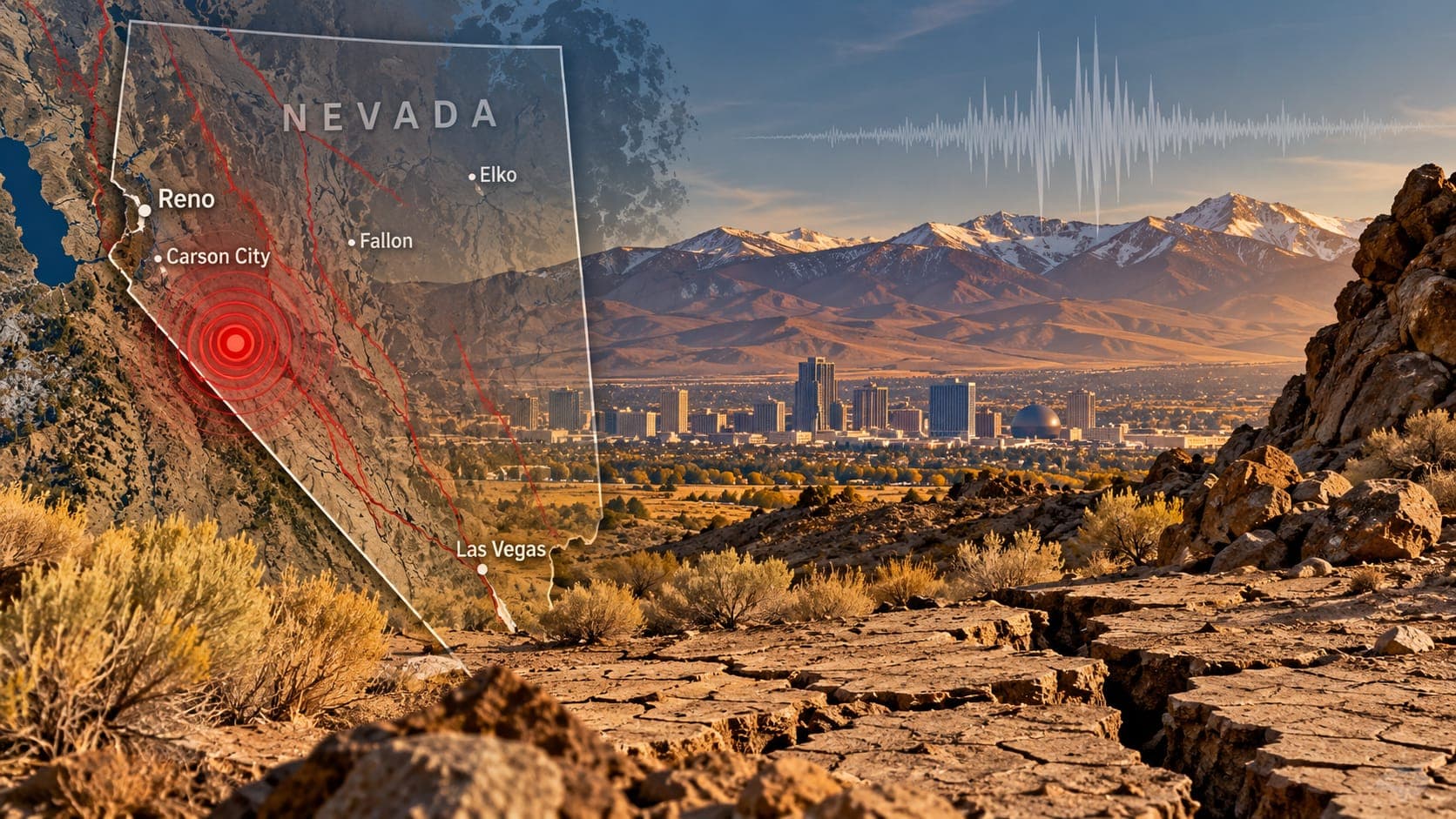
Many people are surprised to learn that Nevada is one of the most seismically active states in the country. It has had several earthquakes larger than magnitude 7 in the last century or so, and smaller ones are recorded somewhere in the state almost every day. Most happen in sparsely populated desert and mountain areas, so they get less attention than California's.
This article is a fixed reference page and cannot tell you what happened today. It shows you where to check verified earthquake information for Nevada, how to read it, and why the state's landscape is so active.
Quick answer
To check for a Nevada earthquake today, open the EQRadar live map of USGS-reported earthquakes, the USGS Latest Earthquakes map, or the Nevada Seismological Laboratory at the University of Nevada, Reno, which monitors the state. First reports are automatic and can change. If you felt shaking, report it to USGS Did You Feel It?
Open the live map of NevadaWhere to check Nevada earthquakes
The Nevada Seismological Laboratory at the University of Nevada, Reno operates the seismic network covering most of the state and nearby parts of eastern California. Its earthquake locations flow into the USGS catalog, which you can see on the EQRadar live map or the USGS Latest Earthquakes map.
Because many Nevada earthquakes occur far from towns, the place names in listings may be small communities such as Mina, Tonopah or Wells. Zoom in on the map to see how far an event was from where you are.
How to read the listing
Nevada uses Pacific Time, 8 hours behind UTC in winter and 7 hours behind in summer. Most Nevada earthquakes are shallow, generally within the upper 15 kilometers or so of the crust, so even moderate ones can be felt clearly nearby.
Each event is first posted automatically. A seismologist then reviews it, and the Magnitude or location may change slightly; the review status tells you which version you are seeing. Nevada also has frequent earthquake sequences and swarms, in which many small quakes occur close together over days or weeks. Use the timeline or history view to see whether today's event is part of a longer sequence.
Why Nevada has so many earthquakes
Nevada lies in the Basin and Range Province, a region where the Earth's crust is being slowly stretched apart in an east-west direction. As it stretches, blocks of crust drop down along faults to form valleys, while neighboring blocks tilt up to form mountain ranges. This is why Nevada's map shows so many long, parallel ranges separated by flat basins. Many of the faults along the edges of those ranges are active, and they produce earthquakes when they slip.
Along the state's western side, near the California border, is the Walker Lane, a belt of faults that takes up a meaningful share of the sliding motion between the Pacific and North American plates. The Walker Lane runs past Reno, Carson City and Lake Tahoe and down through west-central Nevada, and it hosts much of the state's earthquake activity. The Reno and Carson City areas sit next to range-front faults along the Carson Range, such as the Genoa fault.
Nevada's notable earthquakes
Central and western Nevada had a remarkable series of large earthquakes in the first half of the 1900s, many of which left fresh fault scarps that are still visible today. More recently, the 2008 Wells earthquake in northeastern Nevada damaged old brick and stone buildings in the small town of Wells, and the 2020 Monte Cristo Range earthquake, in a remote area west of Tonopah, was the largest in Nevada in decades.
| Year | Name and area | Approx. magnitude |
|---|---|---|
| 1915 | Pleasant Valley, north-central Nevada | about 7.3 |
| 1954 | Fairview Peak, central Nevada | about 7.1 |
| 1954 | Dixie Valley, central Nevada (same day as Fairview Peak) | about 6.8 |
| 2008 | Wells, northeastern Nevada | 6.0 |
| 2020 | Monte Cristo Range, west-central Nevada | 6.5 |
Hazards for Nevada communities
The biggest concern is strong shaking in towns and cities near active faults, particularly Reno, Sparks, Carson City and the Lake Tahoe area. Older unreinforced masonry buildings, like those damaged in Wells, are the most vulnerable. Shaking can also trigger rockfalls and landslides on steep slopes and roadcuts, and in places with shallow groundwater, such as some valley floors and areas near lakes and rivers, Liquefaction is possible.
Las Vegas has less earthquake activity than western Nevada, but it is built on a deep basin of sediments that can amplify shaking from nearby faults or from large earthquakes in California. Studies of Lake Tahoe also suggest that prehistoric earthquakes on faults beneath the lake generated large waves.
Alerts and safety
The ShakeAlert early warning system was built for California, Oregon and Washington; check its website for the current coverage area. Because warnings may be short or unavailable, the most important protection is knowing what to do: Drop, Cover and Hold On as soon as you feel shaking.
After shaking stops, check for injuries and hazards, be ready for aftershocks, and report what you felt to USGS Did You Feel It? Reports from remote parts of Nevada are especially useful, because there are fewer people there to describe the shaking. EQRadar's alerts can watch a saved place while the page is open; they do not send texts or push notifications.
Frequently asked questions
Is Nevada really one of the most earthquake-prone states?
Yes. Nevada is often ranked just behind Alaska and California for large earthquakes. It has had several earthquakes of about magnitude 7 or larger in recorded history.
Why do earthquakes in Nevada often come in swarms?
The stretching crust in the Basin and Range and the Walker Lane is broken into many small faults and fractures. Fluids and stress changes can trigger many small earthquakes on them close together in time. Most swarms end without a large earthquake.
Is Las Vegas at risk of earthquakes?
Las Vegas has lower earthquake activity than Reno, but it is not risk-free. There are faults in the Las Vegas Valley, and the deep sediments beneath the city can amplify shaking, so preparation still makes sense.
Who monitors earthquakes in Nevada?
The Nevada Seismological Laboratory at the University of Nevada, Reno, working with the USGS. Its data appear in the USGS national catalog shown on EQRadar's live map.
Key takeaway
Nevada's stretching crust and the Walker Lane make it one of the most active earthquake states, with a history of magnitude 7 events. Check verified USGS and Nevada Seismological Laboratory data, watch for sequences rather than single events, and prepare, especially if you live in older buildings in western Nevada.
Sources
- Nevada Seismological Laboratory — University of Nevada, Reno
- Latest Earthquakes — U.S. Geological Survey
- Did You Feel It? — U.S. Geological Survey
- Earthquakes — Ready.gov (U.S. Department of Homeland Security)