New York Earthquake Today
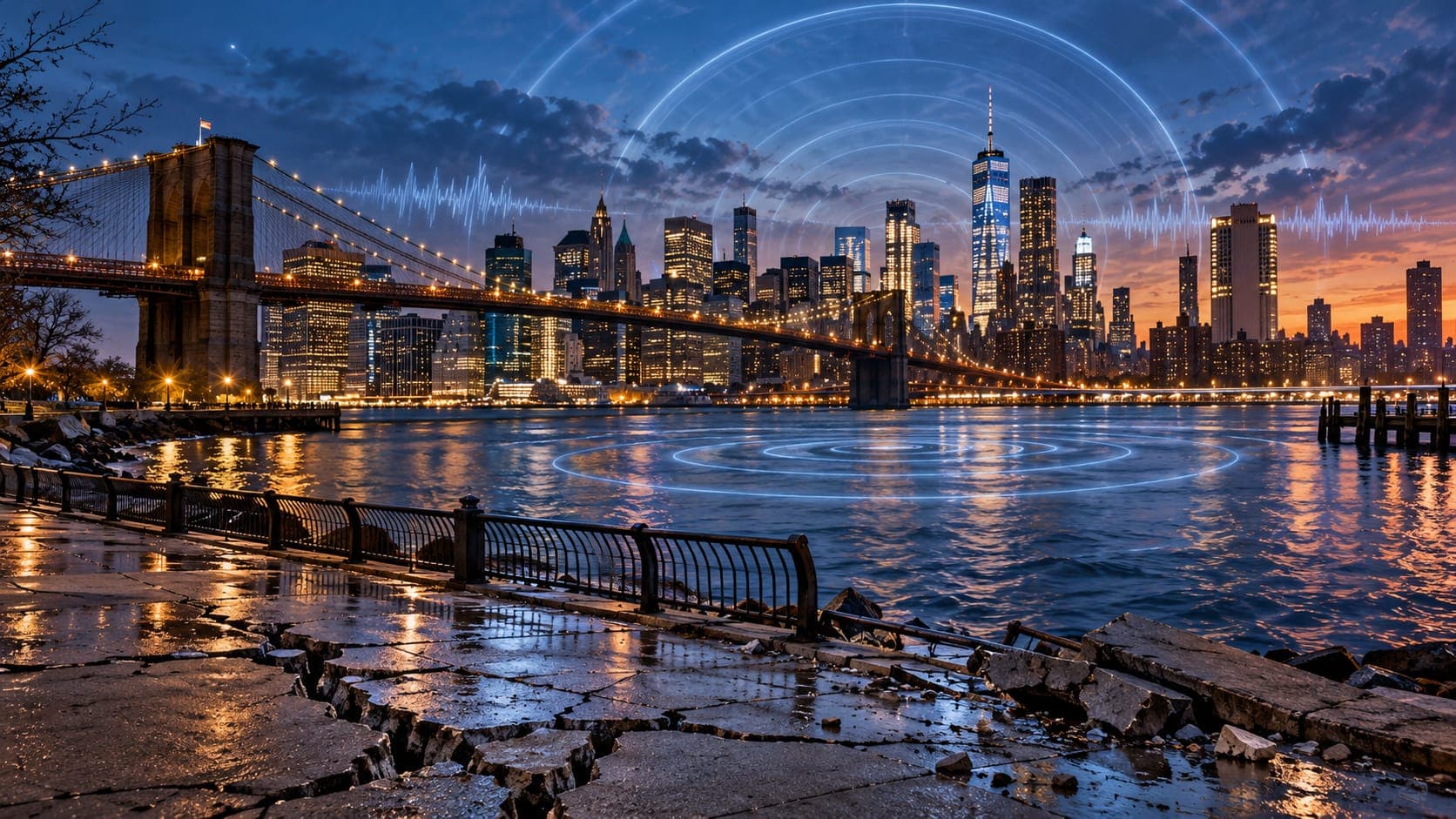
Earthquakes are not something most New Yorkers think about, so when the floor shakes, it is genuinely startling. The region does have earthquakes, though far fewer than California. Most are small, but occasionally a moderate one is felt across the whole metropolitan area and well beyond, as happened with the magnitude 4.8 earthquake in New Jersey in April 2024.
This page is a static guide, not a live feed, so it does not tell you what happened today. It explains how to check verified information, why eastern earthquakes behave differently, and what the hazard really is for New York City and the state.
Quick answer
To check for a New York earthquake today, open the EQRadar live map of USGS-reported earthquakes or the USGS Latest Earthquakes map. The Lamont-Doherty Cooperative Seismographic Network at Columbia University monitors the region. Early details are automatic and may change. If you felt shaking, report it to USGS Did You Feel It?
Open the live map of the New York areaHow to check whether it was an earthquake
Open the EQRadar live map, which is centered on the New York City region and shows earthquakes from the USGS catalog. The USGS Latest Earthquakes map shows the same official information. Regional monitoring is done by the Lamont-Doherty Cooperative Seismographic Network, based at Columbia University's Lamont-Doherty Earth Observatory in Palisades, New York, working with the USGS and other northeastern networks.
In a big city, many jolts and rumbles are not earthquakes at all: construction blasting, subway trains, heavy trucks, building work and sonic booms can all rattle windows. If nothing appears on the map after several minutes, what you felt was probably not an earthquake. If something does appear, it may be in New Jersey, the Hudson Valley, Long Island Sound or even farther away.
Reading the listing
New York is on Eastern Time: 5 hours behind UTC in winter and 4 hours behind in summer. Check the Epicentre location: an event described as a certain distance from a town in New Jersey or upstate New York may still have been felt across the city.
The first Magnitude is computed automatically and can change after review. In the Northeast, where stations are farther apart than in California, early locations may also shift. Most earthquakes here are shallow. The Intensity of shaking you felt depends on distance and on the ground beneath you, which our lesson on magnitude vs intensity explains.
Why eastern earthquakes are felt so far away
The crust beneath the eastern United States is old, cold and relatively unbroken compared with the crust in the West. Seismic waves travel through it efficiently and lose energy slowly. According to the USGS, an East Coast earthquake can be felt over an area as much as ten times larger than a West Coast earthquake of the same magnitude.
That is why the 2024 earthquake near Tewksbury Township (Whitehouse Station), New Jersey, was felt in New York City, Philadelphia and across much of the Northeast, and why it generated a very large number of Did You Feel It? reports. Wide felt areas do not necessarily mean strong shaking; most people felt light to moderate shaking.
Faults and past earthquakes
New York is far from any plate boundary. Its earthquakes happen on ancient faults within the North American plate that are reactivated by stresses in the plate. The Ramapo fault zone, along the border of New Jersey and New York at the edge of the Hudson Highlands, is the best known. Smaller faults also cross Manhattan, including one along 125th Street. Unlike in California, it is often hard to link a specific eastern earthquake to a known fault.
Upstate New York has its own active areas, including the Adirondacks, the St. Lawrence River valley near the Canadian border and parts of western New York.
| Year | Location | Approx. magnitude |
|---|---|---|
| 1884 | New York City area | about 5 |
| 1944 | Massena-Cornwall, St. Lawrence valley | about 5.8 |
| 2002 | Au Sable Forks, Adirondacks | about 5 |
| 2024 | Tewksbury Township, New Jersey | 4.8 |
What is the real risk?
The chance of a damaging earthquake in any given year is low in New York, much lower than in California or Alaska. But low is not zero. A moderate earthquake near the city could cause damage because so many people and buildings are packed close together. Much of the building stock is old, and many older brick and stone buildings, including unreinforced masonry, were built long before modern seismic standards. New York City added earthquake provisions to its building code in the 1990s, so newer buildings are designed with shaking in mind.
Parts of the shoreline, including areas of lower Manhattan, Brooklyn and Queens, are built on artificial fill, which can shake more strongly and may be prone to Liquefaction. See our U.S. earthquake risk map article for how New York compares nationally.
What to do if you felt shaking
Drop, Cover and Hold On until the shaking stops. Do not run outside, where falling glass, bricks and facade pieces are a real danger in a dense city, and do not use elevators. Afterward, check for injuries, look for gas leaks and damage, and expect possible aftershocks; the 2024 New Jersey earthquake was followed by many smaller ones over the following weeks.
Report what you felt to USGS Did You Feel It?, and follow official guidance from local emergency management. The ShakeAlert early warning system does not cover the East Coast, so practicing your response matters most. EQRadar's alerts can watch a saved place while the page is open but do not send texts or push notifications.
Frequently asked questions
Is New York at risk of earthquakes?
Yes, though the risk is much lower than on the West Coast. Moderate earthquakes happen occasionally in the region, and the city's density and older buildings mean even a moderate nearby quake could cause damage.
Is there a fault under New York City?
There are several old faults in the region, including the Ramapo fault zone northwest of the city and smaller faults across Manhattan. They are not plate boundary faults like the San Andreas, and they produce earthquakes far less often.
Why did I feel an earthquake that was centered in New Jersey?
Seismic waves travel efficiently through the old, cold crust of the eastern United States, so even moderate earthquakes can be felt over hundreds of kilometers.
When was the last big earthquake in New York City?
The best-known damaging earthquake near the city struck in 1884 and is estimated at about magnitude 5. It knocked down chimneys and cracked walls. No earthquake of that size has been centered in the city area since.
Key takeaway
New York has a low but real earthquake hazard, and eastern earthquakes are felt over unusually large areas. Check verified USGS and Lamont-Doherty data instead of rumors, remember that many jolts in a city are not earthquakes, and know to Drop, Cover and Hold On if the shaking is real.
Sources
- Lamont-Doherty Earth Observatory — Columbia University
- Latest Earthquakes — U.S. Geological Survey
- Did You Feel It? — U.S. Geological Survey
- Earthquakes — Ready.gov (U.S. Department of Homeland Security)