Most Earthquake-Prone Countries
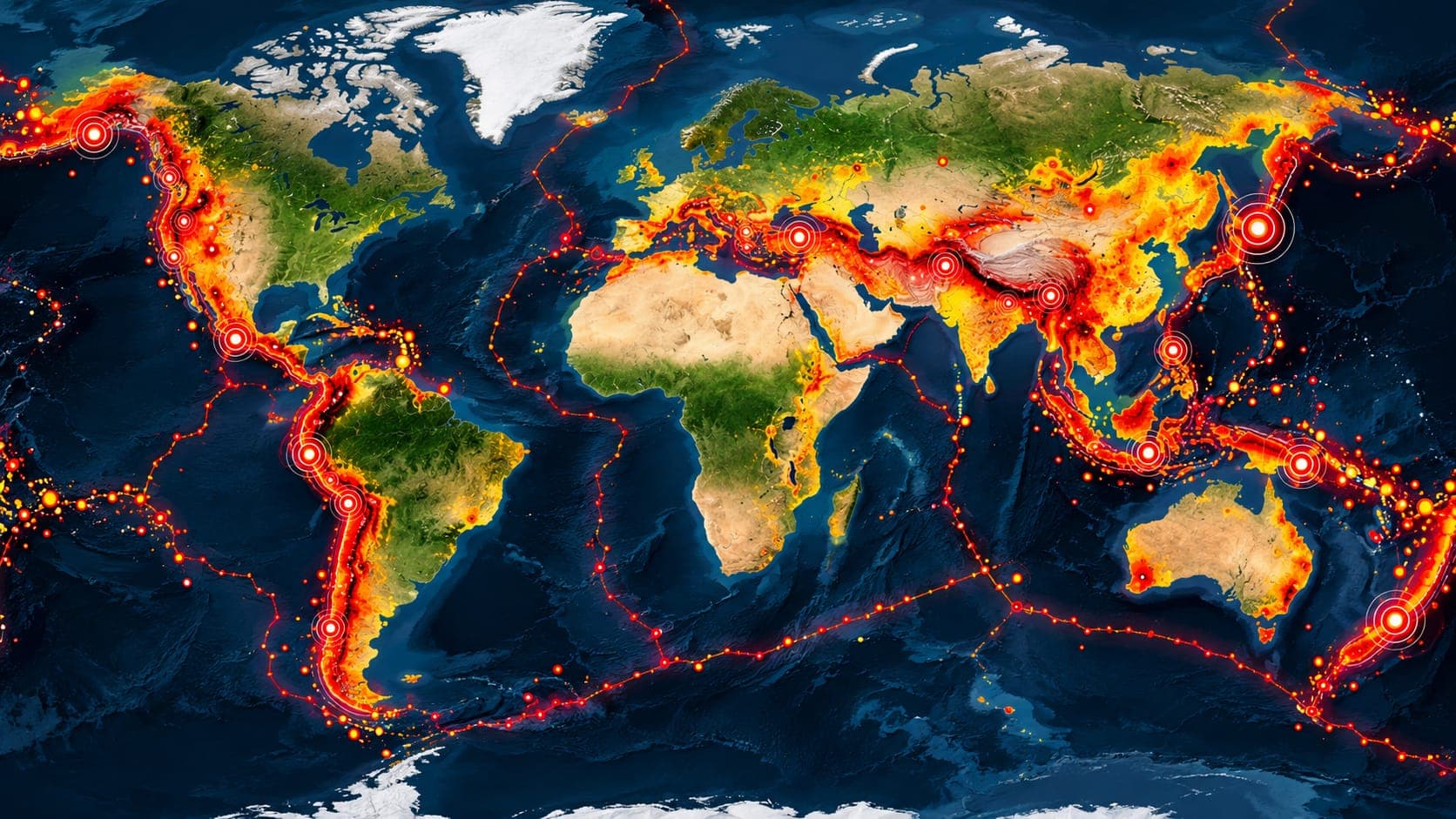
People often ask which country has the most earthquakes. It sounds like a simple question with a single answer, but the honest answer is that it depends on what you count: all earthquakes or only large ones, totals or activity per area, shaking or the harm it causes.
This article explains those different ways of counting, introduces the countries that show up near the top by most measures, and explains why the most active countries are not always the ones that suffer the most.
Quick answer
Countries along active plate boundaries, especially subduction zones and collision zones, are the most earthquake-prone. Japan, Indonesia, China, Iran, Türkiye, the Philippines, Papua New Guinea, Mexico, Peru, Chile and the United States (largely because of Alaska) are among the most active. Which one ranks first depends on how you count, and the countries with the most earthquakes are not always the ones with the highest losses.
It depends on how you count
There are several reasonable ways to rank countries, and each gives a different answer:
- Number of recorded earthquakes: favors countries with dense seismometer networks, which detect many tiny earthquakes that would go unnoticed elsewhere. Japan records an enormous number for this reason as well as its real activity.
- Number of large earthquakes: a fairer measure of natural activity, because large earthquakes are detected worldwide no matter where they occur.
- Activity per area: a small, very active country can rank higher than a large country with activity spread over a big area.
- Deaths and damage: depends heavily on population, building quality and preparedness, not just on how often the ground shakes.
Countries on subduction zones
The most consistently active countries sit on Subduction zones, where one plate dives beneath another. These boundaries produce the largest earthquakes and many tsunamis, and most of them ring the Pacific Ocean.
Japan sits where several plates meet and has frequent earthquakes of all sizes, including the magnitude 9.1 Tohoku earthquake in 2011. Indonesia spans several subduction zones and has very many earthquakes, including the magnitude 9.1 Sumatra earthquake of 2004. The Philippines and Papua New Guinea are on complex, very active boundaries. In the Americas, Chile, Peru, Mexico and Central America sit above subduction zones; Chile had the largest earthquake ever recorded, magnitude 9.5 in 1960. The United States has most of its large earthquakes in Alaska, which had a magnitude 9.2 earthquake in 1964.
Countries in continental collision zones
A second belt of activity stretches from the Mediterranean through the Middle East to the Himalaya, where the African, Arabian and Indian plates push into Eurasia. Here the earthquakes are spread across wide zones of faults on land, often beneath populated areas.
Türkiye has major strike-slip faults, including the North and East Anatolian faults; the February 2023 earthquakes of about magnitude 7.8 and 7.5 on the East Anatolian fault system killed more than 50,000 people in Türkiye and Syria. Iran is crossed by many active faults and has had numerous destructive earthquakes. China has frequent large earthquakes across its western and central regions, including the magnitude 7.9 Wenchuan earthquake in 2008. Nepal, northern India and Pakistan sit along the Himalayan collision zone; see our article on the 2015 Nepal earthquake. Greece and Italy have frequent moderate earthquakes as well.
A quick comparison
The table below is not a ranking. It summarizes why each country is active and gives one well-known example.
| Country | Main source of earthquakes | Notable example |
|---|---|---|
| Japan | Several subduction zones | 2011 Tohoku, about M9.1 |
| Indonesia | Subduction zones and collision | 2004 Sumatra, about M9.1 |
| Chile | Nazca Plate subduction | 1960 Valdivia, about M9.5 |
| United States | Alaska subduction; West Coast faults | 1964 Alaska, about M9.2 |
| China | India-Eurasia collision | 2008 Wenchuan, about M7.9 |
| Türkiye | Anatolian strike-slip faults | 2023 Kahramanmaraş, about M7.8 |
| Mexico | Cocos Plate subduction | 1985 Mexico City, about M8.0 |
Hazard is not the same as risk
Hazard is the natural chance of strong shaking. Risk is the chance of harm, which also depends on how many people are exposed, how buildings are built and how ready communities are. A country can have very high hazard and relatively modest losses if it invests in strong building codes, warning systems and drills.
The contrast between two earthquakes in 2010 is often used to show this. The magnitude 7.0 earthquake in Haiti caused an enormous loss of life, largely because of vulnerable buildings close to the fault. Weeks later, the far larger magnitude 8.8 earthquake in Chile, a country with strict building codes, caused far fewer deaths relative to its size, although it still did serious damage. Our article on the deadliest earthquakes in history explores this further.
Exploring activity yourself
You can see where earthquakes cluster on the EQRadar live map, which shows earthquakes reported by the USGS, or search past events by region in the history view. Notice how activity traces plate boundaries: the Pacific coastlines, the Himalaya and the Mediterranean. For individual countries, see our pages on Japan and Indonesia.
Keep in mind that a global catalog is most complete for moderate and larger earthquakes. Small earthquakes are recorded far better in some countries than others, so comparing raw counts of small earthquakes across countries can be misleading.
Frequently asked questions
Which country has the most earthquakes?
There is no single answer. Japan records a huge number of earthquakes thanks to its very dense network, while Indonesia, being much larger and highly active, has a very large total. Counting only large earthquakes or deaths gives different leaders again.
Which country has the largest earthquakes?
The largest earthquake ever recorded was the magnitude 9.5 Chile earthquake of 1960. Chile, Japan, Indonesia, the United States (Alaska) and Russia (Kamchatka) have all had earthquakes of magnitude 9 or larger.
Are there countries with no earthquakes?
Every country has at least occasional small earthquakes, but some, far from plate boundaries, rarely have damaging ones. Even stable regions can occasionally have a moderate earthquake.
Why do some countries have more earthquake deaths than others?
Deaths depend mainly on building quality, population density near the fault, time of day, secondary hazards such as tsunamis and landslides, and how quickly help arrives, not just on the earthquake's magnitude.
Key takeaway
The most earthquake-prone countries lie on active plate boundaries, including Japan, Indonesia, Chile, Peru, Mexico, the Philippines, Papua New Guinea, China, Iran, Türkiye and the United States through Alaska. Rankings depend on what you count, and hazard is not risk: building quality and preparation largely decide how much harm an earthquake causes.
Sources
- Earthquake Hazards Program — U.S. Geological Survey
- Search Earthquake Catalog — U.S. Geological Survey
- Global Earthquake Model Foundation — GEM Foundation