Ring of Fire Earthquakes
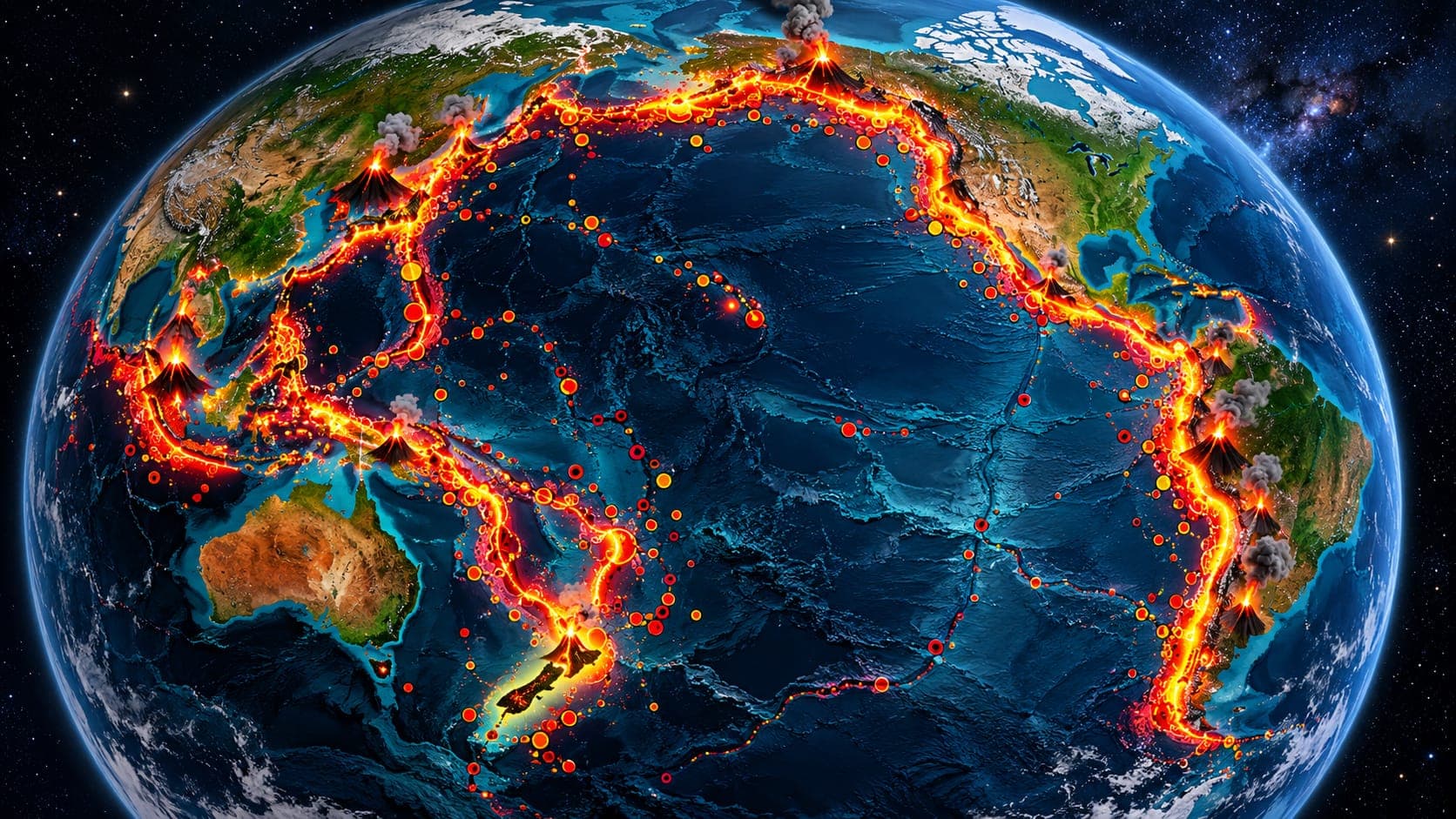
Look at a world map of earthquakes and one pattern jumps out: a long band of activity tracing the edges of the Pacific Ocean, from New Zealand up through Indonesia, the Philippines, Japan and Alaska, then down the coasts of the Americas to Chile. This is the Ring of Fire.
It is not a single fault or a single plate boundary. It is a collection of mostly subduction zones that together produce most of the world's largest earthquakes and host most of its active volcanoes.
Quick answer
The Ring of Fire is a horseshoe-shaped belt about 40,000 kilometers long around the Pacific Ocean where ocean plates sink beneath neighboring plates. These subduction zones produce most of the world's earthquakes, including roughly 80 percent of the largest ones, and about three-quarters of its active volcanoes. Hazard is high along the whole belt, but risk to people varies a lot from place to place.
Earthquakes around the Ring of FireWhat the Ring of Fire is
The Pacific Ocean floor is made mostly of the Pacific Plate and several smaller plates, such as the Nazca, Cocos, Juan de Fuca and Philippine Sea plates. Around much of the ocean's edge, these ocean plates are moving toward and sinking beneath neighboring plates. The places where they sink are called Subduction zones, and they line the Pacific like a horseshoe.
Not every part of the ring is a subduction zone. California's San Andreas Fault and New Zealand's Alpine Fault, for example, are sideways (transform) boundaries. But subduction zones make up most of the ring, and they are what give it both its earthquakes and its volcanoes. The How plates move lesson explains the different kinds of boundaries.
Why subduction zones produce so many earthquakes
Subduction zones are earthquake factories for several reasons. The contact between the sinking plate and the overriding plate is enormous: it can be more than a hundred kilometers wide and hundreds to over a thousand kilometers long. When a large patch of that contact locks and then slips, it can produce a Magnitude 8 or 9 earthquake. No other kind of fault has such a large area able to slip at once.
The sinking plate also produces earthquakes inside itself as it bends and descends, some of them hundreds of kilometers deep. And the overriding plate is broken by shallower faults. The result is a wide range of earthquake sizes and depths in the same region.
Volcanoes form because the sinking plate releases water as it heats up, which lowers the melting point of the hot rock above it. Melted rock rises to feed chains of volcanoes parallel to the trench. EQRadar's volcanoes page shows volcano activity reported by official sources.
The largest earthquakes on record
Most of the largest earthquakes ever measured struck along the Ring of Fire:
| Year | Location | Approximate magnitude |
|---|---|---|
| 1960 | Southern Chile | 9.5 (largest ever recorded) |
| 1964 | Prince William Sound, Alaska | 9.2 |
| 2011 | Off the Pacific coast of Tohoku, Japan | 9.1 |
| 1952 | Kamchatka, Russia | 9.0 |
| 2010 | Off central Chile (Maule) | 8.8 |
Tsunamis around the Pacific
Because subduction earthquakes often lift or drop large areas of sea floor, the Ring of Fire is also the main source of the world's tsunamis. A tsunami from a great earthquake can cross the entire Pacific. The 1960 Chile tsunami caused deaths in Hawaii and Japan many hours later, which is one reason the Pacific has a well-developed international tsunami warning system.
If you are on any Pacific coast and feel strong or long-lasting shaking, go to high ground or inland as soon as it stops; do not wait for an official warning. EQRadar's tsunami page shows official tsunami messages when they are issued.
Hazard is high, but risk varies
Being on the Ring of Fire means a place has high earthquake hazard, the natural chance of strong shaking. Risk, the chance of harm to people and property, also depends on how many people live there, how well buildings are built, and how prepared communities are.
Japan and Chile, for example, have strict building codes, warning systems and regular drills, and modern buildings there have performed well in very large earthquakes. Places with rapid, unregulated construction can suffer far more from smaller earthquakes. Even within one country, an older neighborhood on soft ground can be at much higher risk than a newer one on rock.
Common misunderstandings
The Ring of Fire is sometimes described as if it were one connected system that becomes active all at once. There is no good evidence that a large earthquake in one part of the ring causes large earthquakes on the other side of the Pacific. Each subduction zone builds and releases its own strain, and big earthquakes in different places sometimes cluster in time by chance.
The ring also is not the only active belt. A second major belt, the Alpide belt, runs from the Mediterranean through Türkiye, Iran and the Himalaya to Indonesia and produces many damaging earthquakes. You can see both belts on the EQRadar live map.
Frequently asked questions
Which countries are on the Ring of Fire?
Countries and territories along it include New Zealand, Papua New Guinea, Indonesia, the Philippines, Taiwan, Japan, Russia's Kamchatka Peninsula, the United States (Alaska, the Pacific Northwest and California), Canada, Mexico, Central American countries, Colombia, Ecuador, Peru and Chile.
Why is it called the Ring of Fire?
The name comes from the chain of volcanoes that circles the Pacific. About three-quarters of the world's active volcanoes are found along it, and those same plate boundaries produce most large earthquakes.
Is the Ring of Fire getting more active?
No. Year-to-year counts of large earthquakes go up and down, but there is no long-term increase. Better instruments and faster news can make it seem busier than in the past.
Is Hawaii part of the Ring of Fire?
No. Hawaii sits in the middle of the Pacific Plate above a hotspot, far from the ring's plate boundaries. It has its own volcanic earthquakes, and it can be reached by tsunamis generated around the ring.
Key takeaway
The Ring of Fire is a belt of mostly subduction zones around the Pacific that produces most of the world's largest earthquakes, many tsunamis and about three-quarters of its active volcanoes. Hazard is high along its length, but how much harm an earthquake causes depends heavily on buildings, preparation and warning systems.
Sources
- Earthquake Hazards Program — U.S. Geological Survey
- Search Earthquake Catalog — U.S. Geological Survey
- Earthquake Hazards — U.S. Geological Survey