What Are Earthquake Aftershocks?
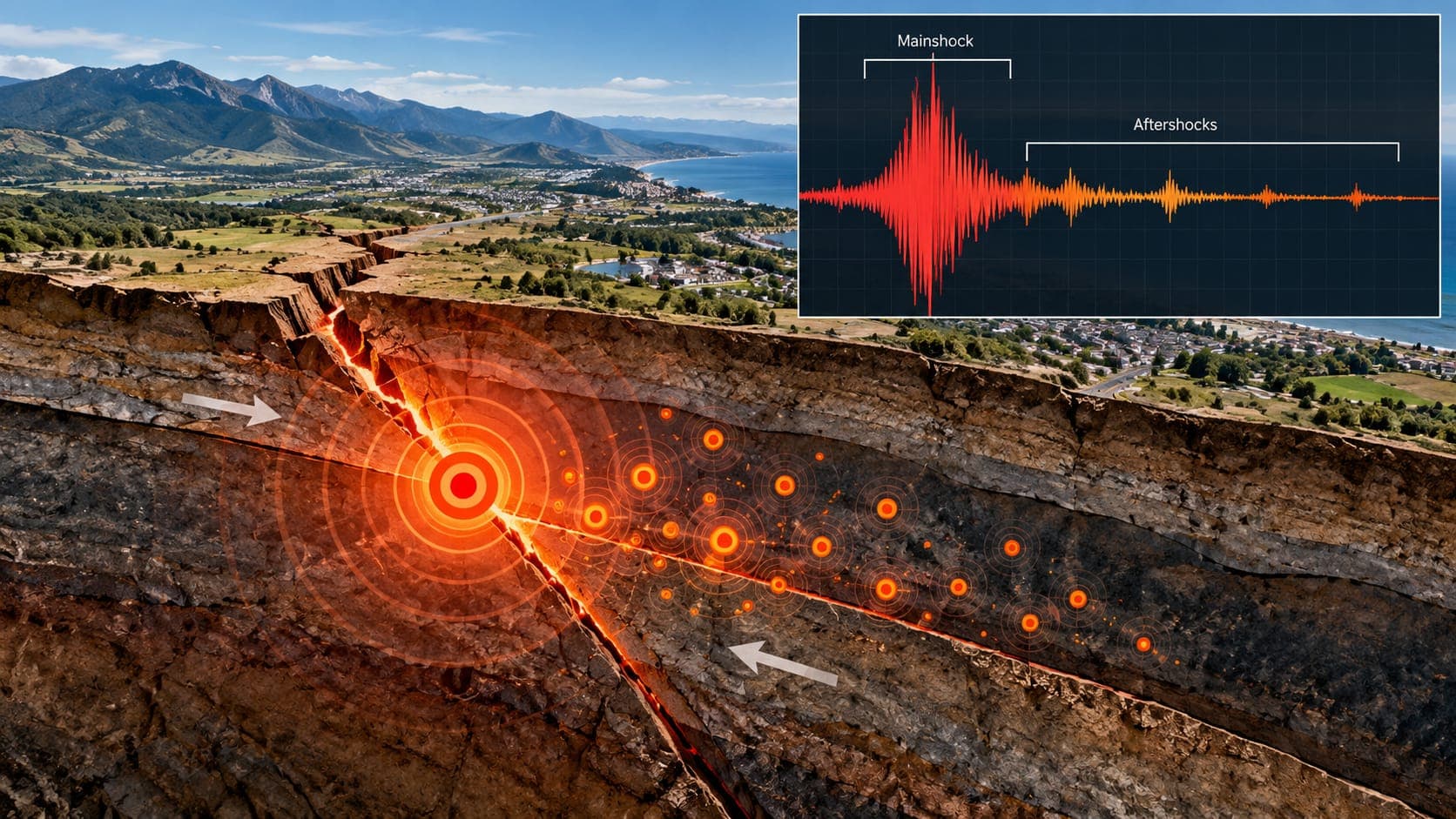
After a large earthquake, the ground rarely goes quiet right away. Over the following hours, days and months, many more earthquakes usually strike in the same area. These are aftershocks, and they are a normal part of almost every sizable earthquake.
Aftershocks can be unsettling, and the larger ones can damage buildings that were already weakened. The good news is that they follow patterns scientists understand fairly well, which makes them one of the few kinds of earthquakes that can be forecast with useful accuracy.
Quick answer
Aftershocks are smaller earthquakes that follow a larger earthquake, called the mainshock, in the same general area. They happen because the mainshock suddenly changes stress in the surrounding rock. They are most frequent right after the mainshock and become less common over time. The USGS issues aftershock forecasts after notable U.S. earthquakes to show how many are likely and how large they might be.
Aftershocks, mainshocks and sequences
When a group of earthquakes happens close together in place and time, scientists call it an earthquake sequence. The largest quake in the sequence is the Mainshock. Smaller quakes that come after it are aftershocks, and smaller quakes that came before it are foreshocks.
Aftershocks can range from tiny events that only instruments detect to strong earthquakes that cause damage on their own. A large mainshock may be followed by thousands of aftershocks, though most are too small to feel.
Why aftershocks happen
An earthquake is sudden slip on a Fault. When a section of fault slips, it releases stress in that patch of rock, but it also shifts stress onto nearby parts of the fault and onto other faults close by. Some of those areas were already close to failing, and the extra push makes them slip too.
The rock and the fault zone also continue to adjust after the mainshock, through slow slip and fluid movement. Together, these effects produce a burst of activity that gradually settles down as the area reaches a new balance.
Where aftershocks occur
Most aftershocks happen along or near the part of the fault that ruptured in the mainshock, and the size of the aftershock zone grows with the size of the mainshock. For a moderate quake the zone may be a few miles across. For a great earthquake, where the fault may rupture for hundreds of miles, aftershocks can spread over a similarly large area.
Scientists often use the outline of early aftershocks to map how much of the fault broke. You can see this clustering for yourself by zooming in on a recent large quake on the live map.
How many aftershocks, and how big
Aftershock sequences follow a few well-known rules of thumb. They describe typical behavior, not exact promises for any single sequence.
- Frequency drops with time. The rate is highest in the first hours and falls off quickly, a pattern known as Omori's law.
- Small aftershocks vastly outnumber large ones. For each step down in magnitude there are roughly ten times as many aftershocks.
- The largest aftershock is often about 1.2 magnitude units smaller than the mainshock, a pattern called Båth's law. A magnitude 7.0 might have a largest aftershock around 5.8, but the actual value varies widely.
- Larger mainshocks produce more aftershocks, over a larger area, for a longer time.
USGS aftershock forecasts
Because aftershocks follow these patterns, the USGS can Forecast them. After notable earthquakes in the United States, it publishes the chance of at least one aftershock above certain magnitudes, such as 3, 5, 6 and 7, over the next day, week, month and year, along with the likely number of aftershocks. Forecasts are updated as new data come in.
EQRadar shows these official forecasts for active sequences on the risk page. For how long sequences typically continue and how to read the numbers, see how long do aftershocks last?
Staying safe during aftershocks
Aftershocks can be dangerous because they strike buildings, slopes and people already affected by the mainshock. A moderate aftershock can bring down a wall or chimney that was cracked earlier.
- Drop, Cover and Hold On during every aftershock, just as during the main earthquake.
- Do not go back into buildings that look damaged until they have been checked by officials or qualified inspectors.
- Stay away from damaged chimneys, walls and steep slopes where landslides may be loosened.
- If you are near the coast and felt strong or long shaking, move to high ground right away. Do not wait for an official Tsunami warning.
- Keep shoes, a flashlight and your phone near your bed while aftershocks continue.
Frequently asked questions
Are aftershocks always smaller than the main earthquake?
Yes, by definition. If a later earthquake is larger, scientists rename it the mainshock and the earlier one becomes a foreshock. Our article can aftershocks be stronger? explains how often that happens.
How soon do aftershocks start?
Aftershocks usually begin within minutes of the mainshock. Many happen in the first hour, though some are hard to detect because they are hidden in the long shaking of the mainshock.
Can an aftershock cause damage?
Yes. Larger aftershocks can damage buildings and cause injuries, especially when structures were weakened by the mainshock. That is why officials warn people to stay out of damaged buildings.
Why do I sometimes feel shaking that is not on the map?
Very small aftershocks may be felt close by but take time to be located and reviewed, and the smallest may not be listed at all. Check the map again later; reports are often added or updated.
Key takeaway
Aftershocks are smaller earthquakes that follow a larger one in the same area. They are common, strongest and most frequent at first, and they become rarer over time. Use official USGS aftershock forecasts, and Drop, Cover and Hold On during each one.
Sources
- Aftershock Forecast — U.S. Geological Survey
- Earthquake Hazards Program — U.S. Geological Survey
- Earthquakes — Ready.gov (U.S. Department of Homeland Security)