Can Scientists Predict Earthquakes?
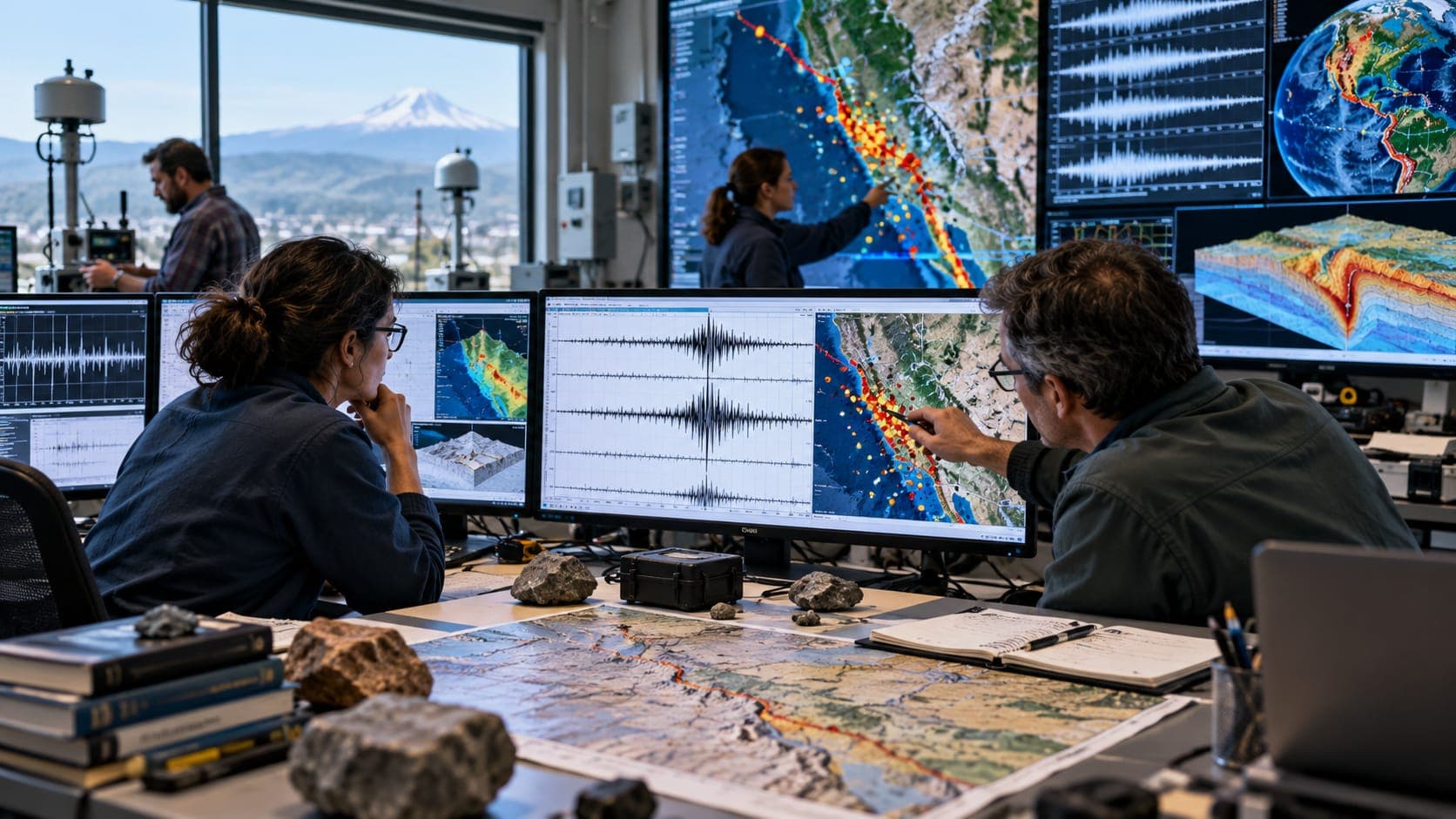
For more than a century, scientists have searched for a way to know when the next big earthquake will strike. They have watched animals, measured gases in wells, tracked tiny quakes and wired whole stretches of fault with instruments. These efforts taught us a great deal about how earthquakes work, but they did not produce a reliable way to predict them.
This article gives the direct answer, explains what was tried and why it is so hard, and offers a simple checklist for judging prediction claims you may come across.
Quick answer
No. Scientists cannot predict earthquakes, meaning they cannot say in advance the date and time, location and magnitude of a specific earthquake. The USGS says no scientist has ever predicted a major earthquake. Scientists can, however, estimate the probability of earthquakes in a region over years or decades and forecast aftershocks after a large quake.
The direct answer
A true prediction would name when, where and how big. The USGS is clear that this is not possible today and is not expected in the foreseeable future. Scientists can describe probabilities, such as the chance of a strong quake in a region over the next 30 years, but probabilities are forecasts, not predictions.
If you want the full comparison of prediction, forecasting and early warning, see earthquake prediction today or the lesson on forecasts, predictions and early warning.
A short history of prediction attempts
In the 1970s, many researchers were optimistic. Laboratory studies suggested rocks might change in measurable ways before they break, and several countries started prediction programs. Scientists looked for changes in the speed of seismic waves, ground tilt, groundwater levels, radon gas and electrical signals.
The most famous episode came in 1975 in Haicheng, China. Officials ordered evacuations after a burst of small earthquakes and other reported changes, and a large earthquake struck soon after. The story is often told as a success, but the warning depended on an unusual series of foreshocks that most large earthquakes do not have. The following year, the Tangshan earthquake struck without any such warning and killed a very large number of people.
Over the following decades, many apparent precursors that looked promising before one earthquake failed to appear before others, or appeared without any earthquake following. By the 1990s most seismologists had concluded that reliable short-term prediction was not within reach.
The Parkfield experiment
Parkfield, a tiny town on the San Andreas Fault in central California, had a series of moderate earthquakes of about magnitude 6 at fairly regular intervals since the 1800s. In the 1980s, the USGS forecast that the next one would probably occur by about 1993. Scientists filled the area with seismometers, strain meters, GPS stations and other instruments to catch any warning signs.
The expected earthquake did not arrive until 2004, more than a decade late. When it did, the dense instruments recorded it in great detail, but they did not show a clear warning signal in the hours or days before it. Parkfield taught two lessons: even fairly regular faults are not on a schedule, and the final moments before a rupture may give no obvious sign at the surface.
Why prediction is so hard
Several basic problems stand in the way, and they are not just a matter of needing more money or better computers.
- Earthquakes begin miles underground, where stress on a Fault cannot be measured directly.
- Faults are rough and uneven. Small differences along the fault decide whether a rupture stops small or grows into a large earthquake.
- Most large earthquakes do not have foreshocks, and when foreshocks happen they usually can only be identified after the main quake.
- Large earthquakes on any one fault are rare, so there are few examples to learn from.
- A useful method would need to work again and again with few false alarms, and none has passed that test.
When communication goes wrong
Prediction is not only a science problem but also a communication problem. Before the 2009 earthquake in L'Aquila, Italy, the region had been experiencing many small quakes, and residents were anxious. After the deadly earthquake, several scientists and an official were put on trial over how the risk had been described to the public. The scientists' convictions were later overturned on appeal.
The case showed how important it is to explain uncertainty clearly: activity can raise the chance of a large quake without making one certain. Today agencies such as the USGS publish probabilities so people can make their own informed choices.
How to judge a prediction claim
Earthquake predictions circulate online all the time, often tied to the Moon, planets or weather. Because earthquakes happen somewhere in the world every day, a vague claim will often seem to come true by chance. Ask these questions:
- Does it give a specific time window, location and magnitude range, or is it vague?
- Was it published before the event, in a place where it cannot be edited later?
- Does the person share a track record including misses, not just the hits?
- Has the method been tested by independent scientists and published?
- Is the USGS or your national geological agency saying the same thing?
Frequently asked questions
Will scientists ever be able to predict earthquakes?
No one can rule it out, but the USGS does not expect it in the foreseeable future. Research continues, and many scientists think progress is more likely in better forecasts and faster early warning than in exact predictions.
What happened with the Parkfield prediction?
Scientists expected a magnitude 6 earthquake at Parkfield, California, by about 1993 based on past regular events. It came in 2004 instead. Instruments recorded it in detail but showed no clear short-term warning sign beforehand.
Why do some people seem to predict earthquakes correctly?
Earthquakes happen constantly around the world, so a broad or vague prediction will often match some event by chance. People tend to remember the apparent hits and forget the many misses.
Are earthquakes more likely during a full moon?
Tidal forces from the Moon and Sun cause tiny stress changes in the Earth. Some studies have found a very small effect on certain faults, but it is far too weak to predict when an earthquake will happen.
Key takeaway
Scientists cannot predict earthquakes, and decades of serious effort, including the Parkfield experiment, have shown why. What they can provide is probabilities and forecasts, which are most useful when paired with everyday preparation.
Sources
- Can you predict earthquakes? — U.S. Geological Survey
- Earthquake Hazards Program — U.S. Geological Survey
- Earthquake Country Alliance — Earthquake Country Alliance