Can an Earthquake Cause a Tsunami?
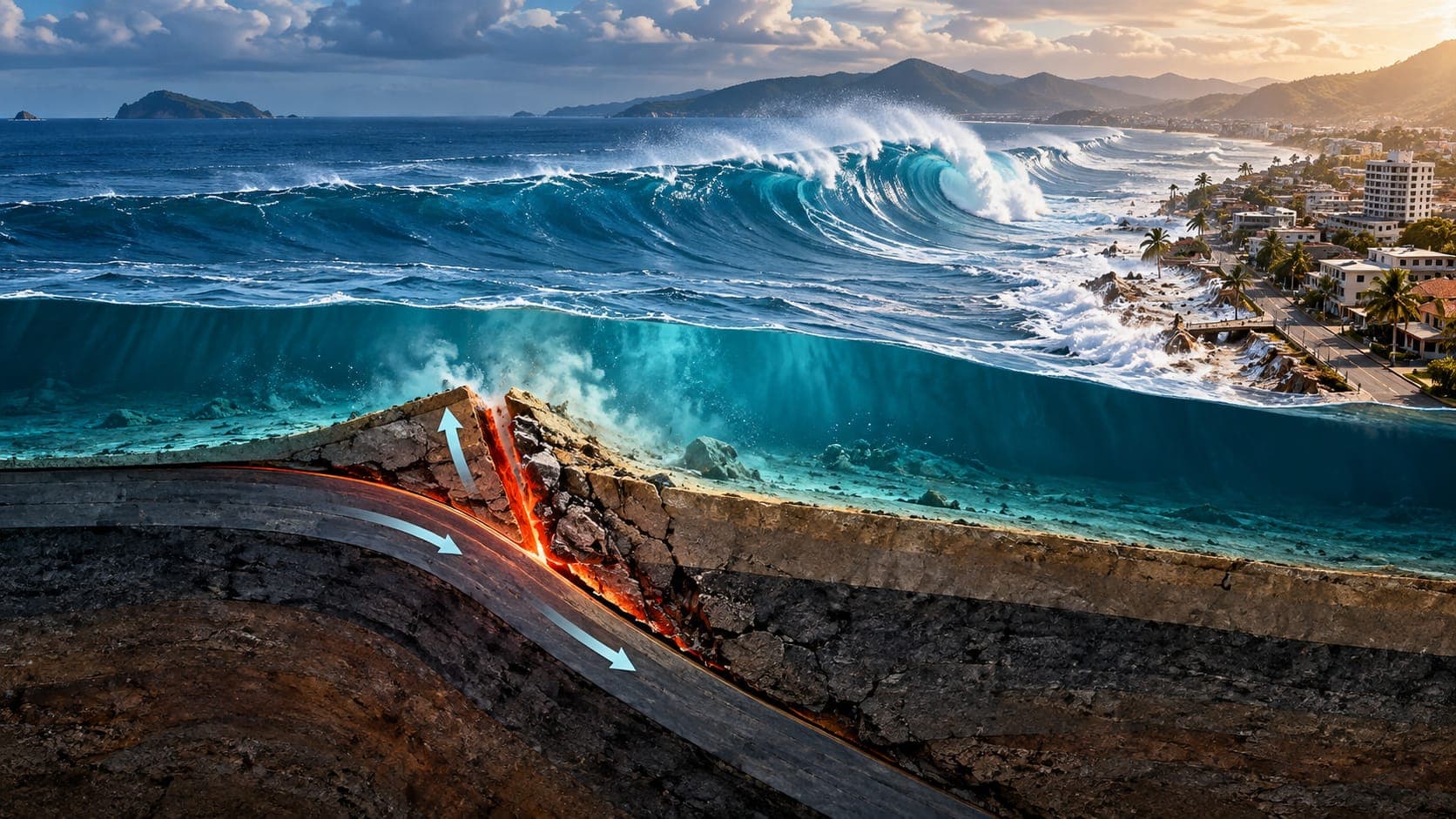
Yes, earthquakes are the most common cause of tsunamis. But most earthquakes, even most undersea earthquakes, do not cause a dangerous tsunami. Whether one forms depends on the size of the earthquake, its depth and, above all, how the sea floor moves.
This article explains how earthquakes create tsunamis, which earthquakes are most likely to do so, the natural warning signs to watch for and how official tsunami alerts work.
Quick answer
An earthquake can cause a tsunami when it suddenly lifts or drops a large area of sea floor, displacing the water above it. This usually requires a large, shallow undersea earthquake, typically magnitude 7 or greater, on a subduction zone. Tsunamis can also be caused by landslides and volcanic eruptions. If you are on the coast and feel strong or long shaking, move to high ground immediately without waiting for an official warning.
How an earthquake makes a tsunami
A Tsunami is a series of ocean waves caused by a sudden displacement of a large volume of water. In an earthquake, this happens when a Fault beneath the sea slips and the sea floor moves up or down. The entire column of water above it, from the bottom to the surface, is pushed up or pulled down at once. Gravity then pulls the water back to level, and waves spread out in all directions.
In the deep ocean, tsunami waves can travel at roughly the speed of a jet airliner, yet be only a small rise in the sea surface that ships hardly notice. As the waves reach shallow water near the coast they slow down and grow much taller, and they can flood far inland. A tsunami is not one wave but a series, often arriving many minutes apart, and the first wave is not always the largest.
Which earthquakes cause tsunamis
The most dangerous tsunamis come from large earthquakes on Subduction zones, where one plate slides beneath another. In these megathrust earthquakes, the overriding plate can spring upward over a very large area, lifting the water above it. The table summarizes the main factors.
| Factor | More likely to cause a tsunami | Less likely to cause a tsunami |
|---|---|---|
| Location | Under the sea or close to the coast | Far inland |
| Magnitude | Large, typically 7 or greater | Small to moderate |
| Depth | Shallow, near the sea floor | Deep, far below the sea floor |
| Fault motion | Vertical, as in subduction zone thrust faults | Mostly sideways, as in strike-slip faults |
Why most undersea earthquakes do not cause tsunamis
Many undersea earthquakes are too small, too deep or involve the wrong kind of motion. On a strike-slip fault, the two sides slide horizontally past each other, which moves little water up or down, so these earthquakes are less likely to cause large tsunamis. A deep earthquake hundreds of kilometers down does not move the sea floor enough. Even a magnitude 7 may produce only small sea-level changes.
That is why tsunami warning centers look at magnitude, location, Depth and sea-level measurements before deciding on an alert. Our lesson on why depth matters covers how depth changes an earthquake's effects.
Other causes of tsunamis
Earthquakes are not the only cause. Underwater or coastal landslides, which can be triggered by earthquakes, can displace water and produce very high local waves. Volcanic eruptions and the collapse of volcanic slopes can also cause tsunamis. These events can sometimes produce a tsunami larger than the earthquake alone would suggest, which is one reason any strong shaking on the coast should be taken seriously.
Local and distant tsunamis
A local tsunami is generated close to the coast and can arrive within minutes, sometimes before an official warning can reach everyone. A distant tsunami is generated far away, across an ocean, and may take many hours to arrive, which gives warning centers time to alert coastal communities. The 1960 Chilean earthquake, for example, produced a tsunami that reached Hawaii about 15 hours later, as described in our article on the biggest earthquake ever recorded.
Natural warning signs
For a local tsunami, nature may be your only warning. If you are near the coast and notice any of the following, move to high ground or inland immediately. Do not wait for an official alert, and do not go to the beach to watch.
- Strong shaking that makes it hard to stand, or shaking that lasts a long time.
- The sea suddenly pulling back and exposing the sea floor.
- A sudden rise of water or a fast-moving wall of water.
- A loud roar from the ocean, sometimes compared to a train or jet.
Official tsunami alerts
In the United States, NOAA's two Tsunami Warning Centers, the National Tsunami Warning Center and the Pacific Tsunami Warning Center, monitor earthquakes and sea levels and issue alerts, which are posted at tsunami.gov. Other countries have their own national agencies, such as the Japan Meteorological Agency.
U.S. alerts come in levels. A tsunami warning means a dangerous tsunami is expected or occurring and people should move to high ground or inland. A tsunami advisory means strong currents and waves are expected that are dangerous near the water, so stay out of it and away from beaches and harbors. A tsunami watch means a tsunami is possible and you should stay alert for more information. You can view current official NOAA alerts on the EQRadar tsunami page.
Frequently asked questions
What magnitude earthquake causes a tsunami?
Damaging tsunamis are usually caused by shallow undersea earthquakes of about magnitude 7 or larger. The largest ocean-crossing tsunamis come from earthquakes around magnitude 8.5 to 9 and above. Smaller earthquakes can occasionally cause small local tsunamis, especially if they trigger a landslide.
Can a strike-slip earthquake cause a tsunami?
It is less likely, because strike-slip faults move mostly sideways and displace little water. However, they can still cause local tsunamis, for example by triggering underwater landslides or where the fault has some vertical movement.
How fast can a tsunami arrive after an earthquake?
A local tsunami can arrive within minutes. A distant tsunami may take hours to cross an ocean. That is why people on the coast should move to high ground right after strong shaking rather than waiting.
When is it safe to return after a tsunami?
Only when local officials say it is safe. Tsunamis are a series of waves that can continue for hours, and later waves can be larger than the first.
Key takeaway
Earthquakes cause most tsunamis, but only when they suddenly move a large area of sea floor, usually in large, shallow subduction zone earthquakes. On the coast, strong or long shaking is your signal to move to high ground right away, without waiting for an official warning.
Sources
- U.S. Tsunami Warning System — NOAA / National Weather Service
- Tsunami Safety — National Weather Service (NOAA)
- Earthquake Hazards Program — U.S. Geological Survey