Foreshock vs Aftershock
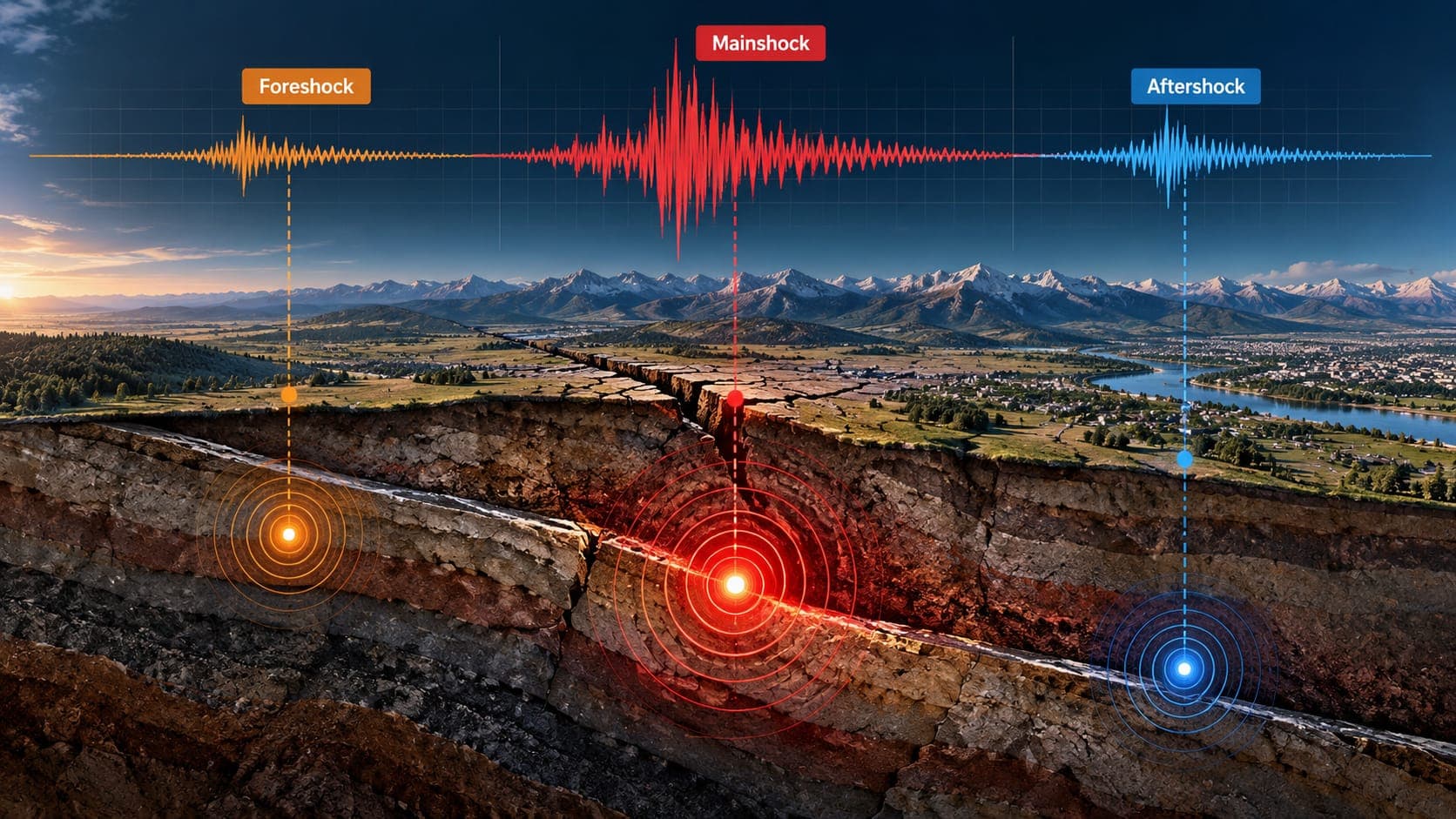
When several earthquakes strike the same area within a short time, news reports start using words like foreshock, mainshock and aftershock. They sound like different kinds of earthquakes, but they are not. All three are ordinary earthquakes; the labels only describe their order and size within a group.
This article explains each term, why the labels can change after the fact, and how earthquake swarms differ from typical sequences.
Quick answer
A foreshock is a smaller earthquake that comes before a larger one in the same place, and an aftershock is a smaller earthquake that comes after it. The largest earthquake in the group is the mainshock. Physically, foreshocks and aftershocks are not different from other earthquakes, and a foreshock can only be identified after the larger quake has happened.
Three labels in one sequence
Earthquakes that cluster closely in place and time form an earthquake sequence. Within a sequence, scientists use three labels:
- Mainshock: the largest earthquake in the sequence.
- Foreshock: a smaller earthquake before the mainshock, in the same area.
- Aftershock: a smaller earthquake after the mainshock, in the same area.
Foreshocks and aftershocks side by side
Both are smaller than the mainshock, and both happen near it. The main differences are timing, how common they are and what they mean for planning.
| Foreshock | Aftershock | |
|---|---|---|
| Timing | Before the mainshock | After the mainshock |
| How common | Most large quakes have none that are obvious | Nearly every sizable quake has them |
| When it is identified | Only after a larger quake follows | As soon as the mainshock is known |
| Number in a sequence | Usually few, if any | Can be hundreds or thousands |
| Useful for forecasting | Not on its own, because it looks like any small quake | Yes; aftershocks follow well-studied patterns |
Why foreshocks are only known in hindsight
A foreshock looks exactly like any other earthquake when it happens. Its waves, its size and its location give no reliable clue that a bigger earthquake is coming. Only when a larger quake follows does the earlier one get relabeled.
This is the main reason foreshocks cannot be used to predict earthquakes. Most small earthquakes are not followed by anything larger. The USGS commonly says about 1 in 20 earthquakes is followed by a larger one nearby, so any given small quake is far more likely to be an isolated event or the start of a normal aftershock pattern. For more on this, see can aftershocks be stronger?
When labels change
Because the labels depend on what happens next, they can change. In 2019 near Ridgecrest, California, a magnitude 6.4 earthquake was first reported as a mainshock. When a magnitude 7.1 struck nearby about a day and a half later, the 6.4 and the quakes after it became foreshocks of the 7.1, and the activity that followed became aftershocks of the larger quake.
Scientists also sometimes discuss whether a quake far from the original rupture counts as an aftershock or a separate earthquake that was triggered. There is no strict boundary, and different studies may draw it slightly differently.
Swarms: sequences without a clear mainshock
Not every cluster has a clear mainshock. In an earthquake swarm, many earthquakes of similar size happen in the same area over days, weeks or even months, without one standing out as the largest. Swarms are common in volcanic and geothermal areas, and in places where fluids move through faults.
Swarms usually involve small earthquakes and often end without a large one, but they are watched closely, especially near volcanoes. You can explore activity near volcanoes on the volcanoes page.
What this means in practice
For everyday safety, the labels matter less than the response. After any strong quake, assume more shaking is coming. Drop, Cover and Hold On during each one, and stay out of damaged buildings until they are checked.
For planning, aftershocks are where forecasting works best. After notable U.S. quakes, official USGS aftershock forecasts appear on EQRadar's risk page, and you can watch a sequence unfold on the timeline.
Frequently asked questions
Is a foreshock a warning sign?
Only in hindsight. A foreshock cannot be told apart from an ordinary small quake when it happens, and most small quakes are not followed by a larger one.
Do all earthquakes have foreshocks?
No. Many large earthquakes have no noticeable foreshocks at all. When foreshocks do occur, they may come minutes, hours or days before the mainshock.
Do all earthquakes have aftershocks?
Nearly every earthquake of moderate size or larger has aftershocks, though for smaller quakes they may be few and too small to feel.
What is the difference between a swarm and an aftershock sequence?
An aftershock sequence follows a clear mainshock and fades over time. A swarm has many quakes of similar size with no single dominant event, and its activity can rise and fall unpredictably.
Key takeaway
Foreshocks, mainshocks and aftershocks are all ordinary earthquakes labeled by their order and size within a sequence. Aftershocks are common and can be forecast; foreshocks are uncommon and can only be recognized after a larger quake happens.
Sources
- Earthquake Hazards Program — U.S. Geological Survey
- Aftershock Forecast — U.S. Geological Survey
- Can you predict earthquakes? — U.S. Geological Survey