Are Earthquakes Increasing?
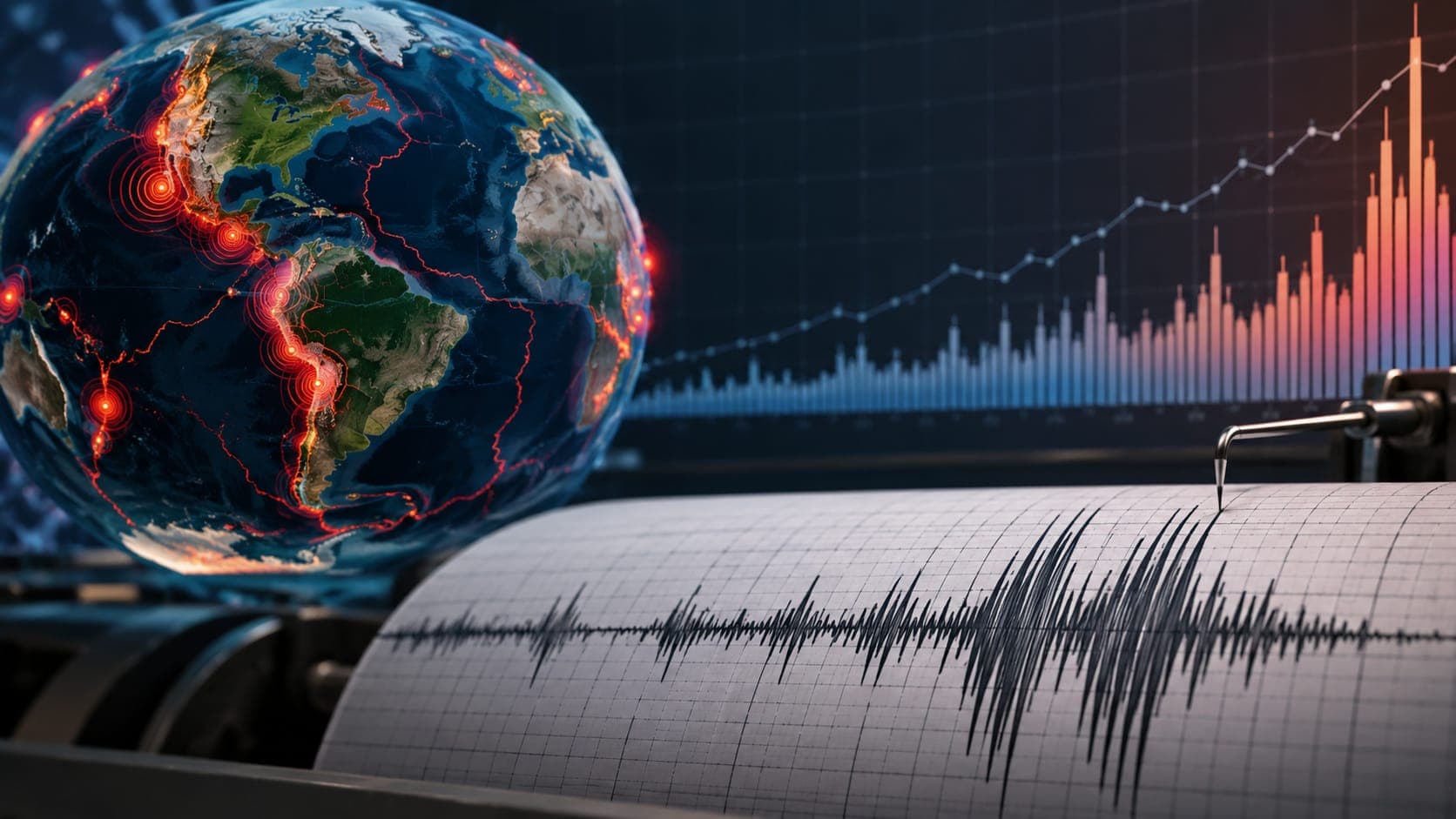
After a string of earthquakes in the news, it is natural to wonder whether the planet is becoming more active. Social media feeds, earthquake apps and live maps can make it feel as if earthquakes are happening more often than ever.
Scientists have looked at this question carefully. The short answer is no for natural earthquakes, but the full story includes better instruments, faster news, normal ups and downs, and one important human-caused exception.
Quick answer
No. The USGS explains that natural earthquake activity is not increasing over the long term. More earthquakes are being recorded because there are far more seismometers and faster communication. The number of large earthquakes, magnitude 7 or greater, has stayed fairly steady at roughly 15 per year on average, varying from year to year. Some regions have seen human-caused increases, such as Oklahoma from wastewater injection.
Why it can feel like earthquakes are increasing
Several things make earthquakes more visible today than in the past, even though the Earth is not producing more of them:
- Many more seismometers: global and regional networks have grown from a few hundred stations in the early twentieth century to many thousands today, so far more small earthquakes are detected and located.
- Faster communication: earthquake data now reach the public within minutes through websites, apps and alerts, so people hear about earthquakes they never would have known about.
- More news and social media: a large earthquake anywhere is now global news within an hour, and dramatic videos spread quickly.
- More people living in active areas: as cities grow, more earthquakes affect people and make headlines.
What the long-term records show
The best way to test whether earthquakes are increasing is to look at large earthquakes, because they are recorded reliably worldwide regardless of where they happen. The USGS notes that the world averages roughly 15 earthquakes of Magnitude 7 or larger per year, including about one of magnitude 8 or larger. Some years have noticeably more and some fewer, but there is no long-term upward trend.
Counts of small earthquakes, by contrast, have risen in catalogs over the decades. That reflects better detection, not more activity. A small earthquake that went unrecorded in 1950 may be detected and published automatically today. You can see how catalogs fill in with small events by searching past years on EQRadar's history view.
Clusters and random ups and downs
Earthquakes do not occur evenly in time. Large earthquakes are followed by aftershocks, sometimes thousands of them, which can make a single month or year look busy. One major sequence can dominate a year's totals.
Even apart from aftershocks, random events naturally bunch up. Flip a coin enough times and you will see runs of heads. Several great earthquakes happened between 2004 and 2011, including Sumatra, Chile and Japan, and statistical studies have generally found such clusters to be consistent with chance rather than a sign of a global increase.
A real increase: human-caused earthquakes
There is one important case where earthquakes really did increase: induced seismicity. Starting around 2009, Oklahoma went from having only a few felt earthquakes each year to having hundreds of magnitude 3 or larger earthquakes per year by the mid-2010s, peaking around 2015. Parts of Kansas and Texas saw increases too.
Research led by the USGS and others linked most of this activity to the disposal of large volumes of wastewater, much of it salty water produced along with oil and gas, injected deep underground. The fluid raised pressure on existing faults and helped them slip. The largest was the magnitude 5.8 Pawnee earthquake in 2016. After regulators required cuts in injection volumes, the rate of earthquakes in Oklahoma dropped substantially.
This is a real but separate, human-caused effect, limited to specific regions. It does not mean natural earthquakes are increasing worldwide.
Myths about earthquake trends
A few ideas come up often when people ask whether earthquakes are increasing:
| Claim | What the evidence shows |
|---|---|
| Earthquakes are increasing every year | Large earthquake counts vary but show no long-term rise |
| Climate change is causing more earthquakes | No measurable effect on global earthquake rates has been shown; plate motion drives earthquakes |
| Planetary alignments or eclipses trigger big quakes | No reliable link has been found |
| A busy month means a big one is coming | Short-term ups and downs are normal and do not predict a specific large earthquake |
What this means for you
Earthquake activity is steady over the long term, which means places with high hazard have always had it and will continue to. The practical response does not change with the headlines: know your local hazard, secure heavy objects at home, keep supplies, and practice Drop, Cover and Hold On.
When you see a busy week on the EQRadar live map, remember that it shows every earthquake the USGS reports, including many small ones that older catalogs would have missed. To see how unusual a period really is, compare it with past years in the timeline, or check EQRadar's outlook, which describes probabilities based on past rates, not predictions.
Frequently asked questions
How many earthquakes happen each year?
Millions of earthquakes happen each year, but most are too small to feel. Seismic networks locate hundreds of thousands. On average, there are roughly 15 earthquakes of magnitude 7 or larger per year worldwide.
Was this year unusually active?
Possibly, but a single year with more large earthquakes than average is normal variation. Scientists look at decades of data to judge trends, and the long-term rate of large earthquakes has been fairly constant.
Can human activity cause earthquakes?
Yes, in some cases. Deep wastewater injection, some geothermal projects, reservoir filling and mining have all been linked to earthquakes. The rise in Oklahoma from about 2009 to 2015 is the best-known U.S. example.
Does one large earthquake trigger others around the world?
A large earthquake triggers aftershocks nearby, and its passing waves can briefly trigger small earthquakes at distance. There is no good evidence that it triggers other large earthquakes on the far side of the world.
Key takeaway
Natural earthquakes are not increasing. Far more are being recorded thanks to better instruments and faster communication, while the rate of large earthquakes, around 15 magnitude 7 or larger per year, has stayed fairly steady. Human-caused increases, such as in Oklahoma, are real but local.
Sources
- Why are we having so many earthquakes? Has naturally occurring earthquake activity been increasing? — U.S. Geological Survey
- Earthquake Hazards Program — U.S. Geological Survey
- Search Earthquake Catalog — U.S. Geological Survey