What to Do During an Earthquake Indoors
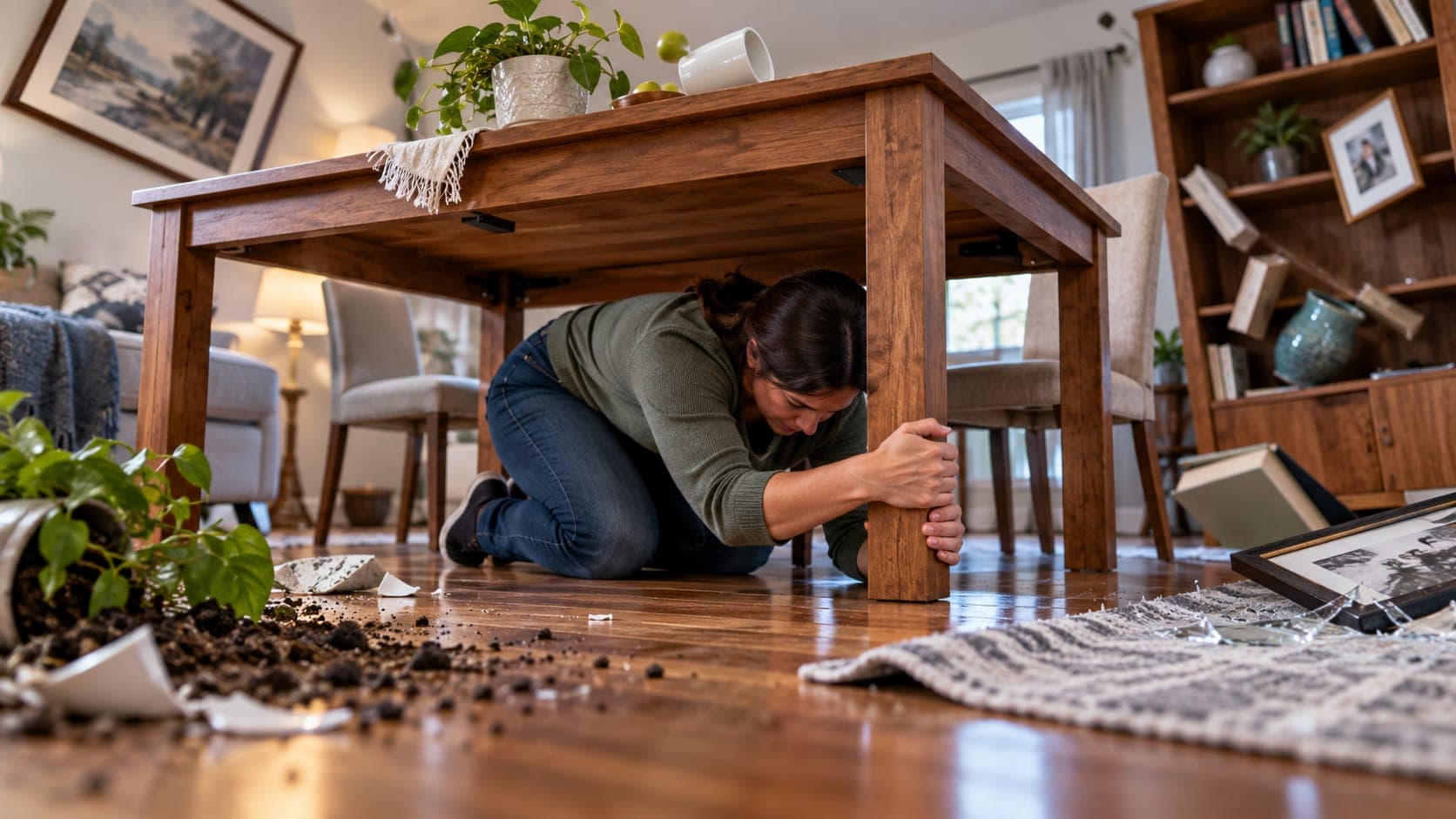
Strong shaking can make it nearly impossible to walk or even stand. In those first seconds, you do not have time to weigh options. That is why safety agencies teach one simple action for most indoor situations: Drop, Cover and Hold On.
This article explains each step in detail and then covers what to do during an earthquake indoors in specific places, from the kitchen and your bed to a high-rise office, a store, a theater or a classroom.
Quick answer
Indoors, Drop, Cover and Hold On. Drop to your hands and knees, cover your head and neck, ideally under a sturdy table or desk, and hold on until the shaking stops. If there is no table, crawl to an interior wall away from windows and cover your head and neck with your arms. Stay inside, and do not run outside or stand in a doorway. In bed, stay there and cover your head with a pillow.
Drop, Cover and Hold On, step by step
Drop, Cover and Hold On is recommended by Ready.gov, USGS and the Earthquake Country Alliance because it protects you from the most common causes of injury: falling down and being hit by flying or falling objects.
- Drop: get down on your hands and knees right where you are. This position keeps you from being knocked over and still lets you crawl if you need to.
- Cover: protect your head and neck with one arm and hand. If a sturdy table or desk is nearby, crawl under it. If not, crawl next to an interior wall, away from windows, and keep your head and neck covered with both arms.
- Hold On: if you are under a table, hold on to it with one hand and be ready to move with it if it shifts. If you have no shelter, keep holding your head and neck with both arms.
- Stay put until the shaking stops. Then look around carefully before getting up.
What not to do
Do not run outside. Many people are hurt trying to move during shaking, and the area just outside a building is where glass, bricks and other debris often land. Do not stand in a doorway either. In modern homes, doorways are not stronger than other parts of the house, and a swinging door can hurt you. Our article on the doorway myth explains why, along with the triangle-of-life idea, which safety agencies do not recommend.
At home: kitchen, bathroom and bed
In the kitchen, move away from the stove, the refrigerator and cabinets full of glass if you can do it in a step or two, then Drop, Cover and Hold On. A sturdy kitchen table makes good cover. Do not try to turn off the stove or catch falling dishes during shaking. Deal with the stove once it stops.
In the bathroom, drop to the floor away from the mirror and any glass shower doors, and cover your head and neck. In bed, stay there. Lie face down and cover your head and neck with a pillow. Getting out of bed in the dark means walking on broken glass and risking a fall. This is one reason to keep shoes and a flashlight by the bed.
If you use a wheelchair, walker or cane
The Earthquake Country Alliance gives specific advice for people who cannot easily get to the floor. The goal is the same: protect your head and neck and stay where you are.
| If you use | What to do |
|---|---|
| Wheelchair | Lock your wheels. Bend over as far as you can and cover your head and neck with your arms or a book. |
| Walker | Lock the wheels if it has them. Bend over and cover your head and neck. |
| Cane | Drop, Cover and Hold On if you can. Otherwise sit down in a chair or on a bed and bend over to cover your head and neck. |
| Cannot get down or bend | Stay where you are and cover your head and neck with your arms, a pillow or a book. |
In a high-rise building
In a tall building, Drop, Cover and Hold On under a desk or table, away from windows and outside walls. Stay on the floor where you are. Upper floors can sway more and for longer than lower floors, which can be alarming but is normal for a tall building.
Expect fire alarms and sprinklers to go off, and the power may go out. Do not use elevators, during or after the shaking. When it stops, follow your building's emergency plan and use the stairs if you need to leave.
In stores, theaters and stadiums
In a store, move away from tall shelves, display cases and glass if you can do it quickly, then Drop, Cover and Hold On. Shopping carts or shelving units are not good cover. Stay away from exits during shaking, because crowds may rush there.
In a theater, stadium or arena, stay in your seat or drop to the floor between the rows. Bend over and protect your head and neck with your arms. When the shaking stops, leave calmly and watch for falling objects. Follow directions from staff.
At school or work
Students should get under their desks or tables and hold on, facing away from windows. Teachers lead the class and keep everyone in place until the shaking ends, then follow the school's evacuation plan. Many schools practice during the annual Great ShakeOut drill.
At work, get under your desk and hold on to it. If you work near machinery, step away from it if you can do so in a step or two. Learn your workplace plan ahead of time, including where to meet after evacuating.
When the shaking stops
Count to 60 after the shaking ends before moving, which gives loose objects time to settle. Then check yourself and others for injuries, put on shoes, and look for hazards such as gas leaks or fire. If the building is damaged, leave carefully. Expect aftershocks, and Drop, Cover and Hold On each time. Our guide on what to do after an earthquake covers the next steps.
Frequently asked questions
What if there is no table or desk nearby?
Do not go looking for one during strong shaking. Drop where you are or crawl a short distance to an interior wall away from windows and tall furniture, and cover your head and neck with your arms.
Why should I stay in bed during an earthquake?
Getting up in the dark during shaking risks falling and stepping on broken glass. Lying face down with a pillow over your head and neck protects you better, as long as nothing heavy hangs over the bed.
Should I try to get outside if I am on the ground floor?
No. Even on the ground floor, the recommended action is to Drop, Cover and Hold On. Debris often falls just outside exits, and moving during shaking causes many injuries.
How long does earthquake shaking usually last?
Most felt earthquakes shake for seconds. Very large earthquakes can shake for a minute or longer. Keep holding on until the shaking has fully stopped.
Key takeaway
Indoors, Drop, Cover and Hold On wherever you are, ideally under a sturdy table. Stay in bed with a pillow over your head, lock your wheels if you use a wheelchair, skip the doorway and the dash outside, and never use elevators.
Sources
- Drop, Cover, and Hold On — Earthquake Country Alliance
- Earthquakes — Ready.gov (U.S. Department of Homeland Security)
- Great ShakeOut Earthquake Drills — Earthquake Country Alliance