How Long Do Aftershocks Last?
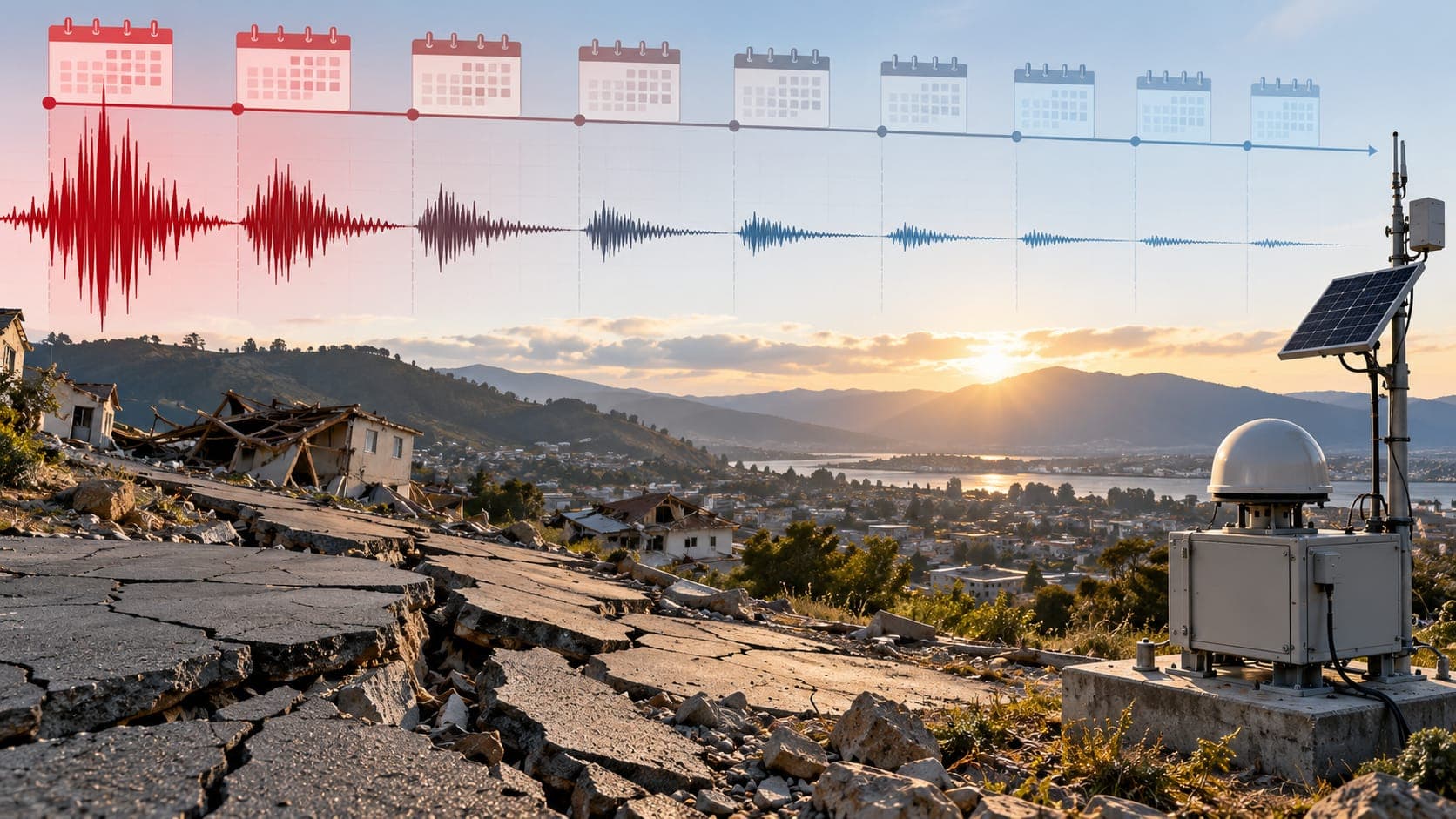
One of the first questions people ask after a strong earthquake is when the shaking will finally stop. Living through repeated aftershocks is tiring and stressful, and it helps to know what to expect.
The answer depends mostly on how big the main earthquake was. Aftershocks always fade over time, but for the largest earthquakes the tail can stretch on for years.
Quick answer
Aftershocks are most frequent in the first hours and days after the main earthquake, then become steadily less common. For a moderate earthquake, noticeable aftershocks usually fade within days to weeks. For a large earthquake, felt aftershocks can continue for months, and small ones can go on for years or even decades. A damaging aftershock is still possible weeks or months later, just less likely.
Aftershocks fade quickly at first, then slowly
Aftershock activity follows a well-known pattern called Omori's law. The rate of aftershocks drops roughly in proportion to the time since the Mainshock. In simple terms, there might be about half as many aftershocks on day 2 as on day 1, and roughly a tenth as many on day 10.
This means the drop feels dramatic in the first week, then seems to stall. The decline continues, but because the numbers are already lower, each further step takes longer. That slow tail is why aftershocks from a big earthquake can keep going long after daily life has returned to normal.
Bigger earthquakes, longer sequences
A larger mainshock ruptures more of the fault and disturbs stress over a bigger area. It produces many more aftershocks, and it takes much longer for the rate to fall back to the area's normal background level.
| Mainshock size | Felt aftershocks | Elevated small-quake activity |
|---|---|---|
| Around magnitude 5 | Usually days to a few weeks | Weeks to months |
| Around magnitude 6 | Weeks to months | Months to a few years |
| Magnitude 7 and larger | Months to a year or more | Years, sometimes decades |
Other things that affect how long they last
Size is the biggest factor, but not the only one. Two earthquakes of the same magnitude can have quite different sequences.
- Tectonic setting: some regions are known for productive sequences with many aftershocks, while others typically have fewer.
- Fault complexity: a rupture that involves several fault segments may trigger activity on more faults.
- Depth: very deep earthquakes generally produce fewer aftershocks than shallow ones.
- Background activity: in busy areas, aftershocks blend into normal activity sooner; in quiet areas they stand out for longer.
Aftershocks that last for decades
For the largest earthquakes, the aftershock tail can be remarkably long. Small aftershocks from great earthquakes, such as the 2011 Tohoku earthquake in Japan, continued for years. In regions with little background activity, some scientists think that part of today's small-quake activity may still be the tail of very large earthquakes that happened long ago, such as the New Madrid earthquakes of 1811 and 1812 in the central United States.
These late aftershocks are usually small. Still, a sizable aftershock can occasionally occur months or even years after a great earthquake, which is why agencies keep updating forecasts for large sequences over long periods.
How to read a USGS aftershock forecast
After notable U.S. earthquakes, the USGS publishes an aftershock Forecast, and EQRadar shows these official forecasts for active sequences on the risk page. The forecast usually lists, for the next day, week, month and year, the chance of at least one aftershock of magnitude 3 or larger, 5 or larger, 6 or larger, and 7 or larger, plus a likely range for how many will occur.
A few tips make the numbers easier to use:
- Longer time windows always show higher chances, because there is more time for an aftershock to happen.
- Pay most attention to the chance of an aftershock large enough to cause damage where you are, often magnitude 5 or 6 and up.
- The range of expected numbers shows uncertainty. The real count could be near either end.
- Check back. Forecasts are updated as the sequence develops, and chances usually shrink over time.
- A low chance is not zero. Keep your safety plan in place until officials say activity has returned to normal.
Coping with a long sequence
Ongoing aftershocks can make it hard to sleep or concentrate. It can help to keep a small routine: shoes and a flashlight by the bed, a clear path to a safe spot, and a sturdy table to get under. Drop, Cover and Hold On during each aftershock, and stay out of damaged buildings until they are inspected.
It is normal to feel anxious or jumpy, especially for children. Talking about what aftershocks are and why they slowly fade can make them feel less threatening. For practical steps, see what to do after an earthquake.
Frequently asked questions
When will the aftershocks stop?
There is no single end date. Aftershocks gradually decrease until they blend into the normal background activity for the area. For a moderate quake that may take weeks; for a very large quake it can take years.
Can a big aftershock happen weeks later?
Yes. The chance gets smaller over time, but a strong aftershock can occur weeks, months or occasionally years after a large earthquake. The USGS aftershock forecast shows the current chances.
Why does it feel like aftershocks are not slowing down?
Most of the drop happens in the first few days. After that, the decline continues but more slowly, and a single strong aftershock can make it feel as if things are starting over.
Does a large aftershock restart the sequence?
A large aftershock can produce its own smaller aftershocks, temporarily raising activity. Forecasts take this into account and are updated after significant aftershocks.
Key takeaway
Aftershocks fade fast at first and then slowly. Small earthquakes have short sequences, while large ones can produce aftershocks for months or years. Check the official USGS forecast, and keep practicing Drop, Cover and Hold On until activity settles down.
Sources
- Aftershock Forecast — U.S. Geological Survey
- Earthquake Hazards Program — U.S. Geological Survey
- Earthquakes — Ready.gov (U.S. Department of Homeland Security)