Can Aftershocks Be Stronger?
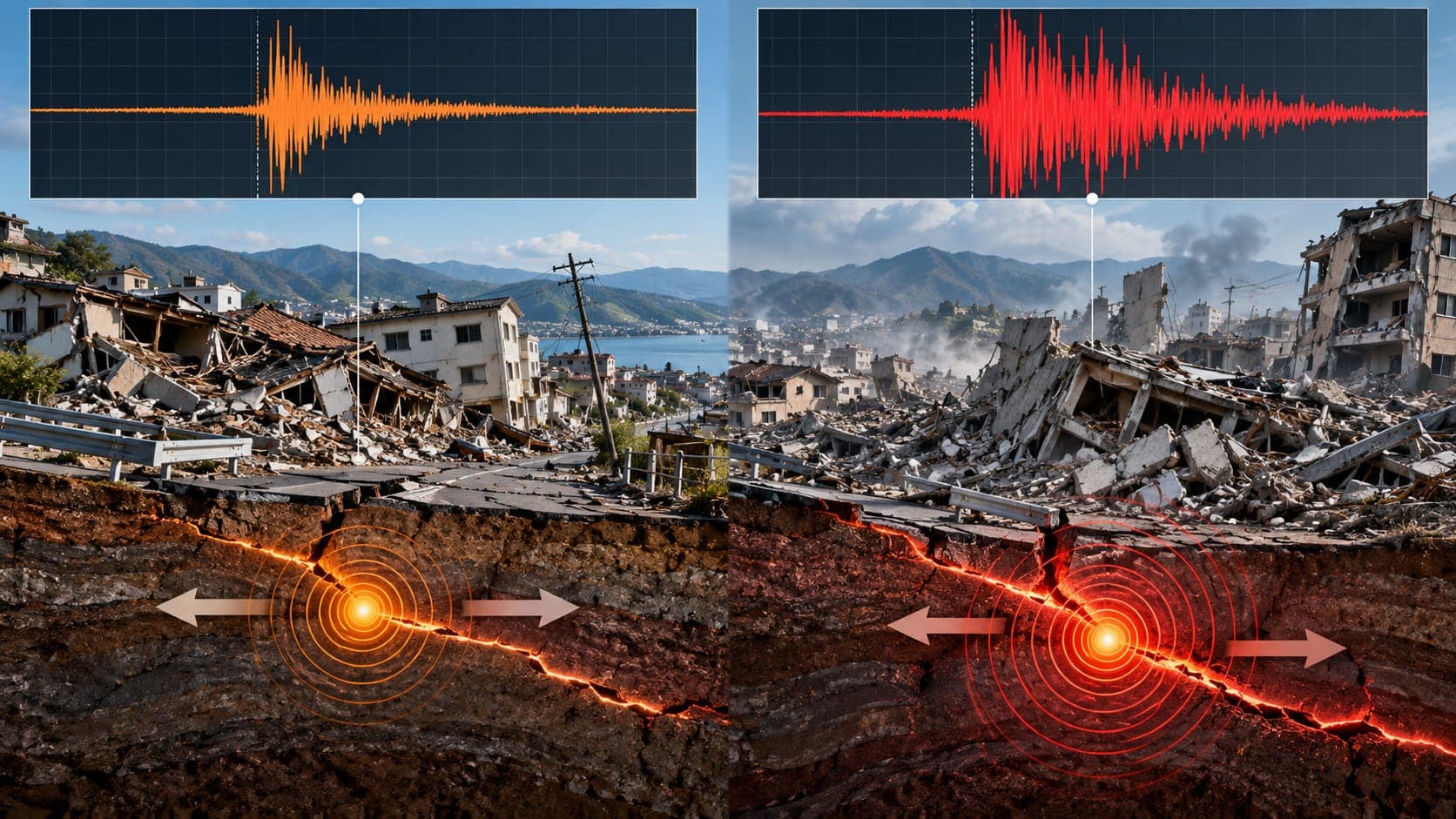
After an earthquake, many people worry that something worse is still to come. It is a fair concern. Occasionally, an earthquake is followed within hours or days by a larger one nearby, and those cases tend to make headlines.
The question of whether aftershocks can be stronger has a surprising answer that comes down to how earthquakes are labeled. Understanding it helps explain what forecasts mean when they talk about the chance of a bigger quake.
Quick answer
No, by definition an aftershock is smaller than the mainshock. But sometimes an earthquake is followed by a larger one. When that happens, the larger quake becomes the mainshock and the first one is relabeled a foreshock. The USGS commonly says there is about a 1 in 20 chance (about 5 percent) that an earthquake will be followed by a larger one nearby, usually within a few days.
It comes down to how earthquakes are named
In an earthquake sequence, the largest event is called the Mainshock. Every smaller event after it is an Aftershock, and every smaller event before it is a Foreshock. These labels describe each quake's place in the sequence, not anything about the quake itself.
So if an earthquake is followed by a bigger one, the first was not the mainshock after all. Scientists update the labels: the bigger quake becomes the mainshock, and the earlier quake becomes a foreshock. That is why an aftershock can never be stronger than the mainshock, while a later earthquake certainly can be stronger than an earlier one.
How often is a quake followed by a bigger one?
Most earthquakes are not followed by anything larger. The USGS commonly says that about 1 in 20 earthquakes, roughly 5 percent, is followed by a larger earthquake nearby. When it happens, the larger quake usually comes within the first few days, and the chance is highest in the first hours.
This is an average across many earthquakes. The chance for any single sequence can be somewhat higher or lower depending on the region and how the sequence is behaving, which is one reason the USGS issues sequence-specific forecasts.
Real examples
Several well-studied sequences show how a strong earthquake can turn out to be a foreshock.
| Sequence | First large quake | Larger quake that followed |
|---|---|---|
| Ridgecrest, California, 2019 | Magnitude 6.4 on July 4 | Magnitude 7.1 about a day and a half later |
| Kumamoto, Japan, 2016 | A magnitude 6-class quake on April 14 | Magnitude 7.0 about a day later |
| Tohoku, Japan, 2011 | Magnitude 7.3 on March 9 | Magnitude 9.0-9.1 two days later |
What the Ridgecrest sequence showed
In July 2019, a magnitude 6.4 earthquake struck near Ridgecrest in Southern California. The USGS quickly issued an aftershock forecast that included a small but real chance of an even larger quake. The next evening, a magnitude 7.1 earthquake struck nearby, and the 6.4 became a foreshock.
The forecast did not predict the 7.1. It correctly described that a larger quake was possible but unlikely. That is exactly how these forecasts are meant to be read: as honest probabilities that help people stay alert, not as yes-or-no answers.
How forecasts handle the chance of a bigger quake
USGS aftershock forecasts usually include the chance of a quake as large as or larger than the mainshock during the next week. This number is typically small, and it shrinks quickly as time passes without a larger quake. If a larger earthquake does occur, the forecast is redone around the new mainshock.
EQRadar shows official USGS aftershock forecasts for active sequences on the risk page, and the EQRadar outlook gives statistical probability estimates for broader areas. Neither is a prediction. For more on how sequences behave, see what are earthquake aftershocks?
What this means for you
Since you cannot know in the moment whether an earthquake is the mainshock, treat the first few days after any strong quake as a time of extra caution.
- Expect more shaking. Drop, Cover and Hold On during each aftershock, or during any larger quake.
- Stay out of buildings that look damaged until they are inspected, since a later quake could finish what the first started.
- Near the coast, if you felt strong or long shaking, move to high ground right away without waiting for an official alert.
- Use this time to restock water, charge phones and check that your household knows its plan.
- Follow official sources such as the USGS and local emergency managers rather than rumors.
Frequently asked questions
How do I know if the earthquake I just felt was the main one?
You cannot know right away. Only time will tell. Most of the time the first strong quake turns out to be the largest, but about 1 in 20 times a larger quake follows, usually within a few days.
If an aftershock is almost as strong as the mainshock, is something unusual going on?
Not necessarily. The largest aftershock is often about 1.2 magnitude units smaller than the mainshock, but that is only an average. Some sequences have large aftershocks close in size to the mainshock.
Does a larger quake that follows count as a new earthquake?
It is a new earthquake, but it is part of the same sequence. Scientists then treat it as the mainshock, and the earlier quake is relabeled a foreshock.
How long does the higher chance of a bigger quake last?
The chance is highest in the first hours and days after an earthquake and drops quickly after that. Check the latest USGS aftershock forecast for the current numbers.
Key takeaway
Aftershocks are smaller than the mainshock by definition, but a quake can be followed by a larger one, which then becomes the mainshock. This happens roughly 1 in 20 times, usually within days, so stay cautious after any strong earthquake.
Sources
- Aftershock Forecast — U.S. Geological Survey
- Earthquake Hazards Program — U.S. Geological Survey
- Earthquakes — Ready.gov (U.S. Department of Homeland Security)