Earthquake Preparedness for Families
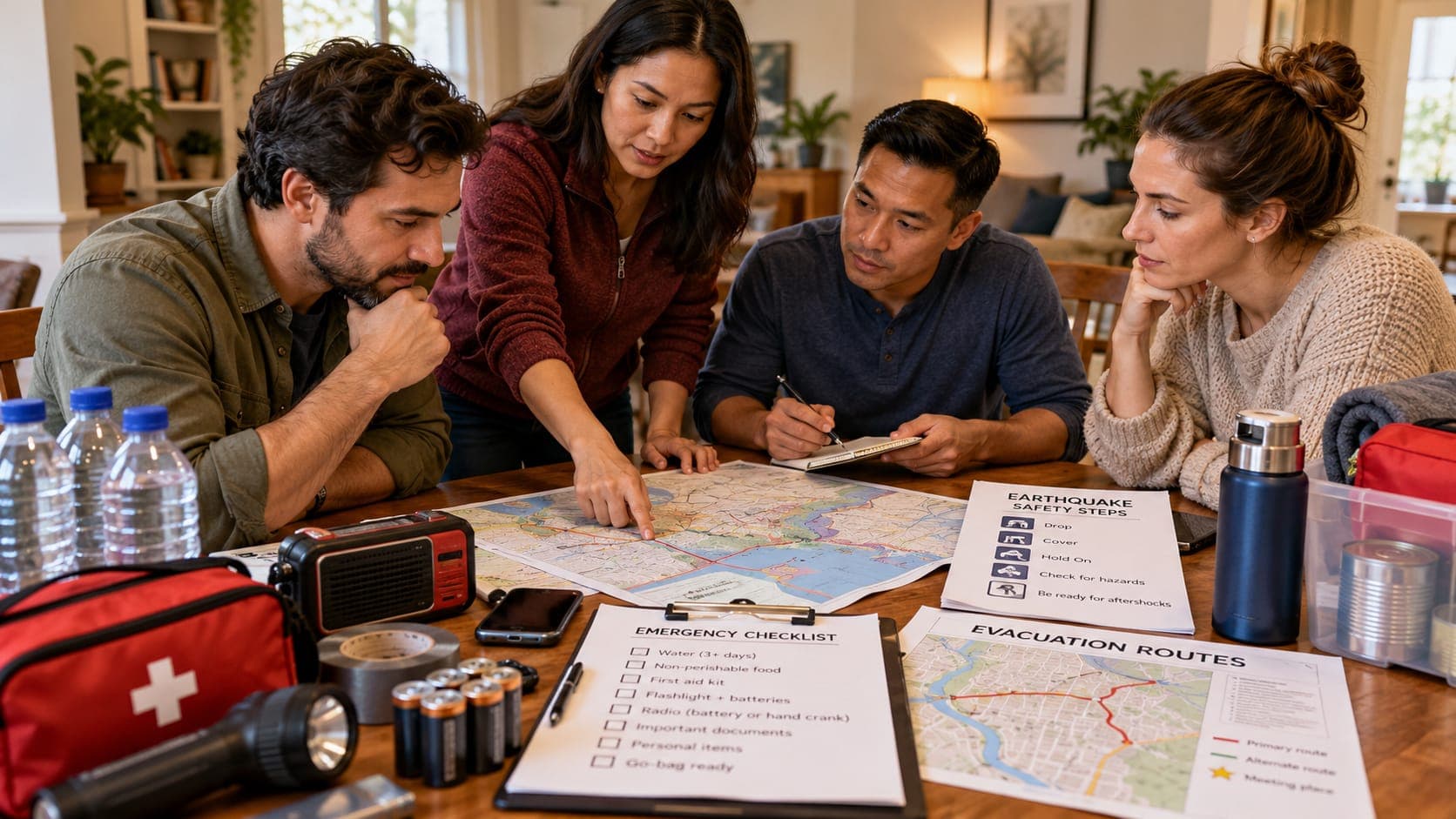
Preparing a family for earthquakes means preparing several different people, each with their own needs. A toddler, a teenager, a grandparent and a dog will each need something slightly different during and after shaking.
This guide focuses on earthquake preparedness for families: how to talk with children without scaring them, how to connect your plan with school, how to practice, and how to plan for babies, pets, older relatives and family members with disabilities. For the general steps every household should take, see how to prepare for an earthquake.
Quick answer
To prepare your family for an earthquake, explain earthquakes to children calmly and simply, practice Drop, Cover and Hold On together, and learn your children's school emergency plan. Pack a small go-bag for each child, and plan for babies, pets, older relatives and anyone with a disability. Agree on an out-of-area contact and meeting places, and practice your plan at least once a year.
Talking to kids without fear
Children take their cues from adults. If you talk about earthquakes calmly, as a normal part of living in a place with earthquakes, they are more likely to feel confident than scared. Focus on what the family will do, rather than on what could go wrong.
- Keep it simple: the ground can shake, and we know what to do when it does.
- Explain that shaking usually lasts a short time and that grown-ups have a plan.
- Turn practice into a game for younger children, such as a turtle pose under the table.
- Answer questions honestly and briefly. It is fine to say you do not know when an earthquake will happen, because nobody does.
- Limit exposure to dramatic news footage, especially for young children.
- Give older children real jobs, such as checking flashlights or helping with the pet kit.
School and childcare plans
Children spend much of their week at school or childcare, so their plans are part of your plan. Ask how the school practices earthquake drills, where students go after evacuating, how long students would be kept on site, and how parents will be contacted. Find out the release procedure, including who is allowed to pick up your child.
Make sure the school has up-to-date emergency contacts, including at least one person other than you who can pick up your child. After a large earthquake, roads and phones may not work well, and it could take time to reach the school. Tell your children that the staff will keep them safe until a trusted adult arrives.
Practice as a family
Practice is what turns a plan into a reflex. Run short drills a few times a year, in different rooms and at different times of day. Many families use the annual Great ShakeOut drill as a reminder.
- Call out Earthquake! and have everyone Drop, Cover and Hold On where they are.
- Count slowly to 60 while holding on, so children learn to wait until shaking stops.
- Practice from bed: stay there, face down, with a pillow over the head and neck.
- After the drill, walk through what happens next: shoes on, check on each other, grab the kit.
- Practice sending a short text to your out-of-area contact.
- Talk about what went well and what to change.
Go-bags for kids
Children can carry a small backpack of their own. Keep it light and include things that offer comfort as well as practical help. Update it as they grow.
- Water bottle and favorite snacks that will keep.
- Small flashlight and a whistle.
- A change of clothes and sturdy shoes that fit.
- A family photo and a card with names, phone numbers and the meeting place.
- A small toy, book, game or comfort item.
- Any daily medicine, packed with an adult's help.
Babies and toddlers
If you are holding a baby when shaking starts, drop to the floor and cover the baby with your body while protecting your own head and neck as best you can. Place cribs away from windows, and do not hang pictures, mirrors or shelves above them.
Add a few days of formula, bottles, clean water for mixing, diapers, wipes and baby medicines to your home kit. A baby carrier or sling makes it easier to carry a young child over debris and keep your hands free.
Pets
Animals often panic during shaking and may hide or run away afterward. Do not try to catch a pet while the ground is shaking. Protect yourself first, then find your pet when it is safe.
Keep a pet kit with food, water, medicines, a leash or carrier, waste bags and a recent photo of your pet in case you are separated. Make sure collars and ID tags are current, and ask your vet about microchipping.
Older relatives and family members with disabilities
Talk with older relatives about how they would protect themselves during shaking and who would check on them afterward. People who use a wheelchair or walker should lock the wheels, bend over and cover their head and neck. People who use a cane can drop, cover and hold on, or sit down and cover their head and neck.
Store extra medicines, a written list of medicines and doses, spare glasses, hearing aid batteries and chargers for medical devices. If someone depends on electricity for medical equipment, plan for a power outage ahead of time, and ask the utility whether it has a program for customers with medical needs. Build a small support network of neighbors or friends who know the plan.
Frequently asked questions
At what age can children learn Drop, Cover and Hold On?
Even young children can learn it, especially if you practice it as a game. Many preschools and elementary schools include earthquake drills, so practicing at home reinforces what they learn there.
Should I go to my child's school right after an earthquake?
Follow the school's reunification plan and listen for official instructions. Schools practice keeping students safe on site. Rushing there can clog roads that emergency crews need, and you may not be allowed to pick up your child until staff are ready.
How do I calm a child who is scared of aftershocks?
Stay calm, keep routines as normal as possible, and remind them of what to do if the ground shakes again. Let them talk about their feelings, and limit news coverage. If fear lasts a long time, talk with a pediatrician or counselor.
What if my family is apart when an earthquake hits?
That is why an out-of-area contact and meeting places matter. Everyone texts the same contact to check in, then follows the plan to reunite when it is safe.
Key takeaway
Talk about earthquakes calmly, practice together, know the school plan, give each child a small go-bag, and plan ahead for babies, pets, older relatives and family members with disabilities.
Sources
- Earthquakes — Ready.gov (U.S. Department of Homeland Security)
- Drop, Cover, and Hold On — Earthquake Country Alliance
- Great ShakeOut Earthquake Drills — Earthquake Country Alliance
- American Red Cross — American Red Cross