Richter Scale Explained
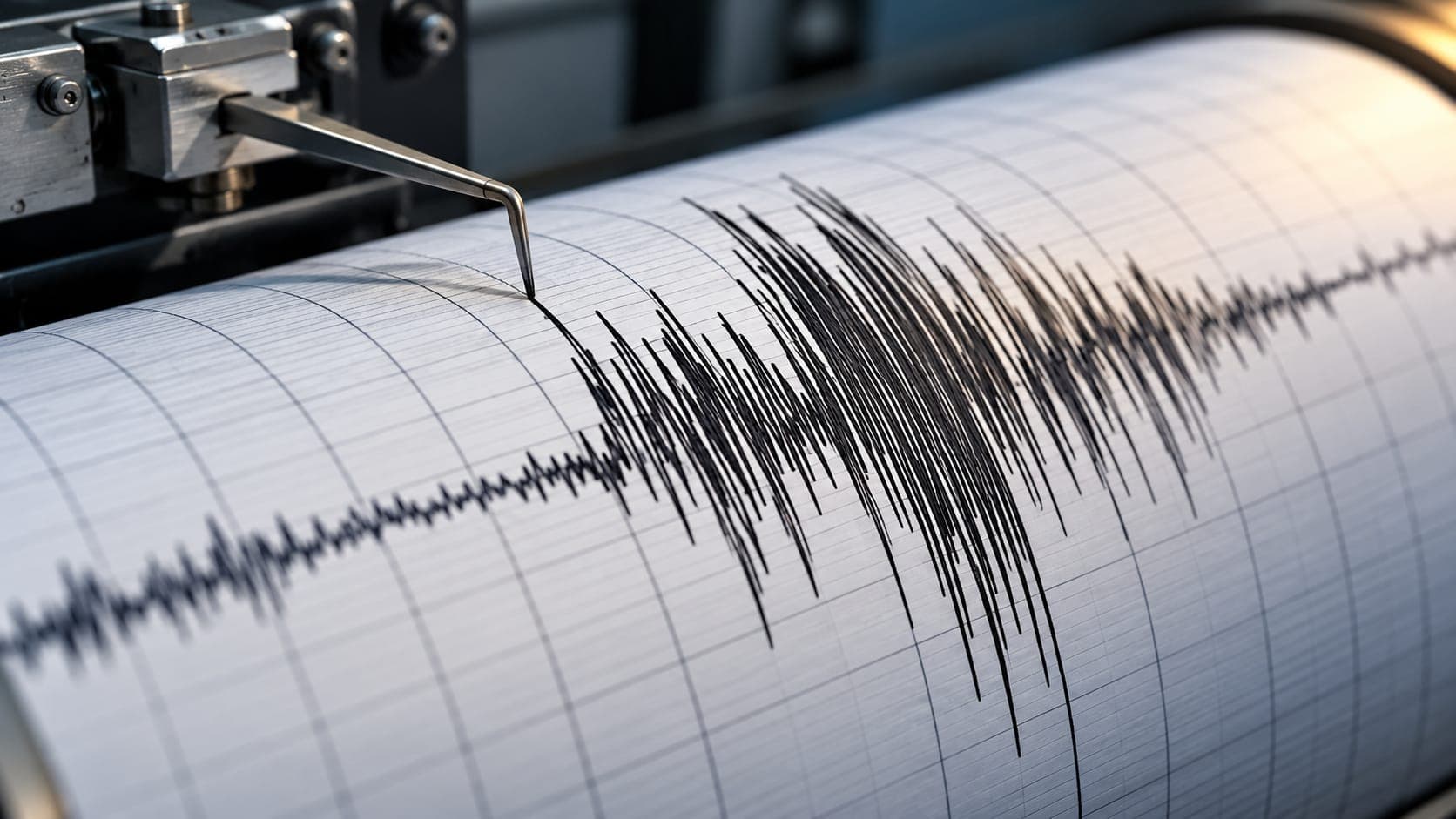
For decades, news reports described every earthquake as measuring so much on the Richter scale. The name is still everywhere, yet the magnitudes you see from the USGS today are usually not Richter magnitudes at all.
This article explains what the Richter scale is, how it works, why it was replaced for most purposes, and how to read the magnitude numbers you see today.
Quick answer
The Richter scale is a way of measuring earthquake size that seismologist Charles Richter published in 1935 for earthquakes in southern California. It uses the size of the waves recorded on a seismometer, adjusted for distance, and it is logarithmic: each whole number up means about 10 times larger ground motion. Richter's scale, now called local magnitude (ML), does not work well for very large or distant earthquakes, so seismologists now mostly use moment magnitude (Mw), which is designed to agree with it in the range where it works well.
Where the Richter scale came from
In the early 1930s, Charles Richter, working with Beno Gutenberg at the California Institute of Technology, wanted a simple, objective way to compare the sizes of earthquakes in southern California. Before then, earthquakes were mostly compared by their effects, such as how much damage they caused, which depends heavily on where people and buildings happen to be.
Richter published his scale in 1935. It was based on the largest wave recorded on a specific instrument, the Wood-Anderson seismograph, with a correction for how far the instrument was from the earthquake. The idea of measuring size from instrument recordings was a major step forward and is still the foundation of every magnitude scale used today.
How a logarithmic scale works
Earthquakes vary enormously in size, so Richter used a logarithmic scale to squeeze that range into manageable numbers. On a logarithmic scale, each step of 1 represents a tenfold change in the measured wave size.
So a magnitude 5 earthquake produces recorded waves about 10 times larger than a magnitude 4 and about 100 times larger than a magnitude 3. The energy grows even faster: each whole step means roughly 32 times more energy released. Decimals matter too. A magnitude 6.5 is not just slightly bigger than a 6.0; it releases several times more energy.
| Step | Recorded wave size | Energy released |
|---|---|---|
| Up 1 whole number | About 10 times larger | About 32 times more |
| Up 2 whole numbers | About 100 times larger | About 1,000 times more |
| Up 0.2 | About 1.6 times larger | About 2 times more |
Why the Richter scale fell out of use
Richter designed his scale for a specific instrument, a specific region and fairly nearby earthquakes. As seismograph networks spread around the world, scientists found it had important limits.
- It was calibrated for southern California and for stations within a few hundred kilometers, so it does not apply directly to distant earthquakes.
- It relies on a type of instrument that is no longer the standard.
- For large earthquakes, the measured waves stop growing in proportion to the true size, a problem called saturation. Very large earthquakes end up underestimated.
Moment magnitude: the modern standard
Scientists developed several other magnitude scales to work with more distant earthquakes, including body-wave magnitude (mb) and surface-wave magnitude (Ms). In the late 1970s, seismologists introduced moment magnitude (Mw), which is now the standard for moderate and large earthquakes.
Moment magnitude is based on the physics of the fault: the area that slipped, the average amount of slip and the stiffness of the rock. Because it measures the earthquake itself rather than the size of one particular wave, it does not saturate and works across the full range of sizes, including the largest earthquakes. It was designed to give similar values to the Richter scale for the earthquakes Richter's method handles well, so the numbers feel familiar.
For small, local earthquakes, networks still often report local magnitude (ML) or similar scales, because they can be calculated quickly and reliably. You will see the magnitude type listed with each event in USGS data and on the live map.
Why the news still says Richter
Richter became a household name, so reporters and the public still use it as shorthand for earthquake magnitude in general. When a news story says an earthquake measured 7.1 on the Richter scale, the number usually comes from the USGS or another agency and is most likely a moment magnitude.
The difference rarely matters for everyday understanding, but it helps to know that the official figure is simply called magnitude, and that agencies choose the best scale for each earthquake.
Is there a top of the scale?
There is no fixed top to the Richter scale or moment magnitude. The scale is not a 1 to 10 rating. In practice, magnitude is limited by how large a fault can rupture. The largest earthquake ever recorded, in Chile in 1960, was about magnitude 9.5, and it ruptured a very long stretch of a subduction zone.
There is no bottom either. Sensitive instruments record tiny earthquakes with magnitudes below zero, which are far too small to feel.
Magnitude is not the whole story
Neither the Richter scale nor moment magnitude tells you how strong the shaking was at your home. That depends on distance, depth, local soil and building type, and is described by Intensity instead. To learn the difference, read earthquake magnitude vs intensity or take the lesson on magnitude and intensity.
Frequently asked questions
Is the Richter scale still used?
Rarely in its original form. Many networks still use local magnitude scales descended from Richter's method for small nearby earthquakes, but moderate and large earthquakes are reported using moment magnitude.
What is the highest number on the Richter scale?
There is no official maximum. Magnitude is limited only by how large a fault rupture can be. The largest recorded earthquake, Chile in 1960, was about magnitude 9.5.
Is a magnitude 8 twice as powerful as a magnitude 4?
Far more than that. Four whole steps means the recorded waves are about 10,000 times larger, and the energy released is roughly a million times greater.
Can different agencies report different magnitudes for the same earthquake?
Yes. Agencies may use different data, methods or magnitude types, especially in the first hours. Differences of a few tenths are common and usually narrow as final values are calculated.
Key takeaway
The Richter scale, introduced in 1935, was the first widely used instrumental magnitude scale. Its logarithmic idea lives on, but seismologists now mostly use moment magnitude, which works for earthquakes of every size. When the news says Richter, it usually just means magnitude.
Sources
- Moment magnitude, Richter scale - what are the different magnitude scales, and why are there so many? — U.S. Geological Survey
- Earthquake Magnitude, Energy Release, and Shaking Intensity — U.S. Geological Survey
- Earthquake Hazards Program — U.S. Geological Survey