How Dangerous Is a 5.0 Earthquake?
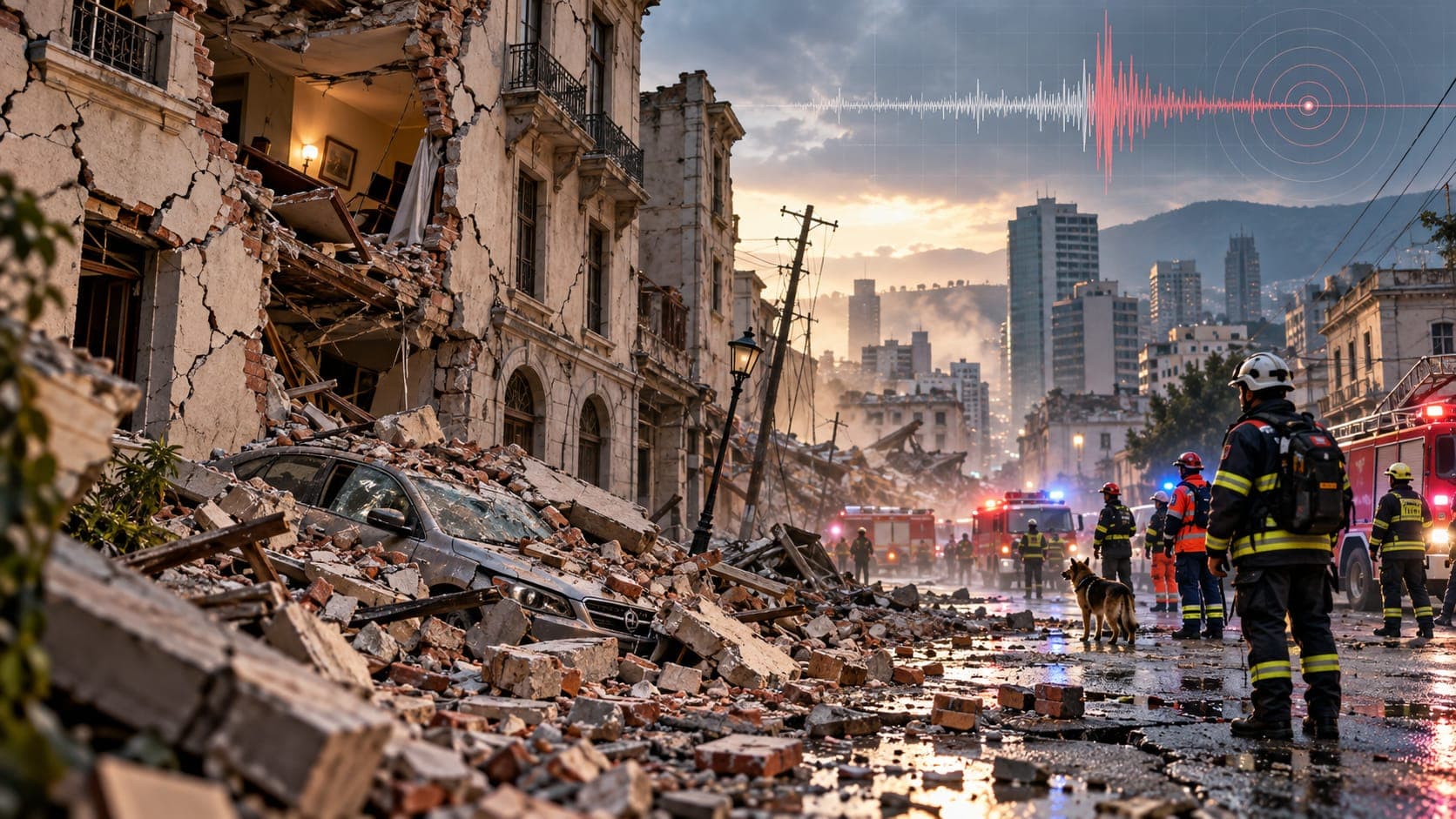
A magnitude 5.0 earthquake sits at an important threshold. Below it, earthquakes are rarely more than a scare. At magnitude 5 and above, shaking near the epicenter becomes strong enough to damage vulnerable buildings, and in some parts of the world a moderate earthquake has caused deaths.
Whether a 5.0 turns out to be a non-event or a local emergency depends less on the number itself and more on where it strikes, how deep it is and what the buildings nearby are made of. This article looks at each of those factors.
Quick answer
A 5.0 earthquake is a moderate earthquake. It is widely felt and can cause damage to poorly built or older structures near the epicenter, such as unreinforced brick buildings and loose chimneys. Well-built modern buildings usually come through with little or no structural damage. A shallow 5.0 under a town with weak buildings can be dangerous, while a deep or offshore 5.0 may cause no damage at all.
What moderate means on the magnitude scale
On the Magnitude scale, earthquakes of magnitude 5.0 to 5.9 are called moderate. Because the scale is logarithmic, a 5.0 releases roughly 32 times more energy than a 4.0 and about 1,000 times less than a 7.0. That jump from 4 to 5 is why a 5.0 can do things a 4.0 almost never does.
The energy of a 5.0 is released from a Fault patch that is typically a few kilometers across. That is small compared with the hundreds of kilometers that can slip in the largest earthquakes, which is why the strongest shaking from a 5.0 is concentrated in a fairly small area around the Epicentre.
Typical effects near the epicenter
Shaking intensity is described with the Modified Mercalli Intensity scale. A shallow 5.0 often produces intensity around VI, and sometimes VII, close to the epicenter. Typical reported effects at those levels include:
- Shaking felt by nearly everyone, with many people frightened and some going outdoors.
- Heavy furniture shifting, and books, dishes and decorations falling.
- Cracked plaster and drywall, and broken windows in some buildings.
- Damage to chimneys, parapets and older masonry walls.
- Rockfalls and small landslides on steep slopes.
- Little or no structural damage to well-designed, well-built buildings.
What makes a 5.0 more or less dangerous
Several local factors can turn the same magnitude into very different outcomes. Recognizing them helps explain why one 5.0 makes the news for damage while another is barely remembered.
| Factor | Raises danger | Lowers danger |
|---|---|---|
| Depth | Shallow, within the top 10 to 15 km | Deep, tens to hundreds of km down |
| Distance | Epicenter directly under a town | Offshore or in an unpopulated area |
| Ground | Soft soil, fill or old lake beds | Firm rock |
| Buildings | Unreinforced brick, adobe, weak concrete | Modern code-compliant construction |
| Terrain | Steep, unstable slopes | Flat, stable land |
Why building type matters most
In many moderate earthquakes, nearly all the serious damage is concentrated in a few types of structures. Unreinforced masonry buildings, which have brick or stone walls without steel reinforcement, can lose walls or parapets that fall onto sidewalks. Adobe and rubble-stone houses, common in some rural regions of the world, can collapse in shaking that a wood-frame house would ride out with only cracked plaster.
This is why the same magnitude can be a minor event in one country and a deadly one in another. Building codes, construction quality and retrofitting programs make a big difference. If you live in an older home in a seismic area, our guide on earthquake-proofing your home explains common upgrades.
How common are magnitude 5 earthquakes?
The U.S. Geological Survey estimates that roughly 1,300 earthquakes of magnitude 5.0 to 5.9 happen worldwide in a typical year. That works out to several every day on average. Most occur along plate boundaries, many of them offshore or far from large cities, so only a small share cause damage.
You can browse recent moderate earthquakes on the EQRadar live map and look up past ones in the history view. For a large event, a ShakeMap shows estimated shaking across the region; you can explore ShakeMaps on the EQRadar shaking page.
Aftershocks and what comes next
A 5.0 is usually followed by aftershocks, most of them much smaller. They are most frequent in the first hours and days and taper off over time. Damaged buildings can be weakened further by aftershocks, so stay out of structures with visible cracks in walls or chimneys until they are inspected.
Occasionally a 5.0 is followed by a larger earthquake, in which case it is called a Foreshock in hindsight. That is uncommon, and there is no reliable way to tell at the time. Our article on whether aftershocks can be stronger covers this in more depth.
Frequently asked questions
Can a 5.0 earthquake knock down a house?
A modern, well-built house rarely suffers structural damage in a 5.0. Older unreinforced brick or adobe buildings close to a shallow 5.0 can be badly damaged and, in some cases, partly collapse.
Is a 5.0 dangerous if I live 100 km away?
At that distance a 5.0 is usually felt as light or moderate shaking at most, and damage is unlikely. The strongest shaking from a moderate earthquake is concentrated within a fairly short distance of the epicenter.
Can a 5.0 earthquake cause a tsunami?
It is very unlikely. Damaging tsunamis are generally caused by much larger, shallow undersea earthquakes, typically magnitude 7 or greater. See our article on whether an earthquake can cause a tsunami.
What should I do after feeling a 5.0?
Check yourself and others for injuries, look for hazards such as gas leaks, broken glass and cracked chimneys, and be ready for aftershocks. If you smell gas, leave and call for help from a safe place.
Key takeaway
A 5.0 is a moderate earthquake that can damage weak or older buildings close to the epicenter, while modern buildings usually fare well. Depth, distance, ground conditions and construction decide whether it is a scare or a serious local disaster.
Sources
- Earthquake Magnitude, Energy Release, and Shaking Intensity — U.S. Geological Survey
- Lists, Maps, and Statistics — U.S. Geological Survey
- Earthquakes — Ready.gov (U.S. Department of Homeland Security)